

Bargaining
by solopes
No, I don't like it, but "In Rome be a Roman"... so, I tried my best bargaining everywhere. I don't know (nor care) if I did good or bad deals! I just found amusing that, for them, it seems more important to discuss the articles than... selling them. That's why sometimes I gave up and left, and... bought cheaper at the shop doors.
Remember: Bargaining is a cultural reference, and if you don't do it you will be spending your money and... chocking them.
Fes el-Jdid
by barryg23
Fes-el-Jdid receives far fewer visitors than Fes el-Bali though it is worth a visit if you have the time. What struck me most about Fes El-Jdid was how laid back it was compared to the medina. You can actually visit shops, and walk around in peace without constant hassle from vendors.
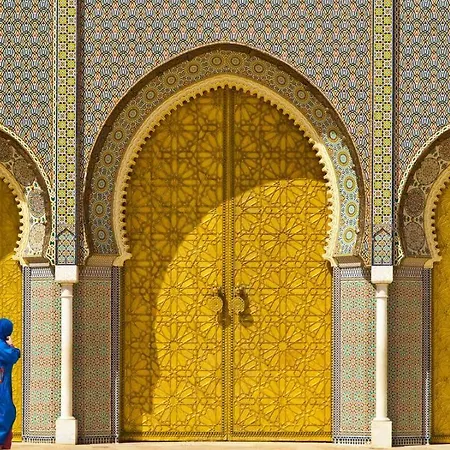
The Dar el-Makhzen (Royal Palace) is the most interesting building in Fes El Jdid. However, all you will see is the exterior as the inside is closed to the public. Also of interest is the mellah, the old Jewish quarter, and the Bou Jeloud Gardens.
Assouan Restaurant
by yoshimi
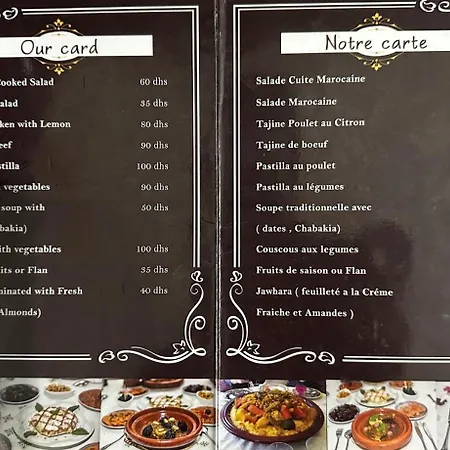
European food, best pizzas in town. Salads are very good.
Pizza: between 40 and 50Dh (US$4-5)
Salads: between 30 and 40Dh (US$3-4)
Next to Sheraton Hotel and across from the handicraft center. Pizza and salads!
Karaouiyine Mosque- 1st Fez University
by VZ-Pam
Karaouiyine Mosque is the first University in Fez founded 857 A.D. , now thousands pray inside the mosque & non-Muslims aren't allowed inside . I did not make that up cause I took a picture of that sign on the door ....I guess I will never really understand but I think its because its an Islamic mosque. One needs to understand the religion in order to truly appreciate the greatness of the mosque. I would say its a archeological gem & a building that can move people 's spirits ... You need to see when they pray inside, feel the power of their prayer :)
The Tanners District or the Suuq Dabbaghin
by amsterdam_vallon
The medieval tanneries are at once beautiful, for their ancient dyeing vats of reds, yellows, and blues, and unforgettable, for the nauseating smell of rotting animal flesh on curing sheep, goat, cow, and camel skins. The terrace overlooking the dyeing vats is high enough to escape the place's full fetid power and get a spectacular view over the multicolor vats. Absorb both the process and the finished product at No. 2 Chouara Lablida, just past Rue Mechatine (named for the combs made from animals' horns): the store is filled with leather goods of all kinds, all of which smell terrific. One of the shopkeepers will explain to you what's going on in the tanneries below -- how the skins are placed successively in saline solution, lime, pigeon droppings, and then any of several natural dyes: antimony for black, poppies for red, saffron for yellow, mint for green, and indigo for blue. Barefoot workers in shorts pick up skins from the bottoms of the dyeing vats with their feet, then work them manually. Though this may look like the world's least desirable job, the work is actually very well paid and somewhat in demand. Studies on tannery workers' health have shown that tanners live, if anything, longer and healthier lives than workers in most other collectives. This might be because they need to be fit to do the work in the first place; or perhaps the foul-smelling liquids contain some as-yet-undefined curative properties.
To see more pictures of the Tanners District : Tanners District
Comments