Favorite thing: Well-known Aswanian granite was obtained on the suburb of the city since ancient times. Numerous statues and sarcophagi, obelisks and columns are cut down of this granite. In stone quarries it is possible to look after all process of extraction of boulders and their primary processing.
In stone quarries you will find the Unfinished Obelisk. On some sources, tsarina Hatshepsut ordered it.
The Museum is open 9.00-17.00. Entrance fee is 25LE ($5). Video and photo are allowed.
Written Oct 7, 2007
Favorite thing: The Nubia Museum is a must. By opening of this museum in 1997 it had been put a point in the international campaign on rescue of the Nubian culture which begun under aegis of UNESCO in 1960.
It is located on a rock in 1 km from the city centre, near to the Corniche. The Museum is opened 9.00-13.00 and 17.00-21.00. Be attentive! From 13.00 till 17.00 it is closed! I visited it from 11.00 till 13.00 and had to leave it because of the daytime brake. Entrance fee 40LE ($8).
It’s allowed to make video and photos. It has a nice air condition atmosphere. You will find not only extremely interesting exposition but also a rest from hot outside it.
Written Oct 7, 2007
Favorite thing: The area around modern Aswan, including the island of Elephantine, was known in antiquity as Yebu ("Elephant Land"). At a later date the name was restricted to the island and town of Elephantine. From the earliest times down to the Roman period the quarries of Yebu, which became known in the Ptolemaic period as Syene, supplied the Egyptians with fine colored granite (containing quartz, yellow and brick-red felspar and blackish mica) for their buildings and statues.
Yebu was also of strategic importance, commanding as it did the Nile cataracts and traffic by water between Egypt and Nubia. It was also the starting-point of the great caravan route to Nubia and the Sudan, along which passed the commercial and military expeditions of the Egyptians.
Aswan suffered severely from the incursions of plundering Bedouin tribes, which were ended only when the Turkish Sultan Selim stationed a garrison in the town in 1517.
Written Oct 7, 2007
Favorite thing: The town Aswan is situated in Upper Egypt north below the First Nile Cataract on the east bank of the Nile, partly on low ground and partly on a hill. Aswan is the capital of Egypt's most southerly governorate and the terminus of the railroad line along the Nile Valley. As a result of the construction of the High Dam farther up the valley Aswan is now becoming one of the country's principal industrial centers.
At Aswan the Nile divides into several arms, separated by large granite rocks and islands, in particular the island of Elephantine.
The best time to visit Aswan is winter (December-February).
Written Oct 7, 2007
Favorite thing: Some practical tips for visiting Abu Simbel:
1) Foreigners are not allowed to go on their own - you have to join the early morning convoy which starts at an ungodly 4 am. Buses will normally pick you up at your hotel at around 3:30 am. Independent travelers may book their trips with travel agencies in Aswan, many of them along Corniche el-Nil. You could also inquire at your hotel if they could help you out . Many of these hotels will, in any case, give you unsolicted offers. The going rate is USD 20 as of May 2007.
2) Advise your hotel that you are doing the Abu Simbel tour a day earlier - so they could pack a breakfast box for you. It's not much (toast, butter and jelly, hard boiled egg), but keeps the hunger pangs away during the long trip. Alternatively, you could bring your own food, but the breakfast box is usually covered by your room rate.
3) Bring protective clothing and sun screen - very important especially during the hotter spring and summer months. The trip begins at dawn and finishes early (convoy leaves Abu Simbel at 10 am), but the sun could still burn your skin.
4) If you don't want to pay for the excessively overpriced drinks at Abu Simbel (can of Coke costs about USD 2) - no choice, you're in the middle of nowhere - you can always bring your own drinks.
Updated Jun 23, 2007
Favorite thing: Many of the great temples normally considered part of the visit to Aswan are rather distant, and so some advance logistics are recommended. Most hotels will arrange a ride in an early morning shuttle to the temples at Abu Simbel, and self excursions via boat to the temples at Philae and Kalabsha are easy enough to arrange with a little help at the hotel desk. But, the trips to Kawm Umbu and Idfu require resourcefulness for the adventure traveler. Egypt is an friendly and easy place to travel, despite all appearances, and so much of the adventure will come in simply getting to these places. Check out the blue links for further details. They are all worth visiting. For those with limited time, skip the cruise ship and take the local van transport.
Fondest memory: I have many great memories of Aswan, but I'll never forget the beauty of the Nile River at this part of Egypt. Simply riding with locals in the vans that ply the ribbon highway which snakes along the Nile River is unforgettable and beyond the norm for most visitors to Egypt.
Updated Aug 11, 2006
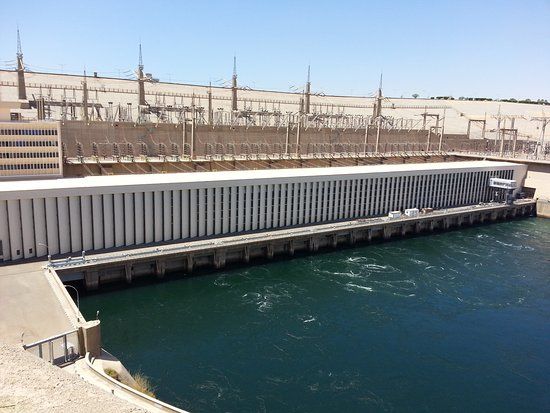
Favorite thing: Without impoundment the River Nile would flood each year during summer, as waters from East Africa flowed down the river. These floods brought nutrients and minerals that made the soil around the Nile fertile and ideal for farming. As the population along the river grew, there came a need to control the flood waters to protect farmland and cotton fields. In a high-water year, the whole crop may be entirely wiped out, while in a low-water year there was widespread drought and famine. The aim of this water project was to prevent the river's flooding, generate electricity and provide water for agriculture.The Aswan High Dam is 3,600 m in length, 980 m wide at the base, 40 m wide at the crest and 111 m tall. It contains 43 million m³ of material. At maximum, 11,000 m³ of water can pass through the dam every second. There are further emergency spillways for an extra 5000 m³ per second and the Toshka Canal links the reservoir to the Toshka Depression. The reservoir, named Lake Nasser, is 480 km long and 16 km at its widest with a surface area of 6,000 km² and holds 150 to 165 km³.
With hydroelectric output of 2.1 gigawatts, the dam powers twelve generators each rated at 175 megawatts. Power generation began in 1967. When the dam first reached peak output it produced around half of Egypt's entire electricity production (about 15% by 1998) and allowed for the connection of most Egyptian villages to electricity for the first time. The effects of dangerous floods in 1964 and 1973 and of threatening droughts in 1972–73 and 1983–84 were mitigated. A new fishing industry has been created around Lake Nasser, though it is struggling due to its distance from any significant markets.
Written Jul 19, 2006
Favorite thing: The Nile River is very well known in Egypt and for a good reason...it is the lifeline of many locals! The Nile is a beautiful river that is the home to many towns/cities and the majority of Egyptians. It is great to sail down, walk beside or boat across/along the Nile...there are so many things to see along the way...
Updated May 24, 2006
Favorite thing: While we were in Egypt the Muslim community were in the middle of Ramadan. We had heard that it could cause problems with our tour or that we may not get to eat because of Ramadan but really we didn't have any problems at all because of it.
The locals did seem to go a bit crazy around 4:30 - 5:30 pm when they ALL seemed to be on the road travelling home or to where ever they would eat their "break-fast" but it didn't affect us too much. We also found a lot of locals eating in the streets and enjoying each others company. It was nice to see!!!
A couple of nights we also joined our tour guide (a local Egyptian) for his "break-fast" meal... :)
Updated Apr 4, 2006
Favorite thing: We stopped off at a village just near Kom Ombo Temple...our guide took us through a local home and a guy there showed us some of the traditional ways of doing things in the past... We also got to pat a baby camel (so cute!)!!!
Written Jan 7, 2006
Sponsored Links
90 Opinions
Moevenpick Elephantine Island Resort Aswan
5 Reviews and 357 Opinions Located in the Elephantine Island in the middle of the Nile river, the Moevenpick is probably the...
16 Reviews and 137 Opinions The world famous Old Cataract Hotel, built in 1899, sits high above the Nile surrounded by gardens...
Reviews and photos of Aswan attractions posted by real travelers and locals. The best tips for Aswan sightseeing.

We stopped off at a village just near Kom Ombo Temple...our guide took us through a local home and a guy there showed us some of the traditional ways of doing...
6 members live in Aswan
Q: Hi! We only have a couple of days for the Luxor/Aswan/Abu Simbel area of Egypt. My question is... 1. would it be more...

A: Hi, by your other posts it seems you only have 5 days in Egypt. Unfortunately you can't do it all in that time. I would stick to Cairo and Luxor and maybe a day trip to...
Read 2 Replies
1

I visited Aswan twice in 1983 and in 1999. In november 1997 the Nubia Museum opened its doors. Only this museum maked it worth to visit Aswan again. It's a really must see. It was also nice to see...
2

Aswan is considered one of the most picturesque places in Egypt. It is located on the distance about 900 kilometers from Cairo and 200 kilometers from Luxor. In days of pharaohs Aswan was the southern...
3

Aswan is a beautiful city in Southern Egypt. A whole lot smaller, quieter and prettier than Cairo and Luxor, it is a place to relax and enjoy the beauty of the Nile. We unfortunately only had 1 day...
4

Aswan has a laid-back feel to it, Aswan reminds me of a quiet little town in the country. Aswan is calming and relaxing, it's charm I believe is it's friendly people. Due to it's extreme heat, Aswan...
5

I've got some interesting experiences in Aswan. I'd love to share with you the 18 tips I've written, the 80 photos uploaded, and 5 travelogues I've created.
Build your own Aswan page
Sponsored Links