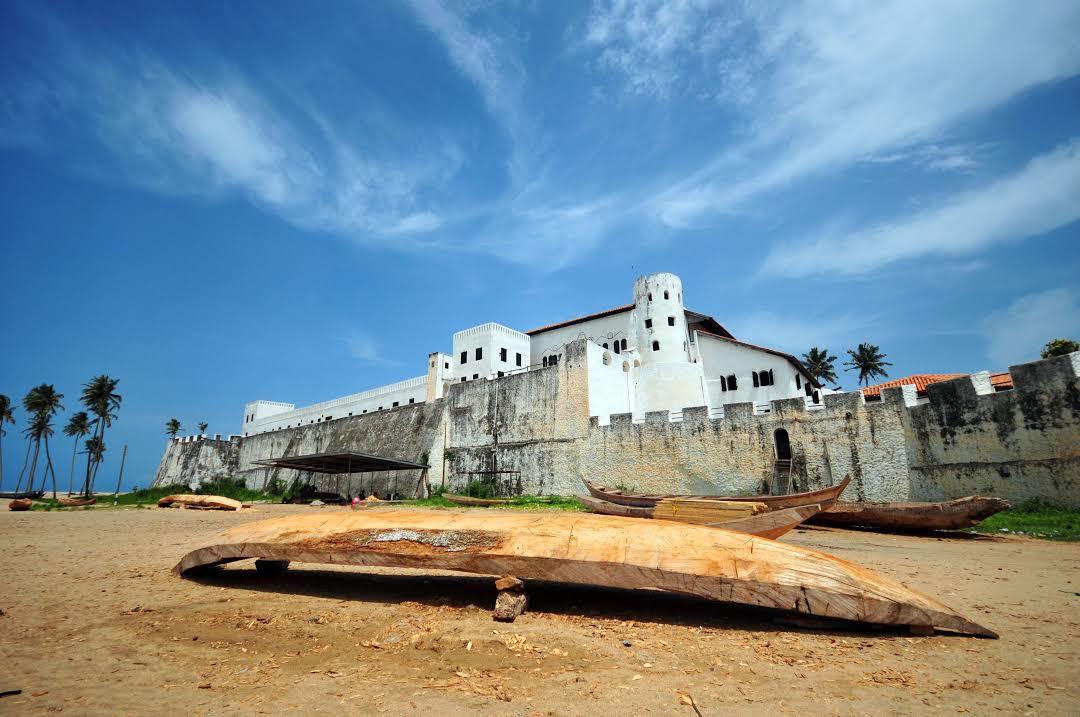
Elmina Castle is a beautiful castle on the coastline of Elmina. It is more popular than the larger Cape Coast castle, and is a must for travellers to Ghana. Elmina castle was built in 1482 as Sao Jorge da Mina Castle (St.George of the Mine). It was built in a small fishing village. The castle is a World Heritage Site by UNESCO. The entrance is 10 GHC (6 USD) plus an additional charge for video cameras.
Updated Dec 29, 2010
African people enjoy playing games, like this "ludo look-alike" game on a table in the main square of Elmina. And strangely they doesn't seem to know eachother before they start. Everybody is invited.
Written Dec 29, 2010
Cape Coast Castle is one of biggest and most important towns of Ghana..good for shopping
Cape Coast Castle is a fortification in Ghana. The first timber construction on the site was erected in 1653 for the Swedish Africa Company and named Carolusborg after King Charles X of Sweden. It was later rebuilt in stone.
In April 1663 the whole Swedish Gold Coast was seized by the Danes, and integrated in the Danish Gold Coast. In 1664 the Castle was conquered by the British and was extensively rebuilt by the Committee of Merchants (whose Governors administered the entire British colony) in the late 18th century. In 1844, it became the seat of the colonial Government of the British Gold Coast.
The Castle was built for the trade in timber and gold, later it was used in the trans-Atlantic slave trade. The Castle, or Castle and Dungeon, to give it its official name, was first restored in the 1920s by the British Public Works Department. In 1957, when Ghana became independent, it passed under the care of the Ghana Museums and Monuments Board (GMMB). In the early 1990s the building was restored by the Ghanaian Government, with funds from the United Nations Development Programme (UNDP), United States Aid for International Development [USAID], with technical assistance from the Smithsonian Institution and other NGOs.
Inside the dungeon of Cape Coast Castle. Hundreds of slaves would have been held in these cramped conditions before being transferred to boats bound for the western hemisphere.Other Ghanaian Slave Castles include the Portuguese foundation of Elmina Castle (later Dutch) and Fort Christiansborg.
The Cape Coast Castle in addition to other forts and castles in Ghana are on the United Nations Educational, Scientific and Cultural Organization (UNESCO), World Heritage List. This site was visited by H.E. President Obama and Mrs. Michelle Obama and family on July 11, 2009.
Written Nov 6, 2009
beside elmina castle the most important slavery castle in west africa, visited also recently by obama
even simular to elmina in the history and in the building they differ from each other
you should visit both and listen to the sad history of the slavery time
Cape Coast's main attraction is the stunning Cape Coast Castle, a World Heritage site that genuinely deserves the accolade
Cape Coast Castle was the nerve centre of British colonial rule in the Gold Coast (the colonial name for Ghana) and, more importantly, it was one of the biggest trading posts in that most abhorrent of all cargoes, slaves.
Written Nov 6, 2009
Website: http://www.theviproom.com/visions/slave.htm
beside the famous elmina castle it is also worth to visit elmina town, its beach and fort coenraaedsburg
Elmina, is a town in the Central Region, situated on a south-facing bay on the Atlantic Ocean coast of Ghana, about 12 km west of Cape Coast. The first European settlement in West Africa, it now has a population of around 20,000 people.
The town grew around São Jorge da Mina Castle, built by the Portuguese Diogo de Azambuja in 1482 on the site of a town or village called Amankwakurom or Amankwa. It was Portugal's West African headquarters for trade and exploitation of African wealth. The original Portuguese interest was gold but this later expanded to include tens of thousands of slaves channeled through the trading post of Elmina. The location of Elmina made it a significant site for reprovisioning ships headed south towards the Cape of Good Hope on their way to India. The Dutch West India Company captured it in 1637; in subsequent centuries it was mostly used for the slave trade. The British attacked the city in 1782, but it remained in Dutch hands until 1872, when it was sold to the English.
Elmina is also home to Fort Coenraadsburg on St. Jago Hill, built by the Dutch in 1666, several Asafo shrines and a lagoon. Today, Elmina's main industry is fishing.
Written Nov 6, 2009
do not miss the most famous and most fascinating sightseeing of ghana and whole africa
the kakuum skywalk
The Kakum forest turns more to a kind of of a jungle experience. The canopy walkway is up to 30 m above the forest floor and within sight of the tallest tree of the forest where elephants can sometimes be seen scrounging for fallen fruit. There are six tree platforms that reach the height of 30 meters above the forest floor. From the treetops, visitors experience a unique and spectacular view of the rainforest ecosystem and have the opportunity to see flora and fauna, which could never be viewed from the ground.
Written Nov 6, 2009
Website: http://ghana-net.com/kakumnationalpark.aspx
One of the best preserved buildings in Ghana is St. George's Castle (or Elmina Castle) in Elmina. It used to be one of the many slave forts at the former Gold Coast, mainly used by the Dutch.
The fort was originally built in 1482, when the Portuguese first set foot on Ghanaian land. The building they made was strategically situated on top of rocks, and at 3 sides surrounded by the sea. The Portuguese built the fort as a trading post when goods from all over West-Africa were brought to. Because this wealth of products they called the place "El Mina", the mine.
In the 17th century, the Dutch conquered the fort, and in the beginning they used it for the same purpose as the Portuguese. There was a church inside, a large dining room, several luxurious suites for the highest officers and a lot of storage rooms. Later however, it was no longer gold and spices that was the main business. For the colonisation of the New World, slaves were needed and the West Africans were the right persons for that. That was the reason of a big expansion of the fort. Large dungeons were made to keep the slaves in, and the fort became twice as big as the original size.
In Elmina, there are two main dungeons: the male- and female dungeons who together could keep up to 1200 people at a time. From Elmina tens of thousands of slaves were "transported" from here. The stories you hear during the tour are terrible, and the smell in the dungeons still smells like horror and emprisonment.
A visit to Elmina Castle is interesting, the view is beautiful, but at the same time it is a horrific thing to see and imagine all that happened there. At least it made me as a Dutchman be ashamed of my ancestors.
Updated Mar 21, 2007
Before the Dutch beated the Portuguese in Elmina, they already attacked them twice from the sea. Twice, they were defeated. In 1637 however, they attacked them from the inland, with the help of the local chief. From St. Jago hill, in the heart of today's Elmina, they opened fire on the Portuguese who were too surprised to react.
When the Dutch had their base in St. George's Castle, after their victory, they wanted to prevent enemies from doing the same thing as they did. Therefore, they built a second fort in Elmina, right op top of St. Jago hill. In 1666 Fort Coenraadsburg was finished, currently known as a more neutral "Fort St. Jago". The building only has a military purpose, and was ideal to rule of the area: from there they could even look further into the ocean than from St. Goerge's.
The fort is not open to public at the moment, a heavy renovation is going on. But still, from the village and from the other fort, it is a nice sight to look at the large, white building, situated wonderfully, high above the town.
Updated Mar 21, 2007
In 1637, the Dutch dragged a cannon to the top of San Jago Hill and bombarded St George’s Castle, then in the hands of the Portuguese. Realising the strategic position of the hill, and wanting to protect their newly acquired castle, the Dutch built a fort atop the hill for defense. Also known as Santiago or St James’ Fort.
Written Jan 8, 2007
Dubbed the Door of No Return as this was where the ‘freedom fighters’ and rebels would spend their last days. Kept in extremely cramped conditions, with minimal ventilation and no light, the mutineers would be starved to death. The Door of No Return.
Written Jan 8, 2007
Reviews and photos of Elmina attractions posted by real travelers and locals. The best tips for Elmina sightseeing.

Dubbed the Door of No Return as this was where the ‘freedom fighters’ and rebels would spend their last days. Kept in extremely cramped conditions, with minimal...
Our members can help!
1

El Mina town started life as a fishing village way back in the 13th century, and was producing salt as long ago as 700 years. Life still goes on pretty much in the same way today. The name is...
2

How cruel history can be.... Elmina has a fort and a castle. The St George's castle is built by the Portuguese in 1482 and captured by the Dutch in 1637. Till 1872 (then the english took over) the......
3
Elmina, Dutch remains in Ghana

Just a few kilometres west from Cape Coast, also in the Central Region, you'll find the town of Elmina. A place with a long colonial history, starting when the Portuguese built a trading base there......
4

take an impressive tour through the elmina castle..cape coast casle is simular but always worth to visit both Elmina Castle was erected by the Portuguese in 1482 as São Jorge da Mina (St. George of......
5

I've got some interesting experiences in Elmina. I'd love to share with you the 21 tips I've written, the 126 photos uploaded, and 7 travelogues I've created.
Build your own Elmina page