Favorite thing: Tripoli's National Jamahiriya Museum houses a superb collection of mosaics, mostly from the 2nd century AD. These mosaics were usually used to decorate the floors of Roman villas, They are made from small pieces of marble, limestone and terracotta, called tesserae, fitted together rather like a jigsaw puzzle.
The most famous of these is the Four Seasons mosaic from the Villa Dar Buc Ameera near Leptis Magna. In it the four seasons are represented by winged maidens, known in classical mythology as the Horae or goddesses of the seasons. Each wears a seasonal wreath. Winter, at the top, wears a wreath of reeds, Spring wears blossoms, Summer, on the right, a wreath of wheat and Autumn, at the bottom, wears grapes. She also has a bunch of grapes pinned to her right shoulder and hanging down over her breast.
Updated Apr 23, 2007
Favorite thing: The Medina is my favourite part of Tripoli. Until the end of the nineteenth century it WAS Tripoli. Since then the city has expanded beyond its walls. It is still by far the most interesting part of the city, with many historical buildings, mosques, churches, old consulates, souqs, alleyways and Roman ruins.
65,000 people still work inside the Medina, mostly as craftsmen in small workshops. You can see coppersmiths, silversmiths etc at work as you wander around. This is very much a place where local people go to shop.
Updated Apr 23, 2007
Favorite thing: Maidan Essa, or Jesus Square, is one of the nicest places in Tripoli. In it there is an outdoor cafe, the Ottoman Clock Tower, Souq Mushir and the entrance to Souq Ghizdir.
If you enter the Medina from Green Square, you will see Maidan Essa, straight ahead, after about 100 metres.
Updated Mar 23, 2007
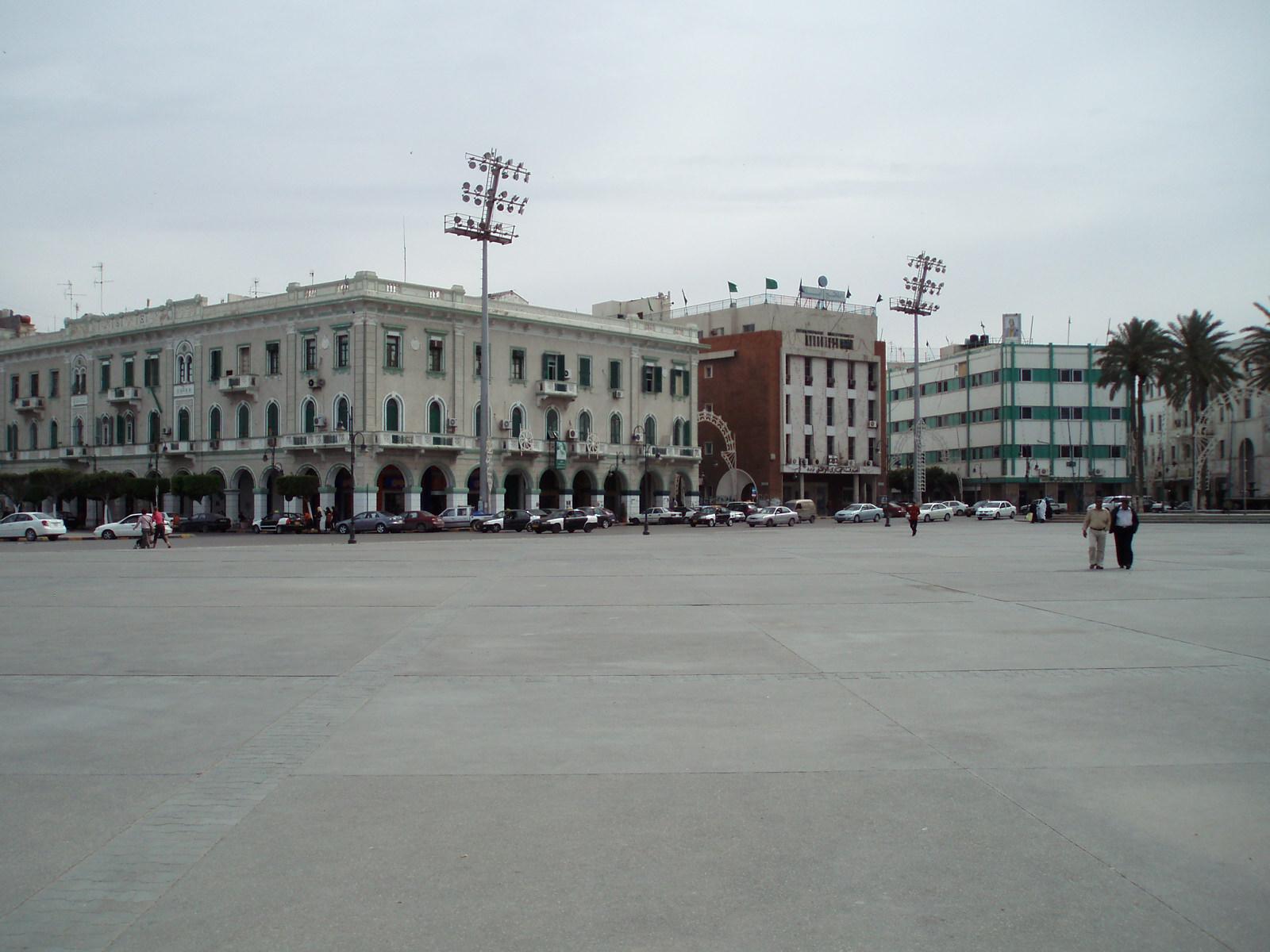
Favorite thing: Green Square is Tripoli's main square. It is known in Arabic as Al Sahah al-Kadrah. On its west side is the Red Castle and the entrance to the Medina, while to the north is the Corniche. On the southern and eastern sides it is flanked by Italian colonial buildings. It is mostly a great expanse of tarmac, a bit like a smaller version of Tianenmen Square, but it is decorated with Libyan flags and palm trees.
This is where Tripoli's crowds gather for important events, such as speeches by the Leader.
Updated Mar 20, 2007
Favorite thing: In Tripoli Harbour is one of the best natural harbours on the Mediterranean. It was the site of the famous Battle of Tripoli Harbour of 1803-04, during the First Barbary War between the United States and Tripoli. During this battle, which was actually a naval blockade by the United States fleet, the USS Philadelphia and USS Intrepid were both destroyed. The officers and men of the Philadelphia were taken as slaves by Yousef Karamanli, the Ottoman pasha of Tripoli.
Nowadays, you are just as likely to see a tourist cruise ship here as an oil tanker. There was a different cruise ship nearly every day when I was staying in Tripoli. You can get great views of the harbour from the upper floors of the Funduq al-Kebir.
Updated Mar 10, 2007
Favorite thing: Algeria Square, or Maidan al-Jezayir, is one of the nicest places to sit and relax in Tripoli. There is a traditional cafe serving tea and coffee on one side of the square from which you can see the grand Italian colonial buildings, like the former cathedral. It is much less hectic here than in the Medina.
Written Mar 10, 2007
Favorite thing: Political rulers exercising cult of personality are on the way of extinction, but here, in Tripoli, the dinosaur is a very resisting one, and he shows up everywhere on any occasion.
On the first picture one you see him in the Bordj al Fatah tower commercial centre, wearing a very smart white dress, raising his revolutionary fist, displayed in a very tasteful tile work.
On picture 2, he is in front of Idriss’s palace, raising again his fist, wearing a nice modern desert keffiah above a map of the great Arab Nation.
Picture 3 shows our leader at Algeria square (from far, sorry), looking for a bright future besides a map of whole Africa, as he always communicates his love for all his African brothers (he even visited them, in the south, in Chad, without being asked, by surprise, in 1980).
He is waiting early morning at the entrance of the Medina, celebrating 36 years of Jamahiriya, waving at all visitors who will come to the Medina on picture 4.
He is watching everything is going well in the port on picture5.
Well, a bit sarcastic, but I am not used to have a guy watching me all times where ever I go and the local population, I do not really know how they receive these messages, may be they do not really care, it is part of the landscape to have these displays everywhere.
Fondest memory: Funny, in some way. . .
Written Oct 25, 2006
Favorite thing: I found one map only of Tripoli, which covers only the city centre. I did not use it (there are mistake, like the location of the big Mosque); I used a A3 print of a satellite image (Google Earth), to find may way, but generally I went where my feet took me, and just used the image to go back to the hotel at night. I have indicated a few spots I visited on the maps, it may help to get around if it happens one of the readers goes to Tripoli. . .
Written Oct 25, 2006
Favorite thing: The crescent moon originates as an emblem of Byzantinium, not Arab Muslim as is popularly believed. It was only used in mosques after the Turks invaded Arab countries in the 15th centuries.
The fish - in Greek ICHTUS = Jesus Christ, Lord of the Saviour - was the secret emblem of the Christians in the 2nd century during the time of the persecution. You can also see the hedera (ivy lef) insignia of Christianity sperading throughout the world.
This was found in a church in the desert.
Written May 1, 2005
Favorite thing: The central square mosaics from the 1st century was set in a tray for easy removal and selling. Here it has been inserted into a younger floor mosaic from a 2nd century villa. Notice how it has not been set into the middle of the gap.
Such a pice of mosaic would take a craftmena maybe one week to complete.
Written May 1, 2005
Sponsored Links
21 Opinions
25 Opinions
1 Review and 1 Opinions I have just watched this video of your staff's treatment of Iman Al Obeidi and the international...
Reviews and photos of Tripoli attractions posted by real travelers and locals. The best tips for Tripoli sightseeing.

The central square mosaics from the 1st century was set in a tray for easy removal and selling. Here it has been inserted into a younger floor mosaic from a 2nd...
118 members live in Tripoli

Q: I have been offered a job in Tripoli and I am trying to find some information as I will be living in Tripoli with my family...

A: I see that you haven't got any answers. I googled Tripoli AND expats and got 105,000 hits. Most of them are useless of course, but some are sites that are specific to...
Read 2 Replies
1

Sunday morning in the medina in Libya's capital, Tripoli - the beginning of the working week (Friday and Saturday are the weekend here). It's still early, morning prayers are over and the souk is only...
2
Tripoli - White Bride of the Mediterranean

Tripoli is a pleasant Mediterranean port city. Originally known as Oea, it was founded by the Phoenecians in the 7th century BC. The modern name Tripoli, or Trablous in Arabic, comes from the Greek......
3

Ah yes, I tell here about the Tripoli capital city of Libya, the western one, not the Lebanese one, the eastern one, I hope to visit one day too; the Libyan one is called the west one since the first...
4
Tripoli - still the white but "booming"bride

Tripoli continues to be one of the most beautiful cities along the Mediterrenean Sea. Friendly people - important monuments, like the national museum - the medina - the green place....
5

In Arabic, Tripoli is known as Tarabalus Al-Gharb (Tripoli of the West). Tripoli was known as Oea in ancient times. Established in the 7th century (as Oea), Tripoli became the capital of Libya in...
Build your own Tripoli page
Sponsored Links