Markets are just the best place for people watching, and they attract me like a magnet!
The main market in Tana is no exception. This replaced the massive Zoma market (which was apparently the second largest open air market in the world - doesn't it really annoy you when you read a statistic like this which doesn't tell you which the largest is?), and although it's smaller, moseying around the current main market makes for an interesting couple of hours.
The part that always fascinates me most is the fresh produce section, as I am passionate about food (especially the eating thereof), love to cook and jump at the opportunity to buy new ingredients to bring home with me! (Be careful of this one if you live somewhere like Australia which has stringent rules - and harsh, strictly applied penalties - about the importation of food stuffs).
The thing that struck me about the food section here was the huge selection of rice available - the Malagasy are addicted to rice (most of the High Plateau is covered with emerald green patchworks of rice paddies) and there are an impressive range of different varieties available. There are also lots of tiny dried fish about the size of whitebait - akin to kapenta in the Great Lakes region - which presumably provides an additional protein source.
As is the case with so many developing world countries, the charm of the vegetables is that they look real - no standardised EU-regulation shape, weight and colour here! Interestingly, in markets throughout the country, one of the standard offerings was pre-prepared vegetables (presumably for stirfrying?), which I though was the preserve of first world convenience stores!
From our experience, Malagasy food is not particularly spicy (often bordering on the bland) and the range of spices available is not as extensive as on other Indian Ocean islands such as Zanzibar. Perhaps the most recognisable condiments are the celebrated Madagascar bottled green peppercorns in brine, which make good gifts, as do the locally grown vanilla pods (at a small fraction of what you'd pay for them at home, so bring back a handful and store them in your sugar jar).
There is also quite a good selection of cheeses - from soft through to hard, and mostly in the French style. Cheese is not a major component of the diet throughout most of Africa, and is clearly a reflection of Madagascar's French colonial influence.
Updated Dec 14, 2011
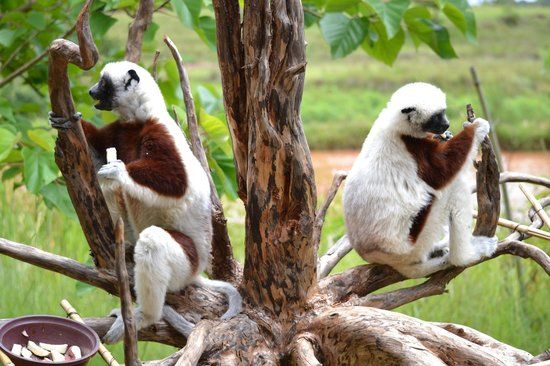
The Lemur Park just outside Tana is an easy half day trip, and provides a good introduction to lemurs even if you're then travelling on to the forest reserves. It is also a great place to bring kids or people with more limited mobility (who wouldn't be up to handling the trails in the forest reserves) so that they can see lemurs roaming free.
The park is small at only 4 hectares (that's 8 soccer fields for the non-metrically minded), and is bordered on one side by a river. The lemurs roam freely and are able to get over the fences and walls that border the property, but as they get fed in the park, they have little interest in straying!
There are several species of sifaka as well as ring-tailed, brown and mongoose lemurs (the few nocturnal lemurs that were previously in enclosures have been freed into the park since our last visit in 2008). The animals are habituated to humans, so you can get very close and observe them at very close quarters - something that is usually not possible in the reserves unless you are extremely fortunate. We were extremely lucky to get within 5m of a mother sifaka whose tiny baby was clinging to her fur and peering out at the world with that characteristic unfocused gaze of the newborn - see photo.
The park is all about lemurs, but there are also a few tortoises in an enclosure, as well as chameleons, geckoes and other lizards roaming free within the park.
The guides (who must accompany you as you walk around the park) are knowledgeable, enthusiastic and speak good English.
One of the most encouraging aspects of the park is the major effort that is being made to plant indigenous 'lemur-friendly' plants such as aloes, baobabs and euphorbias, which will ultimately create a more natural habitat. Many of the species being introduced are from the spiny forest of the south, so if you're not going to that part of the country, it will give you a taste of a very different floral assemblage (note that there is also a botanical garden within the Tana Zoo complex where you can also see plant species from other parts of Madagascar).
There is a restaurant, and a gift shop with a limited but interesting range of T shirts and other tourist goodies. I particularly liked the locally manufactured lemur cuddly toys which are very well made (for example, the eyes are hand stitched to the head, rather than being glued on) - after the disappointment of not being able to see the aye aye at the zoo, my daughter was at least able to console herself with a cuddly aye aye!
Updated Oct 19, 2011
Madagascar Exotic (also known as Réserve Peyrieras after its founder, M. Peyrieras) is a wildlife centre founded by a prominent Malagasy naturalist off the main road between Tana and Andisabe.
It offers visitors the opportunity to enter enclosures with a bewildering array of chameleons, geckoes and other strange beasties (such as tomato frogs) and is well worth a couple of hours if you're in the area.
The beauty of Madagascar Exotic is that you get to see the animals really close up and, in most cases, without a separation of bars or mesh. This means that you can properly appreciate their individual characteristics and have the opportunity to get amazing photos. For me, one of the most interesting aspects of the centre is that several chameleon species are displayed in the same enclosure, which allows you to compare and contrast the different sizes, shapes, colours and protruberances of each - almost like having the opportunity to view God's sequence of prototype designs!
The chameleons were fantastic, but ultimately I was bowled over by the brilliant range of geckoes - my absolute all time favourite lizards. They have such personality and charisma, and in particular it was fascinating to have a chance to appreciate the range of ultra-cryptic leaf tailed geckoes at close quarters. It certainly whetted our appetite for seeking out leaf tails in the wild (and we were lucky enough to find several species in the Ranomafana and Andasibe reserves) - the absolute highlight of our time in Madagascar!
Purists would probably have just cause to dismiss this centre as being 'nature lite'. Whilst I would never claim that this sort of experience is a substitute for spotting such animals in their natural habitat, it is a thrill to be able to observe such awe inspiring animals at close quarters, and only hope that you will be fortunate enought to encounter them at some later point in the wild.
Given the stature of the centre's founder, I can only assume that the animals on display have been gathered by legitimate means rather than taken illegally from the wild. Still, I would have felt more comfortable if this had been stated explicitly, as so many such centres in the developing world do display animals that have been illegally acquired, thus perpetuating this shameful trade.
There is also a small shop selling some good batiks.
Updated Oct 19, 2011
Like every other town on the High Plateau, Tana is surrounded by paddy fields in which the staple starch - rice - is grown. This is a beautiful aspect of the landscape, as the startling emerald green of the young rice contrasts beautifully with the rich red of the soil and houses.
So, what does this have to do with brickmaking, you might ask? Well, people need somewhere to live as well as something to eat, and here the Malagasy have developed an interesting and creative synergy between rice cultivation and brickmaking.
Rice paddies need to be excavated below natural ground level in order for the water to be contained to create the flooded conditions required for rice cultivation. And, in excavating the paddocks, soil needs to be removed which is then used to manufacture bricks. Across the landscape, you will see piles of bricks curing in the sun, which are then collected together once they're dry and piled into heaps for firing. On first glance and from a distance, these random piles of bricks dotted across the landscape look like ruins of abandoned buildings, but their true nature is often belied by the sight of smoke rising from the piles.
Bricks are commonly transported by shallow boats - which is often quicker and cheaper than road transport - and the sight of boatmen punting laden boats along the flooded waterways that crisscross Tana will be one of my most abiding memories of the city.
Updated Jun 21, 2011
Ambohimanga is a royal palace perched atop one of the hills surrounding Tana, and was the summer retreat for the monarchy. I confess that I really didn't know what to expect of it - somehow the guide books didn't manage to convey a strong sense of what it might be like.
In fact Ambohimanga is an intriguing pocket-sized fortified palace complex started in the 17th century and added onto by various monarchs. Inside the walls there are separate buildings for the king and queen and an enclosure for keeping zebu as well as swimming pool-sized baths for ritual bathing (which were apparently filled by water carried by virgins) and tombs of members of the royal family. There are two entrances to the complex - one was originally only used by royalty, although the entry requirements have been substantially relaxed and these days, even mere tourists are allowed to enter by this route!
Like so much in Madagascar, Ambohimanga is impossible to pigeonhole, as it is a unique mix of different influences. The king's palace is a traditional single storey wooden structure with a high, steeply pitched roof and a dark, sparsely furnished interior. By contrast, the queen's building is an airy double storey confection of 19th century metal and woodwork with European furnishings (including a gilt mirror from Queen Victoria). There is a large open space in front of the palace complex, in the middle of which there is a rock on which zebu were sacrified.
It is a restful place, and the atmosphere remains tranquil, even when it is overrrun by parties of kids on school outings. From Ambohimanga you can see the royal palaces of the Haute Ville in the distance, which makes you realise what hard work it must have been for the bearers carrying the royal palanquin! The grounds are well kept, with ancient trees casting welcome shade, and the view from the hilltop over the surrounding area is lovely. It would be a most pleasant spot for a picnic, or to while away a couple of hours relaxing under a tree with a book as you recharge your batteries. If you're not well organised enough to have packed a picnic, there is a small restaurant by the parking area.
The village below the palace is also picturesque and worth wandering through, with a small church and gate that was once closed by rolling a huge circular stone across the entrance.
Updated Jun 21, 2011
For anyone reading my travel pages, it should by now be abundantly evident that I have a passion for railways! I should hastily add that I'm not an anorak-clad train spotter, but (perhaps at least partly because I live in a country where public transport is virtually non-existent) I adore the grand architecture, romance and air of adventure and possibility that I associate with rail travel.
During our first trip to Tana in late 2008, we stayed at the Tana Plaza, which is directly opposite the railway station. At that time, the station was a busy construction site that was cordoned off to the public , and I was frustrated by the fact that I only had glimpses of what appeared to be a stunning exterior of honey coloured stone and grand proportions. To my absolute delight, when we returned in July 2010, the renovations were complete and the grand old lady had been unveiled in all her glory!
Madagascar's railway system has been decimated by decades of neglect and downright sabotage, so very little rail traffic takes place from the station (the little activity that does occur is mostly freight transport, although there are occasional tourist services to Antsirabe and Andisibe - see my transport travel tip). Instead the main building has been converted to a spectacularly elegant retail space, with some upmarket boutiques, a branch of one of the cell phone operators and a very helpful tourist office. Next to the main building is the lovely Cafe de la Gare (see travel tip), which comes highly recommended.
One could argue that there are usually few positive legacies of a colonial presence, but perhaps the architecture and transport infrastructure are two aspects that might sometimes qualify in this category. It is heartwarming that someone had the vision to convert a beautiful but neglected building into a functional contemporary space - I can only hope that in the future, similar vision will bring about a rehabilitation of the railway system to a country so desperately in need of a reliable and efficient transport system.
Updated Jun 21, 2011
On the face of it, Tana and Hollywood have precious little in common. It therefore comes as somewhat of a surprise if you're in the Lower Town around Lake Anasy, and glance northwards towards the Haute Ville on the ridge to notice that 'Antananarivo' is spelled out in huge white letters half way up the slope!
Given the length of the name, all I can say is that it's a good thing that it's a long ridge!
Updated Jun 21, 2011
The Necropole Royale (Royal Necropolis) is located on one of the 12 sacred hills around Tana, about 2km from the village of Ambohimalaza. When we visited, there was nobody else there, and we got the sense that this was off the beaten track for tourists: in fact, this is the one place that our usually obliging guide was politely reluctant to take us (although public access is allowed). It makes for an interesting half day trip from Tana, and as it is just off the NR2, it can also easily be incorporated into a return trip to Tana from Toamasina or Andasibe
Cemeteries can often be peaceful places, but this necropolis has a distinct sense of isolation and foreboding which make it a fascinating but unsettling place. The necropolis is still in use, and the tombs are distinguished by wooden structures ('cold houses') over the main tomb into which the spirit is believed to retreat after death. However, the most moving sight for me were the little graves of uncircumcised children which are dotted between the main tombs: we were told that they are not allowed to be buried in the family tombs, and although it is probably not rational, the thought of children being physically separated from the rest of their families for all eternity due to circumstances beyond their control seemed achingly sad.
The necropolis is surrounded in part by a perimeter wall and trench, and there is a gate with an enormous circular stone which would have been used to restrict access. The site also commands an imposing view out over the surrounding area, which was presumably a factor in selecting the site in the first place.
When we visited (December 2008), there was no tourist infrastructure (signs, information centre, toilets) to speak of, so come prepared.
Updated Jun 21, 2011
We got our first sense of Madagascar's weird and wonderful flora at the flower market.
The market has a predominance of potted plants rather than cut flowers, which we found encouraging. It was also heartening to see that the majority of plants seemed to be indigenous - rather than introduced - species: particularly the extraordinary podycarpus (elephant foot) plants.
I couldn't help being intrigued by the stall selling sacks containing different mixes of potting soils - I don't think that my suburban garden nursery in Johannesburg offers such a selection!
Updated Jun 21, 2011
We love zoos, so it was inevitable that we would end up at the one in Tana, even if it didn't get particularly good writeups. As others have said, it is a tranquil spot, away from the hustle and bustle of Tana, and we thoroughly enjoyed our few hours there.
'
By international standards, it is indeed pretty dismal, both in the range and number of animals, and the dilapidated state of the enclosures that make no concession to natural habitat. That's the bad stuff.
However, we went to the zoo because we wanted to see the animals that we were very unlikely to see in the wild: the aye aye and the fossa. And we weren't disappointed.
Try as I might, I still can't get my head around exactly what sort of beast a fossa is, and reading bizarre details on the fact that it has the biggest penile bone in the animal kingdom really didn't help me any! I came to the reluctant conclusion that the movie 'Madagascar' (whose main characters - with the notable exception of the utterly marvellous penguins - drive me up the wall) actually did a pretty good job of portraying them, and it was quite a buzz to see this feline mongoose-on-steroids in the flesh.
Whereas the fossa has to get by in a fairly spacious but otherwise rather depressing concrete and mesh enclosure, the aye aye has managed to attract an international benefactor, and is housed in an extremely luxurious building where day and night are reversed. If the fossa was confusing, the aye aye left me utterly bamboozled, as it was nothing like the many photographs that I had seen. For one thing, it was huge - about the size of a small cat with coarse sticky-out fur that made it look like it has been put into the wrong cycle of the washing machine. For some reason I had also expected it to be slow moving (perhaps because it doesn't look very bright in the photos, with that vacant stare as it's dazzled by the flash that always reminds me uncomfortably of Paris Hilton?) but these things are extremely agile and move like lightning. Wonderful, wonderful creatures, and we dearly hope that one day we will be lucky enough to see one in the wild.
One other fun thing was dipping our fingers in honey to feed the lemurs (under the supervision of the keepers).
Unfortunately the Natural History Museum - which forms part of the same complex - was closed for renovation when we visited (November 2008): this was a shame as we had been looking forward to seeing the skeleton of the elephant bird. The signs suggested that it was scheduled for completion some time in 2009, but one thing that we learned from Madagascar is that things that involve expenditure seldom happen on time.
Update (July 2010): Have just returned from Tana and am sad to report that the aye aye enclosure is currently "under renovation" (much to the disappointment of our kids). This sounds like a good thing, except at the Tana Zoo, 'renovation' seems to be a euphemism for "closed indefinitely": the Natural History Museum, which was closed when we last visited is still "under renovation" and nobody we spoke to seems very optimistic about when - or if - it will open again. We had thought that perhaps the aye aye might have died and the zoo had decided not to publicise the fact (which would be very much in line with the polite Malagasy trait of keeping quiet about bad news to avoid disappointing visitors), but the lemur keepers showed us its temporary enclosure - whose sign indeed says 'aye aye' - and we spotted the newly gnawed remains of a carrot and lemur-sized poo on the floor of the cage. The latter was absolutely covered with flies, confirming it was fresh, so assuming that the keepers and the sign are correct, we have indirect evidence that the aye aye is alive, well and in good appetite!
Updated Jun 21, 2011
Sponsored Links
32 Opinions
1 Review and 11 Opinions Résidence Lapasoa Isoraka BP 3650 Antananarivo Tél :22 611 40. 180.000 FMG Beautiful colonial...
24 Opinions
Reviews and photos of Antananarivo attractions posted by real travelers and locals. The best tips for Antananarivo sightseeing.

We love zoos, so it was inevitable that we would end up at the one in Tana, even if it didn't get particularly good writeups. As others have said, it is a...
18 members live in Antananarivo
Q: What is the best transport option from Antananarivo airport?

A: To go where?...the information you need *may* vary on where or how far and even at what time you wish to travel...can we know more in order to help you?
Read 5 Replies
1
Antananarivo, my birthplace - Tana, my first home

So you made it to my Antananarivo page. Welcome then ! Where to start... maybe I'd simply comment my picture, first... then broaden, broaden.. to deliver you my impressions, likes and dislikes of my...
2
Tana was an unexpected delight!

When we were researching our Madagascar trip, we got a pretty good idea from the guidebooks and websites of what we thought that the highlights would be, but really didn't get a sense of what to...
3
BET YOU CAN'T SAY IT 3 TIMES REALLY FAST !

I've got some interesting experiences in Antananarivo. I'd love to share with you the 13 tips I've written, the 106 photos uploaded, and 2 travelogues I've created.
4
Three weeks in the highlands of Madagascar

We spent two weeks in Tana, a group of 14, most working in hospitals. It is a great city for walking in the daytime, and you will be pestered by street vendors, but nothing threatening. There are...
5

I always felt a bit overrated by the Top 5 for my antananarivo-page, I now did some research to give you more detailed informations about this fascinating city: Antananarivo formerly TANANARIVE, town...
Build your own Antananarivo page
Sponsored Links