It was fun to watch the local market in Ksar-es-Seghir, near Tangier, with all the women in... uniform. We had already seen that striped djellaba, but never saw so many people together, and all with the sane pattern.
The village seems poor, the market was poor, but the uniformity left a sensation of order and organization
Updated Sep 1, 2011
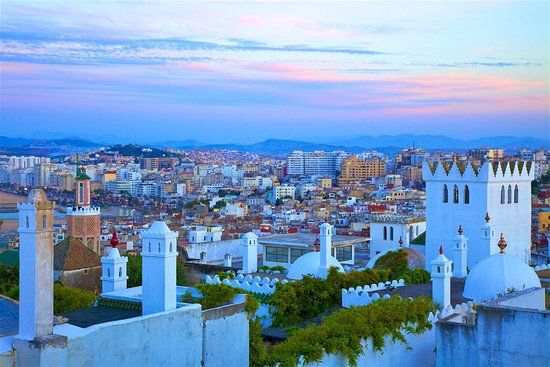
Tangiers multicultural society and large immigrant population has attracted artists like Paul Bowles, William S. Burroughs, Jack Kerouac, Tennessee Williams, Brion Gysin and the Rolling Stones, who all lived here or visited at some stage.
William S. Burroughs wrote Naked Lunch in Tangier in the 1950s and the book?s locale of Interzone is an allusion to the city.
After Delacroix spoke of the amazing light and colours he found in Tangiers, it became an obligatory stop off for many other artists wanting to experience it for themselves.
Matisse became very fond of the place. He made numerous tours of Tangiers, always staying in the Hotel Villa de France. He found the landscapes and colours exactly as Delacroix had described. If you come here you can even visit the room where he painted the famous view out of the window.
Another well-known artist heavily influenced by Tangiers and Matisse was Californian Richard Diebenkorn. He found the Matisse's rhythmic patterns and colours haunting.
The most well known native author from Tangiers is probably Mohamed Choukri. He's widely recognized as one of North Africa?s most controversial and popular authors. His autobiography "For Bread Alone" was described by Tennessee Williams as "A true document of human desperation, shattering in its impact."
During the 1940's and 1950's Tangiers was an international zone. It was a playground for all kinds of eccentric types - artists, writers, millionaires, as well as more sinister crooks, secret agents and gamblers.
Written Aug 7, 2008
Some of the restaurants in Tanger offers a cultural entartainment during lunchtime or dining with their typical dish Couscous and fine fresh mint tea. The lovely belly dancer and the Berber musicians were great. I'm sure to myself, it is one of the best memories i can share way back home.
Updated Jul 12, 2008
After having a meal of Couscous at the Typical Moroccan Restaurant, I was curious. WHAT IS COUSCOUS?.
Couscous is a coarsely ground Semolina Pasta. The grain is a staple in many North African countries. It is traditionally served under a meat or vegetable stew. Couscous is often referred to as Moroccan, but it is equally a dish in Algeria, Tunisia and Libya.
The term comes from Berber languages where it is called Seksou. In Arabic it is Kuskusu.
I have to say, that it was not my favourite dish. I guess it is an acquired taste, especially when you add in the spices, like saffron and cumin.
Updated Oct 10, 2007
There is a superstition among some elderly Europeans and many of the simpler people of the world that the taking of a photograph potentially captures part of the "soul" of a person or a religious object. Thus they avoid being photographed (and may object strenuously). This "evil intent" by tourists is often seen in churches where worshippers as well as custodians may warn you off. It occurs in more sophisticated venues where the excuse is that you cannot violate a copyright. I have experienced this in restricted sites like at the Mona Lisa in the Louvre, of course the Sistine Chapel, Brancacci Chapel(I think Sony has bought the copyrights for all of these) . The most interesting was being stopped from photographing Tiffany stained glass windows in a chapel near Sea Island Georgia. In a palace in Istanbul and one or two other places (I can recall a tapestry museum in Beauvais) they are sophisticated enough to sell you an extra fee photography permit. The worst is in the Museum of Art in my hometown (New Orleans) where I am a high level annual sponsor and to whom I have given a 50K painting (that is stored in the basement); no photography is allowed here,even for my own use as an elderly sponsor for review at home. So I will not volunteer to be a docent. In contrast many museums are putting their collections on line, even as they sell CD's. Many museums have become hoarding collectors no better than the drug lords who buy stolen works we all want to see. C'est la vie!
Updated Oct 12, 2006
As you walk around the kasbah area, you are treading on a part of the city which has existed in this state for centuries. There are back alleys and little corner areas that all make up the maze of buildings and cobbled streets. Getting lost is part of the adventure. One thing you will come up on is residents going about their daily way, fetching water from the communal well, or getting bread from the local baker. This gentleman may have been doing this for years. THe bakery where he works has existed long before his time. Follow your nose...it will be worth it. He will ask for a bit of money for the bread but it is so worth the experience.
Written Jul 5, 2006
Dirham is the currency in Morocco, it is divided into 100 centimes. You will find notes of 20, 50, 100 and 200, but with the last two notes you will find problems when you want to change it.
For exchange of money, you will find ATM machines around, but you can also ask at the reception of the hotel, change of it is around 10,60 for a euro. Big hotels will accept credit cards (not at the Hotel Continental)
Written Feb 17, 2006
Walking around the Tangier's medina I saw a few no-bred but similar, thin and dirty dogs sleeping on a street. They didn't pay any attention to pedestrians unless they smelt somehing to eat. I never met any Moroccan walking a dog in Tangier. I got to know that feeding dogs with doggy food from a supermarket (not always available) is very rare among Moroccans and considered either strange and silly loss of money or at least snobish and luxary caprice.
This quite well maintained dog, on my picture, became my friend as I partly shared my meal in Cap Spartel restaurant with him. Just in case you would like to follow me, he preffered meat than fish and didn't like salads :-).
Written Jun 29, 2005
Whenever I met any kid or young teenager in off the beaten path part of the Tangier's medina I was welcomed with a smile and the French words: "Bonjour monsieur; Ça va?". Always! Some, better educated kids, added English "hello".
Usually they followed us for some time even if we ignored them. Some of them wanted either to take them a photo by my camera or just money. The most known English phrase of Tangier's kids - in pre-Euro times was, in full version: "Sir, give me one dollar, please". Generally, it didn't work that way in other Moroccan cities.
Updated Jun 29, 2005
The street names are always written in both Arabic language and French language in Morocco. In Tangier they are often written in Spanish or Portuguese as well which reflects the past rulers of the city. Most locals who didn't work for tourists, I was talking to, could speak better or worse French. Few knew English, Spanish or Portuguese.
There is unbelievable chaotic tangle of various, both electric and phone, wires going in each direction on a wall of many houses in the medina. I can only imagine what happens in case of any failure or damage.
Updated Jun 29, 2005
Sponsored Links
6 Reviews and 61 Opinions We enjoyed our overnight stay in this old hotel which was being refurbished. Our room was...
11 Reviews and 77 Opinions This hotel, set n the Medina, on a cliff top (small cliff top) overlooking the port, is a grand old...
1 Review and 46 Opinions It's always a good experience this kind of accommodation. They also serve excellent local and...
Reviews and photos of Tangier attractions posted by real travelers and locals. The best tips for Tangier sightseeing.

The street names are always written in both Arabic language and French language in Morocco. In Tangier they are often written in Spanish or Portuguese as well...
17 members live in Tangier

Q: Greetings! We will be in Cadiz late September for a conference and want to travel from there to Tangier and then on to Fez after...

A: catch the fast ferry to Tangier from Algeciras not far from Cadiz
Read 3 Replies
1
Better surroundings than the city itself

Tanger was the second place and city I visited in Morocco (after Tetouan) and to be honest it was not my favourite city in Morocco. It seemed to me too dirty, too strange, too unpleasant even...
2

What comes to your mind when you think in Tangier? Mint Tea … relax , sitting on a terrace, letting the hours pass by with no rush. Smells, colours, life, people .. The past and the present ….......
3
Tangier, a street corner where Europe meets Africa

Tangier is the street corner where Europe meets Africa; where the Atlantic washes into the Mediterranean and where an intersection of Islam and Christendom comes together. Tangier, known as the...
4

Hans and I thought it would be fun to take a side trip to Tangier, while we were in Spain. So we went to our favourite local travel agency in Torremolinos and booked a day tour. This year's price...
5

We had wanted to see Tangier, but couldn't make our minds up whether to go for a day trip, or take advantage of the two-day mini tours which can be had for less than 100 Euros. As Mary hadn't...
Build your own Tangier page
Sponsored Links