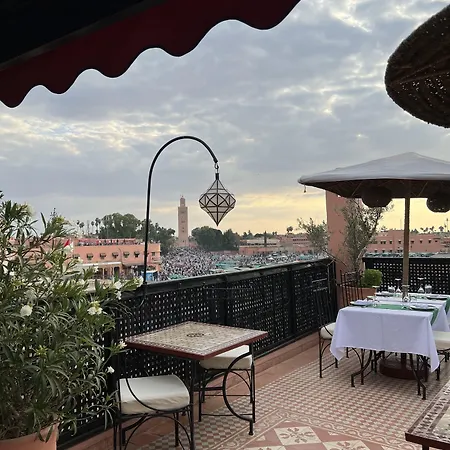


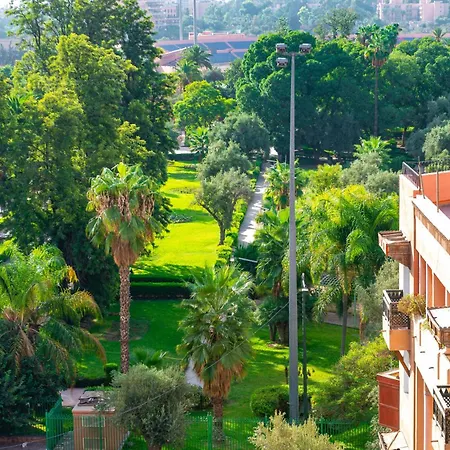
The mosque is located about 200 metres (660 ft) west of the city’s the Jemaa El Fna square. It is situated on the Avenue Mohammed V, opposite Place de Foucauld. During French occupation, the network of roads was developed with the mosque as the central landmark, in the ville nouvelle. To the west and south of the mosque is a notable rose garden, and across Avenue Houmman-el-Fetouaki is the small mausoleum of Yusuf ibn Tashfin, the builder of Marrakech, a simple crenellated structure. In the mosque's esplanade, which backs onto Jama el Fna, the ruins of the original mosque can be seen. Koutoubia Mosque's minaret tower is a landmark of Marrakech. All the names and spellings of Koutoubia Mosque, including Jami' al-Kutubiyah, Kotoubia, Kutubiya, and Kutubiyyin, are based on the Arabic word koutoubiyyin, which means "bookseller". The Koutoubia Mosque, or Bookseller's Mosque, reflects the honorable bookselling trade practiced in the nearby souk. At one time as many as 100 book vendors worked in the streets at the base of the mosque.
If your not of the Muslim faith you are not allowed inside the mosque but you can enjoy the gardens and the surrounding areas ...... no admission price is charged for gardens ....
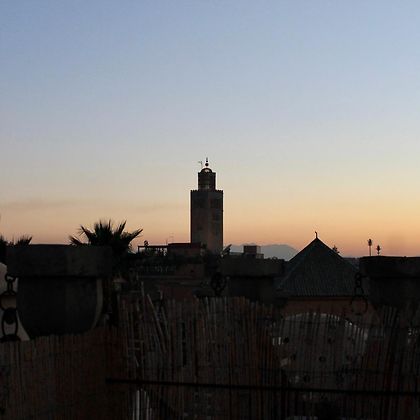
The tallest structure in Marrakech is the Koutoubia Minaret. Dating back to the 12th century, it is a fine example of Moorish architecture, and a symbol of the city. At around 70 metres high, it makes an excellent marker for tourists to help them orientate themselves. On top of the minaret are three golden balls made from copper - rumour has it that the original balls were made from gold.
The Koutoubia mosque was first built in 1147, but was then demolished and re-built soon after because it was not correctly aligned with Mecca. You can see some remains of the original mosque in the surrounding Koutoubia Gardens. The gardens make a nice place for a stroll and enable you to have a closer look at the minaret.
Five times a day the 'call to prayer' rings out across the city from the top of the minaret, with speakers facing every direction to ensure that all muslims know when they should be praying.
Non Muslims cannot visit the interior of the mosque or minaret, so the closest you will get is a visit to the gardens. But you can see the minaret from all over Marrakech so an up-close visit isn't mandatory.
The Koutoubia Mosque is the largest mosque in Marrakech, and its minaret dominates the skyline. Indeed, no other building is permitted to be taller. As a librarian, I was intrigued to learn that its name is derived from the Arabic for librarian or book-trader, al-Koutoubiyyin, due to the fact that it used to be surrounded by sellers of manuscripts. These are long gone, and it now stands in a square facing the Djamaa el Fna and surrounded by gardens. Like all mosques in the city it cannot be entered by non-Muslims, but its exterior is well worth a look and the minaret makes for striking photos by day and night. It was built in the 12th century and is 69 m (221 ft) tall. The minaret is topped with four copper balls of decreasing size. This is a traditional design in Morocco, but there are usually only three. Legend tells that the fourth was a gift from the wife of the Saadian ruler Yacoub el Mansour as a penance for breaking her fast during Ramadan.
Five times a day the call to prayer rings out from here as it does from every other minaret in the city, but unusually for modern times, here the call is still made “in person” by a muezzin rather than being a recording. Rather than the more usual staircase, Koutoubia’s minaret has a spiraling ramp wide enough for a horse to be ridden to the top, but I don’t know whether this means of access is still actually used!
The surrounding gardens apparently offer a restful escape from the city’s madness as well as a chance to get closer to the minaret, but this was a walk too far for me on my crutches so we didn’t go inside them.
At night the mosque and minaret are nicely floodlit. Ideally you’ll need a tripod to get a good photo but a bit of inventiveness pays dividends – I used the roof of a nearby parked taxi and cropped out the foreground afterwards to get this shot (photo 3).
When you look at how perfect the minaret of the Koutoubia mosque is, it's hard to believe that it is as old as it is. At 70m, it has dominated the skyline of the Medina since the 12th century.
It was built between 1150 and 1199, mostly during the reign of Sultan Yacoub el Mansour.
Non-muslims are not allowed to enter the mosque, but you can wander around the adjacent gardens. and take lots of photos. The minaret is particularly photogenic at sunset.
During our 7 days in Morocco we were taken on many guided tours, most took us to the major Mosque in the city or town, however we were only allowed to enter a few and the Koutoubia Mosque was one we entered.
This mosque stands out above the city with its minaret being 77 metres (252 feet) above the ground. The reason it can be seen from so far is a local law which forbids any other building in the medina to rise above the height of a palm tree.
Built by the Almohad, Yakoub el-Mansour during the 12th century this is the oldest and best preserved minaret in Morocco.
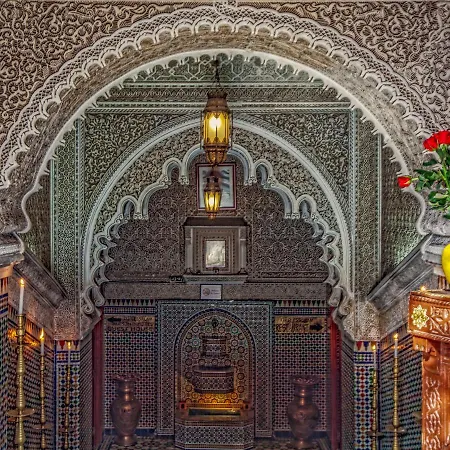
We were inside this mosque for 10 minutes, plenty of time to admire the beautiful tiling and other decoration. We were allowed to take photos.
Then long path when entering the gardens gives a great view of the Koutouba minaret. There is a rose garden in the park and public toilets where the signs leave no doubt as to the female and male toilet. The gardens are always open and admission is free.
The gardens leading up to and surrounding the Koutouba Mosque are smaller and not as impressive as the other gardens such as the Majorelle and Menara but nevertheless offer a tranquil escape from the bustling Medina.
The building of the Koutouba’s minaret was actually completed in 1196 by Yacoub el-Mansour. It was this minaret that the Minaret of the Hassan Mosque in Rabat and the Giralda of Seville were modelled after. On the top of the minaret are 3 golden balls which symbolise the spiritual world, the celestial world and the spiritual world. The gold was said to have come from the jewellery of the wife of Sultan Yacoub el Mansour. All four sides of the tower are slightly different.
Abd el-Moumen wanted to build one of the largest mosques in the Western Muslim world so in 1146 he began the building of the Koutoubia Mosque. Today it is the largest in Marrakech and is certainly a landmark not to be missed. Unfortunately the mosque’s prayer hall is not open to non-Muslims.
There are 3 predominent residential areas in Marrakesh for anyone wanting to invest in the city. Hivernage, Palmeraie and Gueliz district. You will see many modern apartment buildings springing up and a lot of the apartments are sold off the plan.
Sponsored Links
La Maison Arabe Marrakesh
4 Reviews and 507 Opinions This riad is consider the oldest- may be the fiart- and best riad in Marrakech. Hoever. it is a bet...
Riyad Al Moussika Marrakesh
7 Reviews and 265 Opinions My husband and I went with good friends to stay at Riyad Al Moussika. I had read reviews and was...
Riad Kniza Marrakesh
2 Reviews and 721 Opinions Beautifully decorated room, cozy aura, clean bathroom, delicious food and warmhearted staff. I got...
Sponsored Links
Comments