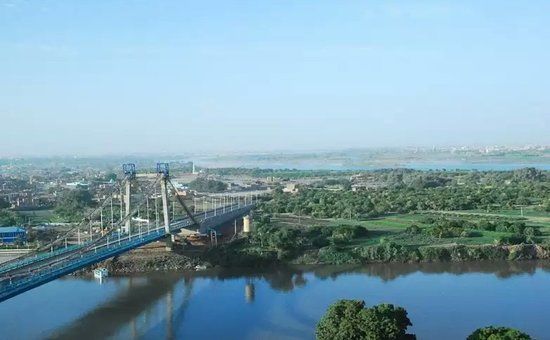
The area called Soba lies about 12 km south of Khartoum Formerly agricultural land, it is now being encroached upon by housing and small industrial enterprises.
We lived here for 18 years when working at the Forest Rangers' College, This has now become part of Sudan University Faculty of Agriculture and Forestry. There is also a Research Station in the same complex. Nearby is Soba University Training Hospital, originally built by the Russians as a Chest Hospital.
Between these two places beside the river is the dairy farm and factory where Capo Yoghurt and milk products are produced. Entering this site is liking being taken into a different world- clean, organised and modern.
Along the river there used to be farms , but now resthouses are replacing these. Brick kilns and allotments too were to be found and when there was a high flood as in 1986, everything would be submerged in water. It used to be popular with expats for picnics, swimming and launching their boats, but I suspect all that has changed.
A few km further south is Soba Village which itself has been expanding over the past decades. And nearby is Soba Aradi where displaced people live.
2012 update. The whole area is different with a modern green golf course where there used to be the arboretum and railway. New housing complexes are springing uptoo, and it no longer seems a long way from Khartoum. It is being swallowed up !
Updated Dec 31, 2012
Jebel Olea is about an hour South of Khartoum. It is basically a big dam and some of the pictures I took here were no no's. It is a great place to spend a morning as there is a small fish market along the side of the road. Bring your photo permit here and check in with the local security man....I got some cool photos here watching the locals throw nets off the dam and go out in their boats.....a Russian/Sudan Air Force helicopter also made a low pass while I was here but I was too slow with the camera to catch it.
Written Nov 14, 2009
Omdurman Boat Yard is situated along the Nile and on the edge of the Abu Roaf district of Omdurman.
The method of building boats has been around since the Nubians. Local boat builders cut tree trunks and shape them into traditional style boats which are still used today. The trade is in danger of disappearing since fast development is ongoing in the region. You will also find small stalls selling small pieces of wood and wooden cups used for burning incense.
Updated Aug 18, 2007
The Battle of Omdurman actually took place in the Kerari battlefield, about 11km north of Omdurman present. Along the west bank of the Nile River, you will see the old mud fortress walls just outside of Omdurman.
The fortress was built to protect and watch out for the British approaching from the Nile. There is no admission fee to enter the site
Written Aug 18, 2007
Muhammad Ahmad Ibn As-sayyid 'abd Allah or El Mahdi was a great man in Khartoum who unfortunately died 5 months after the fall of Khartoum in 1885. In his honor, the people built a spectacular tomb for him with a silver dome. During the Battle of Omdurman in 1898, Lord Kitchener destroyed Mahdi's Tomb but later was restored to its present state.
The local Sudanese muslims consider this tomb as very important and every Friday, religious men come to the tomb's compound to sing songs of the man.
There is no admission fee to enter the compound but you are not allowed into the building, unless invited. Luckily while I was there, one of the religious men let me in to get a closer look at the tomb. Please remember that this is considered a sacred place and therefore, you must cover your arms & legs as a sign of respect
Written Aug 18, 2007
A visit to the Sufi school is fascinating and very rewarding. The school takes boys from all around the area both those who can afford to pay and others who are subsidised by donations.
Sufism is associated with both Sunni and Shi'a muslims, but encompasses other religions found around the world. The essence of Sufism is to let go of the self and realise divine unity with beauty truth and god.
You can walk around the grounds and watch the boys learning and they are very curious and friendly. You can also go inside the temple but cannot take photographs and must not watch people praying.
Updated Aug 15, 2007
Technically this is not in Khartoum as it is 250km or so to the North, but you can do it in a day trip from Khartoum with a good vehicle and driver.
It is worth the trip because there is nobody there apart from the ticket sellers and the guys trying to sell camel rides. You can get some good tourist-free photos here, and it is a pleasant site to explore as it is not too vast, although there is little shade and it is very hot.
The site was the capital of the Cushite kingdom between 300BC and 350AD and contains the pyramids, burial chambers, a temple and the remains of a palace. The ruins suggest this was a very important city in its time. The pyramids have no tops because an Italian archaelogist blew the tops of thinking there was gold inside them.
There are some restorations which are pretty bad patching up efforts but they don't detract from the general enjoyment of the site as a whole.
You can have a short camel ride down from the pyramids to the gate, but I thought the camels were a lot thinner than those I have been on before and I didn't feel very secure.
Written Aug 15, 2007
Since Khartoum is landlocked, you can't enjoy a day at the beach unless you take an excursion to Tuti Island, the island right in the middle of the confluence of the White & Blue Niles.
Each year, the the rivers rise and recede to reveal a little beach on the east side of Tuti Island. This normally occurs after the rainy season and during the "winter". From the beach, you get fabulous views of Palace Hotel & the Presidential Palace.
Getting here is a little tricky because there are no roads to the beach. From Khartoum, you will have to take a ferry across to Tuti Island, then take a bajaj and walk through someone's farm before you arrive at the beach. To me, it was a fun trip with friends and it's always nice to feel real sand between my toes again.
Updated Mar 19, 2007
Tuti Island is a crescent shaped island situated at the confluence of the White & Blue Niles, and is surrounded by the three major areas of Khartoum that are Khartoum city, Omdurman & Bahri. For 1½ years, I've only been able to look at this island from across the banks but I finally got the chance to step on the island and do a little exploring
This is a great place to "get away" from Khartoum without getting away from Khartoum because the island not linked to the mainland by any bridges. To get there, you will have to take a short boat ride across the Nile, either from Nile Street or Omdurman.
Tuti Island is mainly agricultural and where Khartoum gets most of its supply of fruits & vegetable and therefore, you can find many farms situated all around the island, many of them still using manual methods of farming. You will find acres of green fields & lime groves and riding through them, I sometimes forget that I am actually in the heart of Khartoum!
Life here is slower and people are friendly, no one will harass you or ask you for money except that they will be curious about you, especially if you're a foreigner. This is a lovely escape from the traffic, noise & monotonous brown color of Khartoum. However, a bridge between Khartoum & Tuti Island is currently under construction and I don't know how long before this way of life will change
Updated Mar 19, 2007
Sejana from its name derives from the word 'prison'. I don't know if there was once a prison in this area or if prison workers lived here. Nowadays it is an area of workshops for artisans , auto part salesmen, building construction materials and the like, as well as being a residential area. If you want anything in the hardware line or gardening equipment too, this is the area to come to. There are also schools and mosques for those who live in the area. It is not an attractive area because this is where people work, not sit in air-conditioned offices.
Written Feb 5, 2007
93 Opinions
2 Reviews and 65 Opinions My wife and I lived in the Burj Al-Fateh Hotel for 5 months. The staff (and there's plenty of them)...
1 Review and 4 Opinions I just spent 14 days in 5M-hotel and if you leave a hotel after two weeks with a smile on your face,...
Comments