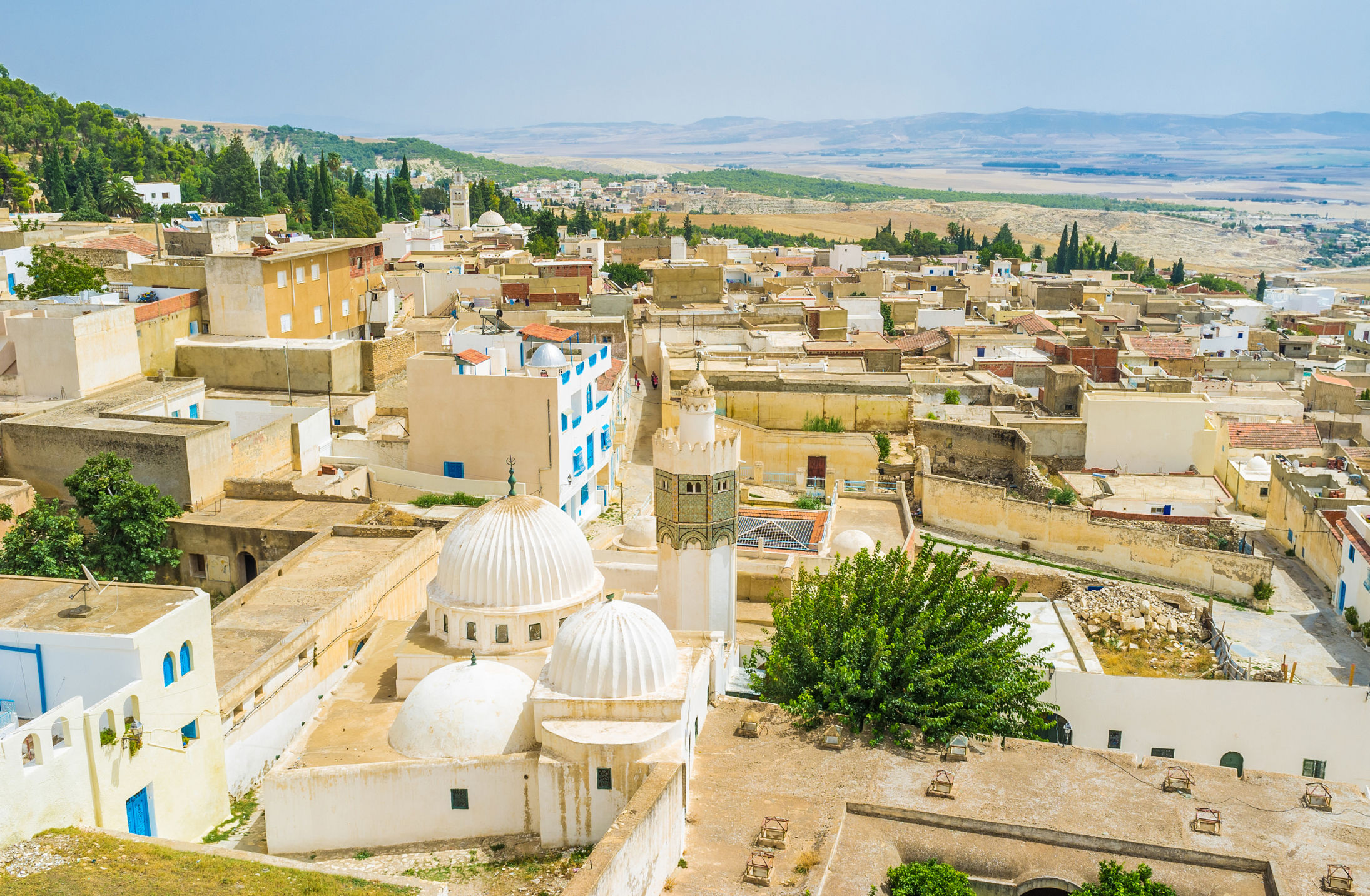
The reason why the town is here in the first place is due to these springs which can be found right in its centre. The springs supplied water to the nearby Roman baths which feature a hexagonal hall as well as the cisterns.
Written Aug 19, 2008
This very early church was first built as far back as the 4th century and has been restored since. It was built on the sire of a Pagan temple during Roman times and features a large naive, two side aisles and an apse which was added in Byzantine times, even though I couldn't get inside.
Written Aug 19, 2008
I think this is the synagogue but I wasn't too sure. Anyway, Le Kef had a thriving Jewish community and this building is all that remains of their culture even though it lies in the middle of the former Jewish quarter. I couldn't get inside but you be able to find someone who has the key if you ask around.
Written Aug 19, 2008
The Grand Fort lies just behind the Petit Fort and was first built by Mohammed Pasha in 1679 before being enlarged in the 18th and 19th centuries. It was used until recently as a barracks by both the French and Tunisians and even today is used to house a large TV/radio ariel, given its dominance over the surrounding area.
Written Aug 19, 2008
The Petit Fort (Small Fort) was built in 1601 and was the first part of the Kasbah to be built. It commands the best views over the town if you walk along its upper part and is protected by four corner towers.
Written Aug 19, 2008
The Turkish Kasbah in Le Kef was built by Mohammed Bey of Algiers in 1679 on Byzantine foundations, using stone from ancient buildings. Much altered in subsequent centuries, it was used until recently as a barracks by both the French and Tunisians. The Kasbah contains two forts - a small one built in 1601 and a larger one built in 1679 but there has been some kind of stronghold here since the 5th century B.C. When you arrive, you may have to find the guy who has the key so as to let you in and when you find him, he'll show you around and give you a guided tour in French only!
Written Aug 19, 2008
In front of the Kasbah is the former Great Mosque, Djemaa el Kebir, built in the 8th century on the site of an earlier building thought to have been a Basilique. The Basilique may have been built in the 4th century as some sort of storage depot for precious items such as silver and grain. It was turned into a church by the Byzantines before becoming a mosque. In the gardens and inside the building are fragments of stone, remains of mosaics and stelae.
Written Aug 19, 2008
This gleaming white buildings was built at the beginning of the 17th century and features cupolas and a 19th century octagonal minaret. It was named after the town's Fez-born patron saint who, along with his family, is buried here. Unfortunately, I couldn't get inside as there was some kind of celebration going on outside.
Written Aug 19, 2008
The Kasbah was used, until recently, as a barracks by the French and their buildings are still in evidence lying just to the north of the Kasbah itself. The barracks were then used by the Tunisian army who were based here until 1992. You get a good view of them if you climb up on the Grand Forts roof.
Written Aug 19, 2008
The old town walls stretch roughly for a kilometre along the rocky slope to the north of the town and incorporate the Kasbah which commands a dominate presence over the town. The towns only surviving gate, out of the original five built, is the Bab Ghedive which gives access to Christian and Muslim cemeteries and some underground Roman cisterns.
Written Aug 19, 2008
Reviews and photos of El Kef attractions posted by real travelers and locals. The best tips for El Kef sightseeing.

The old town walls stretch roughly for a kilometre along the rocky slope to the north of the town and incorporate the Kasbah which commands a dominate presence...
4 members live in El Kef
Q: hi I would like to know if there are any leisure centres in Le Kef? thanks and whats names and how to contact them

A: I would be most surprised if there was. Certainly noticed nothing of the sort when I was there.
Read 2 Replies
1

El Kef is situated in the northwest of Tunisia, close to the Algerian border. El Kef is arabic for 'the rock', and the town is built around the Kabah (castle), perched on huge outcrop of rock on a...
2

Le Kef, just 30 kilometres from Algeria, was one of my favourite places in Tunisia. Located on a hilltop, whitewashed houses spill down the slopes under an impressive Ottoman kasbah. Climb the...
3

El Kef is a quiet, reasonably attractive town. perhaps not quite the gem implied by the guidebooks, but worth a short diversion anyhow. The crennelated walls of the old kasbah guard the town, and...
4

SO WHAT EL KEF ACTUALLY IS, OR AN OFFICIAL VIEW El Kef, or Le Kef - town, northwestern Tunisia. The town is situated at an elevation of 2,559 feet (780 m) on the slopes of the Haut (high) Tell, 22......
5

The old town of Le Kef (kef = "rock"), known in Arabic as Chikka Benar, is picturesquely situated on the slopes of Dir el Kef, an outlier of the High Tell. The upper town, crowned by the Kasbah, has...
Build your own El Kef page