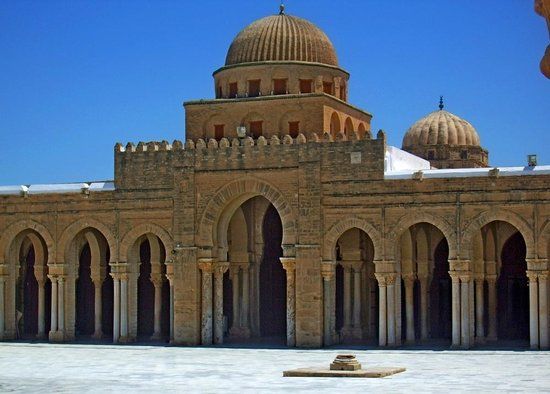
The prayer hall has 17 aisles which are seperated from each other by rows of columns. The floor of the prayer hall is covered with hand made rugs. These rugs are usually made by women and can take up to 1 year to make each rug.
Written Jan 13, 2012
The arcades surround the courtyard, they form long aisles to protect people from the sun. If the Mosque is full people will pray in the courtyard and the aisles.
The pillars of the arcades were taken from carthage where the Roman baths stood.
Written Jan 13, 2012
Address: THE GREAT MOSQUE, KAIROUAN
The Cistern is in the centre of the courtyard which slopes slightly to allow water to filter into it. Water is important before prayers to cleanse the prayer. There are also cleansing facilities outside the courtyard.
Written Jan 13, 2012
Address: THE GREAT MOSQUE, KAIROUAN
The base of the minaret was built between 724 and 728. It is one of the oldest Minarets and it set a pattern for all Minarets in this part of the muslim world. It is 115 foot high and has 129 steps leading to the top.
Written Jan 13, 2012
The Great Mosque is in the centre of the Medina. It is the fourth most important pilgrimage destination iun the Islamic world and one of the oldest and largest places of prayer. According to muslims seven visits here are equvilent to one visit to Mecca.
Written Jan 13, 2012
I had little enough time to do this, but what I saw in twenty minutes or so made it very clear that a longer exploration would hold a great deal of interest.
The doors, the narrow winding alleyways and streets, the shops, the souk.......all are worth exploring.
The medina walls were first constructed in the mid-700s, but they have been destroyed and rebuilt several times since then. Those in the Place des Martyrs, at the southern end of Avenue 7 novembre, are apparently the most impressive......luckily, this was where I spent my limited wandering time.
I hope you can find a bit more time than I did to explore Kairouan's medina and its walls. I 'm certain it will be worthwhile.
Written Aug 13, 2010
This is a mausoleum as well as a mosque. Abou Zamma el Belaoui was a companion of Prophet Mohammad and always kept 3 of the latter's beard hairs on his person.
It's still an important pilgrimage site, although the buildings you see now are not ancient. They date from the seventeenth century onward, and part of them are in the Andalusian style, with beautiful tiling and plaster work.
Adjacent to the mosque, and part of the same complex, is the tomb of Sidi Serif Ben Hindu who designed the Great Mosque. This is a popular place for boys to be circumcised (aged around 6). When I visited, this was happening. The ululation of the boy's female relatives when he was restored to them (as a very sober little boy) was a magical and exhilarating experience, although it also made me feel as if I was intruding.
Updated Aug 13, 2010
Address: Avenue de la Republique/Rue Ibn al Aghlab
The story goes that a 13th-century holy man needed water; his dog scratched the gournd here and water appeared.
Or, if you prefer, this is the spring found by Oqba Ibn Nafi in 660AD, the spring which connects directly with a holy well in Mecca.
Whatever, climb the narrow stone steps to the top of this domed structure and you'll find a camel (I have no idea how it gets in and out, I assume it is trained to climb steps!). It will turn the ancient wheel whilst you watch. The wheel is noria, irrigation technology which probably originally came to Tunisia from Syria in Medieval times. Make sure you squish yourself against the wall, for the camel cares not upon whose toes it treads! The water will be available for you to drink, should you wish (I didn't).
For the price of one dinar, it is a fascinating bit of history-in-action. Camels must have been doing the same thing on the same spot since 1690AD, when one Muhammed Ben Murad restored the building into what you can see today.
The same chap also installed a fountain which flows into a marble basin out on the opposite side of the building.
Written Aug 13, 2010
With massive walls surrounding it, the oldest mosque in Africa is unmissable.
The present building (although much restored and somewhat changed over the centuries) was started in 836AD, but its minaret has lower layers dating from 730AD. the prayer hall and arches are stuffed full of Roman columns and capitals, and two inscribed Roman stones form part of the minarets lower courses.
There's a courtyard with clever drains leading to huge underground cisterns to catch rainwater.and wellheads to draw it up again, and two sundials (one for morning, one for afternoon).
Although you can't enter the prayer hall itself, you can peep through the intricate wooden doors at the wealth of columns inside, each with its wooden block to absorb the shock of earth tremors.
You'll need to cover bare shoulders and knees. There are jallabas on offer if you have brought nothing suitable.
A holy and historical place to visit. Open Mon > Thurs, Sat and Sun from 8am to 2pm, and on Fridays from 8am to 12 midday. Entrance fee.
Written Aug 13, 2010
Address: Boulevard Idi Ibrahim Ibn Aghlab
The cemetery of Ouled Farhane (the children of Farhane?) situated just outside the walls and near the Grande Mosquée, is a real city of deads as most of the tombs have the shape of little houses (picture 2). A little untidy, not very well kept, it is a good place to take nice pictures. Unlike most of cemeteries in Tunisia, this is not a peaceful place as one of the main roads of the city passes just behind it.
Updated Apr 22, 2009
Sponsored Links
2 Reviews and 83 Opinions I must admit I am not used to stay in 5 star hotels. But as we wanted a bit of luxury and to pamper...
6 Opinions
7 Opinions
Reviews and photos of Kairouan attractions posted by real travelers and locals. The best tips for Kairouan sightseeing.

The cemetery of Ouled Farhane (the children of Farhane?) situated just outside the walls and near the Grande Mosquée, is a real city of deads as most of the...
2 members live in Kairouan
Our members can help!
1

After spending a fantastic week in the south of Tunisia we drove north to Kairouan, one of the most popular cities in the country, with many important religious sites and an interesting history.
2

Some people in Tunis get offended if you say that Tunisia is Africa. . . Oh, no! They say . . . this is "the Méditeranée". But when you visit places like Kairouan and you find yourself in the middle...
3
A city of mosques but also much more...

"Tunisia's oldest and holiest arabic city". Too fast a shortcut for a city which hides so many treasures. A maze for medina, hiding minaret, wooden doors, children playing football in narrow alleys,...
4

Kairouan is the most religious city of Tunisia-the pilgrimage to Mecca can be replaced with 4 (or 7 ) pilgrimages to Kairouan.. This city was at the crossroads of important caravan routes ( the name...
5
Kairouan: the 4th Holiest Muslim City

JUST WHAT KAIROUAN IS - OFFICIAL DESCRIPTION Kairouan: town, north-central Tunisia. The town, one of the holy cities of Islam, lies on the Low Steppes, a semiarid alluvial plain southeast of the...
Build your own Kairouan page
Sponsored Links