Fondest memory: Although you're very restricted in your movements (can only follow the guide wherever she goes, and you can't choose which caves you want to look at on the tour), that wasn't an issue for us. Read up as much as you can before you go; the guide actually directed most of her commentary and other chatting at the 3 of us as she overheard me talking to my other 2 friends about what was in cave number X/Y/Z! They appreciate people who're genuinely interested in the grottoes instead of those who don't know anything about them. It's a good idea to go off-peak as there're less visitors and the guides can afford to talk in more detail instead of having to rush out of each cave once they finish the usual blurb because there're more visitors coming. I don't think you get more caves opened for free, but having more detailed info and a slower pace is decidedly worth it.
Written Mar 6, 2006
Favorite thing: Being in the Silk Road, it was easy that silk would become part of the artistic materials used in Mogao.
You can find some marvellous detailed paintings on silk, with beautiful colors. Here is depicted a nobleman of those days, with delicate dressings that suggest an atmosphere of luxury and refinement....
Updated Oct 29, 2003
Favorite thing: The caves are really monks cells, really small spaces carved on the rock. Don't think of them as natural huge caves with stalactites and so, but rather 5x5 carved cubes inside the rock, with all the walls painted (and the celings too) and some ocassional statue too.
You pass from one another by narrow steps on the rock walls.
Written Oct 29, 2003
Favorite thing: These painted statues are relly impressive. You can still see the colours on them, though they were originally painted in much brighter colors!
Some of them represent Buddhas, some Devils, Angels....
Written Oct 29, 2003
Favorite thing: Because the buddhist cave art and statues in the Mogao Grottoes are very sensitive to carbon dioxide and light, no photography is allowed and visitors are limited to visit a handful of caves only. This is to preserve them for future generations.
Written Apr 18, 2003
Favorite thing: The grottoes, also known as Caves of the Thousand Buddhas, preserve nearly a thousand years of Buddhist cave-temple architecture, clay sculpture, mural paintings, and manuscripts, dating from the 5th to the 14th centuries
Written Sep 17, 2002
Favorite thing: Its position at the intersection of two trade routes was what made Dun-huang flourish. The coming and going of horse and camel caravans carried new thoughts, ideas, arts and sciences to the East and West.
Written Aug 25, 2002
Fondest memory: Beijing -
Xi'an -
Lanzhou -
Dun Huang
-
Tulfan -
Urumqi -
Ining -
Kazakstan
Dunhuang, a small city in Gansu Province, is located near the crossroads of the ancient Silk Road.
It is made famous largely by the Buddhist Grottoes, known as the Mogao Grottoes, which are one of the world?fs most important sites of ancient Buddhist culture.
The grottoes, also known as Caves of the Thousand Buddhas, preserve nearly a thousand years of Buddhist cave-temple architecture, clay sculpture, mural paintings, and manuscripts, dating from the 5th to the 14th centuries
Dun Huang is the peak of this tour. Probably there is no place in China that is so mysterious and rich in culture.
Dun-huang lies at the western end of the Hexi Corridor. The name Dunhuang originally meant 'prospering, flourishing'-- a hint that Dunhuang must once have been an important city.
Its position at the intersection of two trade routes was what made Dun-huang flourish. The coming and going of horse and camel caravans carried new thoughts, ideas, arts and sciences to the East and West.
The center of Dun Huang. In the fourth century a Buddhist monk had a vision of 1,000 Buddha, and began to carve grottoes into the sandstone cliff and fill them with Buddhist images.
Now we know these caves as The Muogao Caves, or MuoGao Grottoes. It later become a local tradition and here are now 482 caves with 4500 square meters of murals and 2500 sculptures.
These caves and the city itself were abandoned and forgotten in around the 11th century until its rediscovery in early 20th century.
softly, gently, nicely and comfortably.
Written Aug 25, 2002
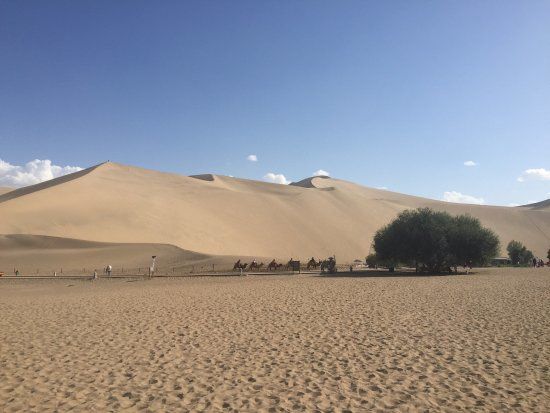
Favorite thing: The Gobi Desert is all around Dunhuang. The place is a real oasis in this desertic endless landscapes, a bit monotonous but fascinating...
Updated Oct 29, 2003
Favorite thing: Dunhuang is famous for its silk paintings of Buddhist and the artwork of the Mogao Grottoes, such as the one in the picture which I bought.
Updated Mar 19, 2003
Sponsored Links
2 Reviews and 62 Opinions After leaving Dun Huang, we spent a night at Silk Road Dun Huang Hotel. This hotel has a sprawling...
1 Review and 4 Opinions Excellent four-star hotel very close to the night market. The rooms were enormous and very well...
1 Review and 5 Opinions Dunhuang has no 5-star hotels; Grand Sun Hotel, as one of only two 4-star hotels in Dunhuang, lives...
Sponsored Links
Comments