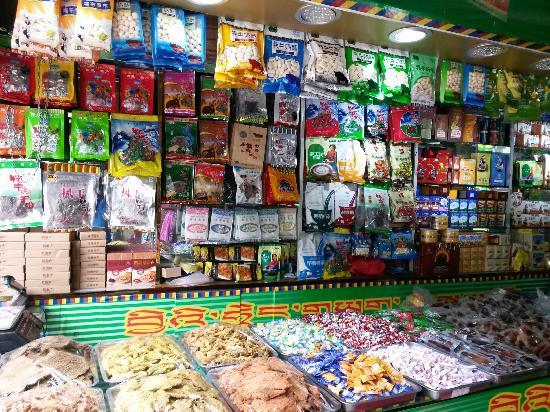
This review has been a long time in coming, but I promised to say something and am now fulfilling my promise. The shop, located somewhere along Barkhor street, is one of the more recognized and trusted shops, given a large interior and two floors. They sell all kinds of souvenirs and crafts, from jewelry to combs to animal products to clothes, etc.
I want to draw attention to the torquoise stones that this shop sells on the second floor, sometimes cut and sometimes uncut. If you ask to see the nicer/best stones, an assistant will take you to a back room filled with their best merchandise. This is where I selected a beautiful uncut torquoise stone and had it custom-made into two half-cut pendants to be adorned on any rope of my choice. The manager was even kind enough to waive the price of the custom silver work after the stone was sent to a local silversmith.
I not only appreciate the quality of the stones that the shop sells, but am very appreciative of the way the assistants and manager handled my financial situation, giving me a very good deal compared to the original asking price. I would recommend the shop not only because of its merchandise but because of its customer service.
As it has now been so long and I cannot seem to find the name of the shop on-line, I hope that during your wanderings in Barkhor street that you find this shop and patronize it the way I did.
What to buy: Beautiful and priceless torquoise, the kind you cannot find from small vendors.
What to pay: For some of the best torquoise stones (not the discolored and quite possibly fake or cheap ones seen on the streets by small vendors), you can expect to pay anywhere from just a thousand RMB to tens of thousands of RMB, depending on the color and shape of the stone and the depth at which the torquoise was unearthed (where the deeper the better). Stones are priceless, and their value depends on what value you give it.
Updated Jan 6, 2012
Address: Somewhere in Barkhor street...
You should bargain in Barkor Bazaar. Vendors were generally cute old women and it was easy to believe the first price they told. In our situation we passed two exchange rates (in Bhutan and Nepal) and I had adjusting problems in Tibet. I even couldn’t calculate the price in dollars. So we ended up buying stuff in high prices. It wasn’t so bad, though. After seeing Tibet you’ll understand what I mean. Barkor’s opening prices were higher than a souvenir shop in 5 stared hotels and much higher than a vendor in Shigatse. But the sellers keep shouting “Lookie, lookie! Cheap cheap!”.
What to buy: I bought prayer flags, pearls, a silver bracelet, a t-shirt and an apron wore by married women in Tibet in Barkor. You can also have teeth(!), vegetable, rosary, fabric door curtains… Barkor has diversity.
Written Oct 23, 2009
phurbu tsamchu, the manager, is very friendly and fluent in english. the staff is very eager to assist you in finding what you need. they will also gladly ship to your country anything too big for your backpack.
for a relatively small and inexpensive shop, it accepts major credit cards - perfect for people who don't want to carry a lot of cash around.
a good place for one-stop shopping where you know you won't be ripped-off.
What to buy: they carry everything from clothes to carpets. they sell jewelry as well as all sorts of tibetan souvenirs.
What to pay: relatively inexpensive, possible to bargain.
just say you were referred by miko, the good looking guy (haha!) from the philippines who bought a lot of clothes there late one night during the first week of august, 2006 - she might just give you a better price! (can't hurt to try)
Updated Jan 25, 2008
Address: mentsikhang lam rd.
Phone: showroom: +86 891 632 1481
This is a newly founded company, on the road between Lhasa and Gongkar airport, in Nam village. Traditional Tibetan carpets are woven at their riverside site, and you can see the whole process from start to finish. There are carpets for sale in the showroom on site. The General Manager is called Norbu Tsering: he speaks English and it's best to call him on his mobile phone 1398 990 8681 to arrange a visit (they can arrange transport for small groups). They accept credit cards and can ship overseas for you.
What to buy: There are both small traditional carpets and larger contemporary pieces. The wool used is all local, handspun.
What to pay: 100-1000 US dollars
Written Nov 27, 2007
Address: Nam Village, Chushu county, on the airport road
Phone: 1398 990 8681
Website: http://www.toranahouse.com/Tanvasite.html
For tourists staying at the Lhasa Hotel or any of the hotels on Beijing Zhong Road, this sidewalk market is a convenient alternative to the Barkhor Bazaar if you don't have time to go shopping again on the other side of town. Pick up those last minute gifts for friends and relatives who just e-mailed you the day before departure and requested prayer wheels or singing bowls.
The sidewalk in front of Lhasa Hotel is wonderful because the merchants are in closer proximity to each other. This means you can bargain with two or three folks at the same time and simply choose the lowest price since they all sell practically the same stuff.
I recommend "My Friend", as seen in the additonal photo, who is one of the merchants always situated right next to the Lhasa Hotel exit. I call her "My Friend" because she likes saying "My Friend" to anybody who shows the slightest interest in her wares. "My Friend" gave me free gifts when I bought a prayer wheel and singing bowl from her; three extra bracelets for giving her all of my business instead of buying from her nearby competitors. She's a very amicable lady and also let me take as many photos of her as I wished.
What to buy: Aside from prayer wheels and singing bowls, you should look for prayer flags, necklaces, hada scarves, bells and other musical instruments, as well as those neat skull bowls called "kapala" by Tibetans. (Some kapala are also made from turtle shells)
I only saw a single kapala at the sidewalk market in front of the Lhasa Hotel, but I wasn't really shopping for one so perhaps other merchants kept them hidden. I have heard that this controversial item is often only shown upon request, so you might want to include the word "kapala" in your essential Tibetan shopping vocabulary.
What to pay: With the likely exception of kapalas, nothing at the sidewalk market should exceed 300 yuan. Good quality prayer wheels range in price from 20-200 yuan and singing bowls are from 50-300 yuan depending on the size. There are plenty of cheap items that can be bought for 10 yuan. Everything is negotiable, and so if you add something else from the same merchant then try to get the price down for both objects. For example, 160 + 80 = 200 is an equation that makes sense to merchants who are desperate for a late afternoon sale.
Updated Sep 23, 2006
Address: No. 1, Minzu Road, Lhasa
Barkhor Square is hundreds of vendors with small carts sell all types of tibetan art and buddhist items. Many of the vendors have the same or similar items. DO NOT SETTLE ON THE ASKING PRICE! Tibetan are natural negotiators. It is not uncommon to have the price drop 3 or 4 times before you settle. If you talk them down two times just walk away. They will agree to your price if it is reasonable.
The vendors are located all around Jokhang Monestary. It is recommended that you walk clockwise around the Monestary to see the vendors. If you do not, you will be working your way ask the many Tibetan pilgrams making the Kora around Jokhang.
What to buy: If you are looking for any type of Buddhist artifact or religous items, this is the place to get it.
What to pay: Haggle, Haggle, Haggle! If you are shrwed you will get the best pricein tibet.
Written Jul 12, 2006
On the street stand many souvenir stands and shops selling antiques, jewelry and local craft. This my favorite place in Lhasa! :D
It's also the place where people enjoy watching traditionally tibetan architecture. (actually it's repaired several years ago. )
What to buy: Necklaces, local crafts, tibetan knives, bangles,............................................
What to pay: Some say that start low - about 3/1 of the price told. It maight not that easy but worth trying. :P
Written Sep 23, 2004
What to pay: Getting prices down in Lhasa or anywhere else in Tibet was slightly more difficult than elsewhere, with 60% of first price as far as I was able to push. Not pushing below 70-75% seems to be better, as at least you amd the seller part on good terms. As I found out, the 'get the price down as low as possible' attitude of tourists elsewhere in the world was frowned upon in Tibet - pay what you think the item is worth. If you have to push the price below the 70-75% of first asking price mark, don't buy.
Updated Apr 24, 2004
²Ø¶¬³æÏIJݵÄÀ´Ô´ £ºÔÚÎÒ¹úÎ÷²Ø²ý¶¼¡¢ÄÇÇú¡¢ÇຣÓñÊ÷¡¢¹ûÂåÖݵØÇøÄÚÓÐÒ»ÖÖcordyceps sinensis (Berk.)Sacc¶¬³æÏIJݾú(Õæ¾ú)ÓÖÃûÖлª³æ²Ý¾úºÍÒ»ÖÖÁÛ³áÄ¿òùòð¿ÆÀ¥³æòùòð¶ê ¡£Çﶬ¼¾½Ú£¬¶¬³æÏIJݾúÔÚÌØÊâÌõ¼þÏ£¬ÇÖÈëÕݾÓÓÚÍÁÖÐÒ»²¿·ÖÖеÄòùòð¶êÓ׳æÌåÄÚ£¬ÎüÊÕÓ׳æÌåÄÚµÄÎïÖÊ×÷ΪÉú´æµÄÓªÑøÌõ¼þ£¬²¢ÔÚ³æÌåÄÚ²»¶Ï·±Ö³,ÖÂʹÓ׳æÌåÄÚ³äÂú¾úË¿¶øËÀ¡£²¢ÔÚÌØÊâÌõ¼þÏÂ,ת±ä³ÉΪ³õÆÚµÄ²Ø¶¬³æÏIJÝÎïÖÖ.ÔÚÐÂÒ»ÄêµÄ6ÔÂÖÐÏÂÑ®×óÓÒÌìÆø×ªÅ¯Ê±£¨ÒòÎ÷²Ø²ý¶¼¡¢ÄÇÇú¡¢ÇຣÓñÊ÷¡¢¹ûÂåÖݵØÇøº£°Î¸ß£¬ÌìÆø×ªÅ¯±È½ÏÍí)£¬×Ôòùòð¶êÓ׳æÍ·²¿Éú³ö×Ó×ù£¬Éú³¤ºóð³öµØÃæ¡£×Ó×ùÈç²Ý¾¥£¨²ÝÍ·£©£¬Ï¸³¤ËưôÇò¹÷ÐÎ×´¡£×Ó×ù£¨²ÝÍ·£©Éú³¤Ê±,Í·²¿ÉÔ½¥½¥±äµØÅò´ó³ÊÍÖÔ²ÐΣ¬»ù²¿ÁôÔÚÍÁÖÐÓëÓ׳棨³æÌ壩ͷ¶¥ÏàÁ¬¡£òùòð¶ê×Ô²úÂѵ½Ó׳æÆÚ¸ÐȾ¶¬³æÏIJݾúÖÁת±ä³ÉÕæÕýµÄ²Ø¶¬³æÏIJÝ,ǰºó´ó¸ÅÐèҪʱ¼ä32¸öÔÂ×óÓÒ¡£
What to buy: It is well-known that the chinese herb, ¶¬³æÏIJÝ, cordyceps sinensis (Berk.)Sacc, those grown in and from Tibet are of the best quality in China. They are fat and thick, and the frangrance is intensive when you use in cooking soups, and you don't need to use up to ten sticks. The reason they grow well in Tibet is mainly because of the altitude and climate of the Tibetan plateau, other places which produces cordyceps are Szechuan, Yunnan and Qinghai.
Normally, if you buy them elsewhere in China, e.g. in Chengdu, Tibetan-grown ¶¬³æÏÄ²Ý are the most expensive.
But beware of discerning between the good and the lousy or fake ones.
Updated Oct 2, 2002
1 - 9 of 9
Sponsored Links
3 Reviews and 20 Opinions I love House of Shambhala since the moment I stepped in. It is exactly what I had on mind. Rustic,...
1 Review and 60 Opinions I stayed at this hotel in February 2007. The beds were hard, but that's normal in China. They had...
6 Reviews and 24 Opinions I would recommend a stay at The Lhasa hotel we did for 4 nights The beds were firm like most beds in...
Reviews and photos of Lhasa attractions posted by real travelers and locals. The best tips for Lhasa sightseeing.

²Ø¶¬³æÏIJݵÄÀ´Ô´ £ºÔÚÎÒ¹úÎ÷²Ø²ý¶¼¡¢ÄÇÇú¡¢ÇຣÓñÊ÷¡¢¹ûÂåÖݵØÇøÄÚÓÐÒ»ÖÖcordyceps sinensis (Berk.)Sacc¶¬³æÏIJݾú(Õæ¾ú)ÓÖÃûÖлª³æ²Ý¾úºÍÒ»ÖÖÁÛ³áÄ¿òùòð¿ÆÀ¥³æòùòð¶ê...
12 members live in Lhasa
Q: Hi there, I plan to travel to Tibet in Aug 2012. I am planning to book with a local tour agency. I found this company called...

A: I have never heard of this company but if you have reason to be doubtful my advice would be Trust your instinct. Why not post a new question asking members who have...
Read 2 Replies
1
Lhasa, the pilgrim capital of Tibet

Lhasa is situated at an altitude of 3,595 metres on the north bank of the Kyi-chu River. The name Lhasa is thought to come from the Tibetan words Lha (sacred) and Sa (earth). In Chinese the town is......
2

The most breathtaking view in Lhasa is from the roof of the Jokhang temple to the Potala Palace......
3

at long last, i made it to the top of the world! it turned out to be so much more than i expected - the people, the culture, the architecture, the history, the landscape, and the sky! oh yes, the......
4
Lhasa, the capital of pilgrims

Lhasa is the capital city of Tibet. It was also the city of the Dalai Lamas and it now is the capital of the pilgrims. Many Tibetans come to the city to walk the pilgrim routes like the Barkhor,...
5
Go to Lhasa before its ruined!!!

This was my first time so far west of the country and I was very excited about going. As I have written on my TIBET page introduction, I was given the opportunity to go as part work and part pleasure...
Build your own Lhasa page
Sponsored Links