Favorite thing:
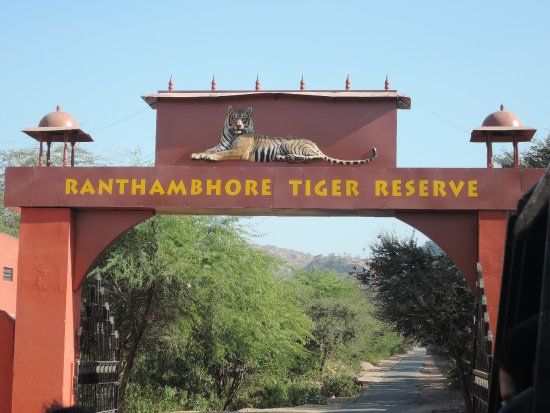
The only way to visit the Ranthambhore National Park is via Indian government-run jeep safaris. You book these safaris through a variety of marketers, and as I mention in my warnings, you'd best book your safaris well ahead of time. The number of visitors to the park is strictly regulated, and as you'd guess - it's popular.
The company that was involved in our booking of jeep safaris was Ranthambhore Travel and Tours. They were selected by Navin Pandey and Gatik Eventures of New Delhi, the company and man that I selected to help me put together the arrangements for our trip. The fellow at Ranthambhore that we worked with personally in Sawai Madhopur was a fellow named Balraj. (I'm sorry, I didn't get his surname)
If you are booking your safaris, I'd suggest that you get in touch with this company, they'll take good care of you. They are dependable and will do everything possible to insure that you get into smaller jeeps, rather than the larger group safaris. (There's never a guarantee, as the government makes the calls. But Ranthambhore Tours and Travel seem to do a good job of getting small jeeps, which are nice)
Contact information:
Ranthambhore Tours and Travel
Head Office is near the Girls Senior Secondary School in Sawai Madhopur.
There is a branch office attached to the Sawai Madhopur Lodge over on Ranthambhore Road.
Email : tours_rant@yahoo.co.uk
Website: www.ranthambhoretoursandtravels.com
Phone: 22 22 61
Fax: 22 12 80
Fondest memory:
Well, Ranthambhore Travel and Tours gets partial credit for THE moment of our visit to Ranthambhore. That would be the afternoon that we saw that stunning male bengal tiger at a distance of only 40 meters. :)
Favorite thing:
If you are going on a tiger safari the chances are you will be leaving quite early in the morning and it is still pretty cold.
You may leave your hotel and thing, "its not too cold and will warm up". However, once you get in the open top safari vehicle and it starts driving to the park it is absolutely freezing!
When they offer you a blanket to take with you, take it. Men - don't be macho and so no, take it, you will need it.
Favorite thing:
Timings for entry into, and exit from, the park vary according to the season. In winters, due to the shorter duration of daylight hours, the morning entry time is later and evening exit time is earlier.
Fondest memory:
Winter Safari Timings,
Morning Safari 07.30 to 10.30
Evening Safari 15.00 to 17.00
Summer Safari Timings,
Morning Safari 06.30 to 09.30
Evening Safari 16.00 to 18.30
Favorite thing:
Still cameras are allowed into the park free of charge, but there is a Rs 200 fee per entry, for non-professional video camcorders.
For professional film crews, there is a fee of Rs 3,000/ day for Indians and Rs 5,000/ day for foreign crews.
Generally speaking, the best time to get good pictures is early mornings or late in the evenings, when the sun is not too strong.
Favorite thing:
The park is open for visitors from 1st October to 30th June.
The temperatures in summer though can reach 45 degrees cel at its peak. It is perhaps a better option to avoid trips in summer. However, Tigers are more visible during summer. Probably due to the fact that there may be less undergrowth in terms of vegetation, and therefore less room to hide.
The period between November and Feb is probably the best time to visit. Winters, at their peak, can also be fairly cold. Temperatures can go down to 2 or 3 degrees cel. Tigers, and most of the animals, are generally more active during the winter months, and its a great time to see birds.
Favorite thing:
Having spend a beautiful morning in the park, we are quite unprepared for the adventure awaiting us outside the gates: there, on top of the escarpment, is a leopard! A very rare sighting indeed, we are absolutely thrilled to see the leopard!
Tigers will attack, kill and eat leopards if given the opportunity, so the leopards tend to stick to the outskirts of the park.
Favorite thing:
Latin name: Lissemys punctata
Found throughout India, the turtle is common and not considered endangereed. It is found in ponds and rivers and will grow to a maximum size of 35 cm. It lays 3-8 eggs during September to December, and eats small fish and insects.
Favorite thing:
Local name: Gilheri; Scientific name: Funambulus pennanti
The squirrel is widespread and very tame in and around the villages, as well as in the park.
There is a legend attached to this squirrel - it was this species which Rama thanked for helping the monkeys to build the bridge to Lanka when he was rescuing Sita from Ravana.
The stripes were left when he stroked one of them, and have been there ever since!
Favorite thing:
The Sambar is the most widespread spread deer species in the world, covering sevral Asian countries.
It is also one of the largest members of the deer family, with males being able to attain weights up to 300 kg and can grow to a height of up to 150 cms at the shoulders. The males have antlers nearly 100 cm long, and life expectancy is up to 20 years. The sambar are the main prey of the tiger, and he can feed for four days from a large deer.
Favorite thing:
Also known a Blue Bull, the Nilgai is a large antelope. Males have short, smooth horns with an average lenght of 18 cm. Females usually do not grow horns, but may occasionally. They grow to 119-150 cm at the shoulder and can weigh up to 290 kg. Life expectancy up to 30 years. This, the largest of the Asiatic antelopes, is considered sacred in India.
General colouring is grey to brownish grey in females with patches of white on the face and below the chin. Males are darker with a blueish tone to the body, hence the name.
Sponsored Links
View all Sawai Madhopur hotels
Sponsored Links
Comments