Favorite thing: The most important site in Bhuj was considered to be the Aina Mahal (housed in the Darbargadh Palace). The palace complex was largely destroyed in the 2001 earthquake ~ previous to that it had stood since the mid-18th century. It was designed and decorated by a Dutch-trained builder who even managed to construct working fountains that reached the second floor royal apartments (though they weren't still functioning by the time I visited :-) ).
The Aina Mahal was open as a museum when I was there (clocks, ceramics, embroidery) and it was also the location of the Tourist Office. We made arrangements here for a driver and guide to go into the Rann of Khachchh.
Updated Jun 18, 2003
Favorite thing: Located in the Darbargadh Palace complex (across from the Aina Mahal), the Prag Mahal was added a hundred-odd years after its neighbouring building. The views from the clocktower (pictured) were fantastic. The building itself showed more British than Indian architecure influences.
Updated Jun 18, 2003
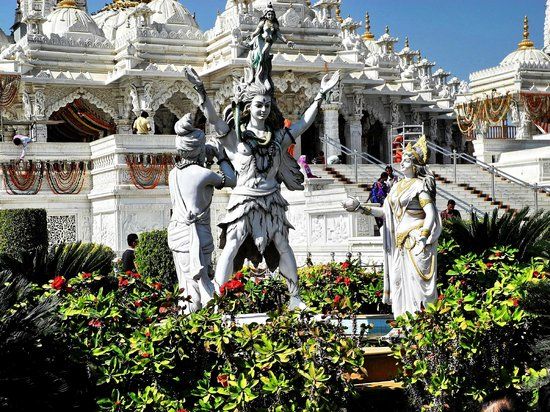
Favorite thing: The Swaminarayan Temple's doors were actually closed to visitors the first and second time we dropped by (we had hoped to have better luck with a second try). The temple exterior itself though was very colourful and the street surrounding it quite busy.
I've read since that this temple was lost to the 2001 earthquake.
Updated Jun 18, 2003
Favorite thing: Hamrisar Lake forms the Western centre of Bhuj and it makes for a good point of orientation. It was an incredibly peaceful place to sit for a while.
Bhuj in general seemed to have a slower pace (admittedly, I was just coming from Mumbai), and this observation held up over the length of our travels.
Updated Jun 18, 2003
Favorite thing: Bhuj was a walled city with a fantastic maze of markets that seemed frozen in time. It was very easy to get lost in the winding streets ~ occasionally we'd would make a wrong turn and end up back out on a quieter road, but we would quickly wheel around and re-enter the centre of shops and stalls.
My photos from the market area didn't turn out (poor lighting), but this photo gives a peek at the nature of the slower, calmer streets of Bhuj.
Updated Jun 18, 2003
Favorite thing: This is a view over the Aina Mahal (taken from the Prag Mahal's clocktower).
The Aina Mahal had a fantastic exhibit by a local photographer when I was there. The man had spent five years living with rural tribes in the Khachchh ~ the displayed photos were largely of a marriage ceremony between a 7 and 9 year old girl and boy. The traditional dress and jewellery in the photos gave us a terrific sneak peek at what was to come in our road trip into the Khachchh. The level of intimacy that the photographer gained by investing those years with the tribe was indescribable and came through in every shot.
Updated Jun 18, 2003
Favorite thing: One of the main features in the Aina Mahal was the Hall of Mirrors ~ this was a long room with walls of white marble. The marble was almost entirely covered with mirrors separated by gilded ornaments. The effect of the lighting (an ornate chandelier) was not quite as impressive as the candle-revealed Sheesh Mahal at Jaipur's Amber Fort, but it was beautiful nonetheless.
Updated Jun 18, 2003
Favorite thing: The Bhuj markets hold all sorts of interesting items ~ you'll see a lot of embroidery (it's a tribal specialty in the neighbouring Rann of Khachchh), handicrafts and jewellery.
There is also a section (and additional stalls peppered throughout the lanes) of spices and foodstuffs. It's these items that always entice me. . .with their carefully-groomed little peaks of colour. . .
Updated Jun 18, 2003
Favorite thing: The Rann of Khachchh is located in the Northwest corner of Gujarat, along the border with Pakistan.
The area south of the Rann ~ all around Bhuj ~ is called the Khachchh district and it is home to a number of tribal communities.
Fondest memory: My fondest memory is of hiring a guide in Bhuj to drive out into the tribal villages. . .and ultimately to a monastery filled with characters who can hardly be described.
Updated Jun 18, 2003
Favorite thing: Gujarat is one of the lesser-visited states in India; villages near the Rann of Khachchh are even more off the beaten path. The roads outside of the cities are fairly empty and it's more likely that you'll come across camels than cars and trucks.
It's a wonderful place to feel as if you're seeing an untouched part of the country.
Updated Jun 18, 2003
Reviews and photos of Bhuj attractions posted by real travelers and locals. The best tips for Bhuj sightseeing.

Gujarat is one of the lesser-visited states in India; villages near the Rann of Khachchh are even more off the beaten path. The roads outside of the cities are...
15 members live in Bhuj

Q: I shall be visiting Gujarat in January 2006 and would like to visit Bhuj. Has the town been (partially) rebuilt after the...

A: BHUJ IS NICE PLACE AND REBUILT AFTER THE EARTHQUAKE, OFCOURSE THE OLD MONUMENTS ARE DESTROYED DUE TO EARTHQUAKE OF JAN 2001. BUT RECENTLY I HAVE SEEN LOT OF TOURIST...
Read 4 Replies
1

Bhuj is a wonderful 500+ year old town. It was ruled by the Jadeja clan of Rajputs for 450 years before it merged with the Indian Union. The town is home to many powerful Jain families (whose money......
2

Bhuj Town, known after the Bhujiya Hill. Established in 1552 by Khengarji-I, town was protected by great wall and 5 giant gates. Most precious treasures are Hamirsar Lake, Prag Mahel (Dutch style...
3

This picture was taken in 1998 at Pureshwar Temple near Bhuj with some friends. Bhuj is just 50 km away from Gandhiaham and the King of Bhuj was Maharao. You can see Forts, Museums, Monuments and......
4

I had been for Earthquake relief as a volunteer to Anjar. i was there 9 months aftr the D day. the might of the earthquake was even eveident then.with debris all over.. i was involved in organising......
5
WHERE EARTHQUAKES GIVES LESSONS OF HOLLYNESS

ASIA->INDIA->GUJARAT->BHUJ NO, DON'T WORRY FOR EARTHQUAKE BIG BAD HAPPENS NEVER REPEAT VERY FINE CITY WITH HONEST LOVING PEPOLE ,
Build your own Bhuj page