you can see some of non-permanent blue tents selling beautiful tibetan accessories made by the tibetan refugees along the old fort road (from zorawar fort) heading to main bazaar and there are several tibetan shops selling thanka and tibetan praying and music instruments.
Written Feb 12, 2013
Address: old fort road and main bazaar
On day one, as you go towards your first monastery (gompa or gonpa) visit to Hemis (3740 m; 12,270 ft.), the river Indus flows towards you on your right. The drive is smooth and the breeze is so pure. You drive up to Karu village, a distance of only 35 kms. Then you branch off to your right and go up a long, windy, narrow road for another 7 kms. As you cross the bridge, turn left, look down and snap a photo of the Indus River.
The monastery itself is nestled halfway in the mountain. As you climb up, stop the vehicle and click away. You may be too tired on your return journey to remember this photo op. As is the rule, the monastery has at least 50 steep steps to negotiate before you present yourself, huffing and panting, to a serene, smiling monk selling entrance tickets. So here also, take a photo or two of the massive monastery before attacking the steps.
The moment you enter, you encounter a large courtyard. To your right are the prayer wheels lined against the wall while to your left are some benches. At the extreme left-hand corner at the other end, is the famed Hermis Museum. Next to you, on your left, there is a decent washroom. You walk around and then enter the prayer hall to your right. You can then retrace your steps and go through a narrow door on your right. There is another, smaller prayer hall here which houses a large statue of Lord Padmasambhava. His eyes are large and round and his expression redoubtable. His right boot is stretched out in front of him and is shouldered by an equally menacing monk. The moment you come out of this room, take the rickety flight of steps up to the ramparts of the monastery. The view from there of the Stok range of mountains as well as the crisp air, are both a rare treat.
A tour of the museum is a must. There’s plenty to see there. You deposit your camera, video and cellphone, pocket your locker key and proceed downstairs. Even a cursory visit may take you upwards of 30 minutes. Souvenirs are available on the ground floor store. The timings are 8.00 am to 6 pm with an hours’ lunch break from 1 pm to 2 pm.
Founded in 1602 by Stagtsang Raspa during the reign of King Sengge Namgyal, it is also known as Changchub Sangling (solitary place of the compassionate one) and is the most famous and richest monastery in Ladakh. It belongs to the Drukpa lineage of the Kargyupa sect. It houses a very rare tangka which is supposedly the world’s largest and which is unfurled only once in 12 years. The monastery is also famous for the Hemis Tse-chu festival which commemorates the birthday of Guru Padmasambhava. This festival is held sometime during July. The monastery has over 300 monks studying within its premesis.
###Click Here For Next Day###
Updated Dec 5, 2011
Address: About 42 kms from Leh, near Karu town
On day six, you return through the same thrilling scenery back to Leh. If you did not get proper sleep the previous night, blame it on the height of Tangtse (4,322m; 14,180 ft). There are locations for a helipad here but security concerns may not permit this. However, before starting your return journey, don’t miss out the engravings on a huge boulder in Tangste. From the market, go towards the Forest Department Guest House, ask around and you will be directed to the rock. People say some of the engravings were made by travellers and merchants going towards Tibet or returning from there. Next to the Guest House is the rushing waters of the Tangste River and above it, the sheer and barren mountain. It is a place worth visiting. In the market, go into Dothguling Guest House & Restaurant, the place where the Bollywood star Aamir Khan stayed with his team while filming the movie, ‘The Idiots’. If time permits, visit the Tangste monastery nearby, perched as it is on the edge of a precipitous ledge. Once you reach Leh, take you lunch and go in for a last stroll towards Leh market. Who knows? You just might get lucky and bag a treasure.
Later in the evening don’t miss the chance to visit the sound and light show at Zorawar Singh Fort. This huge fortification is at the edge of the town on the General Hospital Road by the side of the Gangeis Shynem Stream. Maintained by the Army, you need someone in the Armed Forces to vouch for your good intentions. The show itself is educative as well as enjoyable but the history is engrossing. General Zorawar Singh led as many as four expeditions into the Ladakh region before the Ladakh kingdom was lost forever. By 1819, Kashmir was under Sikh rule and Raja Gulab Singh wanted to fill his exchequer as well as expand his kingdom. The only way he could accomplish his twin objectives was to bring the entire pashmina-producing areas under his control by conquering the Ladakh region. He therefore despatched his Dogra General Zorawar Singh who, between 1834 and 1841, managed to subjugate the region. Thus ended the Namgyal (Victorious) dynasty which had ruled Ladakh since 1551. Before that was the Lhachen dynasty from 990 AD. Prior to that, Tibet was following the Bon Chos religion. With the advent of Buddhism, a schism between these two religions divided the Tibet empire. To reunite his kingdom, king Lang-darma tried his best to promote the Bon Chos religion, leading to his assassination. His two sons then divided the empire between themselves, with Utshang ruling over western Tibet and Yemstan over the Ladakh region. This historical fact is, perhaps, the basis for the Chinese claim over Ladakh and by extension, Arunachal Pradesh.
Written Nov 22, 2011
The lake is over 130 kms long and 5-6 kms broad. However, the major portion of the lake lies in Chinese territory (Tibet).
The water of the lake is clear but has high salt content which prevents normal marine life from flourishing. Birds of various varieties are present around the lake. A small camping site called Lakung is available where tourists are allowed to pitch up their tents, with due permission only. A small village, Spamik or Spangmik, is at a distance of 8 kms from the lake. It is the scene of the deep blue lake against the harsh brown mountains (Chang-Chenmo) nearby with a backdrop of snow-capped ranges (Panggong) in the distance that will live with you forever. The calmness, the solitude, the rawness of the breeze, the vastness of the lake, the azure-blue sky with white, foamy clouds rolling along, all combine to enthral you and make the arduous journey worthwhile. During winter, the lake freezes.
Written Nov 21, 2011
Address: 146 kms from Leh
Day five, you travel to Pangong Tso or Lake (4,420m; 14,500ft ; 146 kms; 4 ½ hours) in the Changthang valley after negotiating the pass at Changla (5,360 m; 17,586 ft.), the third highest pass. At Karu, you show your permit, go past the picturesque Chimrey Monastery (300 yrs. old; 45 kms from Leh; near Sakti village) and arrive at Tangtse, 113 kms away after travelling for 3 hours through some of the most beautiful scenery in Ladakh.
Written Nov 21, 2011
The entire journey from Leh to Diskit, Nubra Valley and to Hunder is 118 kms and it takes roughly four and a half hours.
Kalsar is 59 kms (3 hrs) away. You may take your lunch here but as Diskit is only 30 kms away, you might as well wait. Along this journey, River Shyok keeps you company. A little distance away, take the left turn and 13 kms later you enter Diskit town and the Nubra Valley. The road straight ahead leads to the Saichen glacier base camp.
Once you deposit your belongings at your place of stay, try out the sand dunes and a ride in the unique Bactrian camels (two-humped creatures) in the Hunder region. The scenery is again out of this world. On one side are the barren, rocky, stark, brown mountains. Straight far ahead are the snow-capped range of mountains. Your feet are on sand but you see small pools of water amidst the sand dunes. And you need to cross a rickety bridge over a stream of water to reach this spot. The camels take you either for a 15-minutes’ ride or a 30-minutes’ safari.
Written Nov 21, 2011
Address: 118 kms from Leh
By day three, you’ll feel like a pro in Leh and will be rearing to go past one of the world’s highest motorable pass, the Khardungla on to Diskit and the Nubra Valley. However, it’s best to remember that in a matter of 1 hr and 15 minutes, you’ll traverse 39 kms to reach Khardungla and rise from 11,500 feet 18,400 feet.
At South Pullu (15,300 ft.), you have to show your permit. The entire stretch consists of totally barren hills, rocky with nary any vegetation. However, in the distance, the snow-capped Stok Kangri range of mountains, look ethereal. From October to March, traffic is regulated, one day one way, owing to the snow. The roads are fairly good. However, South Pullu to Khardungla (14 kms) is bad road.
At Khardungla, everyone alights from their vehicle to be met by a blast of raw air. Head for some wholesome tea as well as some ‘maggi’. Both are delicious. Take lots of photographs, of the road you have traversed and of the range of mountains you have crossed as well as of those you will soon encounter. The scenery is simply out of this world, the whiteness of the snow as it clashes with the brownness of the lower mountains. There is a small temple as well as a stall selling memorabilia here.
Updated Nov 21, 2011
Address: 39 kms kms from Leh
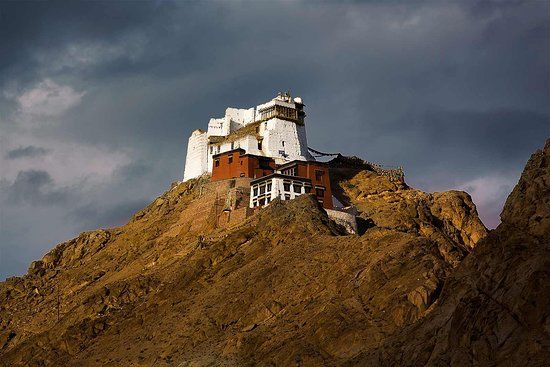
Once you reach Leh, head straight for the Tsemo Gompa located on Namgyal Peak (Victory Peak) and the Khar or Lachen Palkhar or Royal Palace. The monastery, the fort and the red Maitreya temple, are all in ruins though attempts are being made now by the ASI to renovate these ancient heritage buildings. Further down, and merging with the Leh market place, is the unmistakable Royal Palace. The Gonkhang or Temple of Guardian Divinities contains the 6-armed Mahakala, the Vajra-Bhairava and Dharma-raja with his consort. This is a dark room and taking photographs without a flash is a difficult proposition.
The nine-storied palace was constructed by Sengge Namgyal, one of the greatest rulers of Ladakh, in the late 1630s. The palace has 9 storeys as 9 is an auspicious number in Tibetan Buddhism. Though the palace is in ruins now, one room houses some rare photographs of a bygone era. From the balcony, the view of Leh town and of the snow-capped mountains, is awe-inspiring.
Written Nov 21, 2011
Address: In Leh Town
Alchi Choskor (religious enclave), 35 kms away, is one of the oldest shrines in Ladakh and is the oldest among the 20 branches of the Likir Monastery. It is situated in Alchi village (3165m; 10,384 ft). You will heave a sigh of relief as there are no steep stairs to climb; rather, a narrow cemented road leads gently down to the cluster of shrines. There are plenty of shops along the way to distract you. A signage informs that Rinchen Zangpo, the great translator, visited Ladakh and founded this monastery in 1020-1035 AD. Translators and painters were invited from far and near to decorate the shrines here. Actually, there are four shrines here, all in a row, separated by a few paces. All are built of wood with earthen floors. There is only one priest who opens and closes these four shrines as well as manages a small book store inside the Sum Tsek Temple. As photography is not permitted inside the shrines, pick up a book on the shrines here. The art, architecture and paintings here are a veritable treasure trove. The timings are 8 am to 1 pm and 2 pm to 6 pm with a lunch break in between.
The first one is Sum Tsek Temple (three-tiered temple), a 3-storeyed structure with a huge stupa in the middle. On the left is the 12 foot high white statue of Avalokitesvara (Boddhistava of Compassion). Next is the 16 foot high red Maitreya or future Buddha. Next to this is the 12 foot high light brown starue of Manjushri (Buddha of Wisdom and Knowledge). All these statues have smaller statues on both sides of the walls.
The next shrine is the Vairocana Temple, a smaller one which is a bit further away. It houses the 12 foot high statue of Avalokitesvara, standing tall with feet apart. There are plenty of murals on the walls. On the right-hand side, there is a small opening. Couch and go in. You can then view the Barukana mandala.
Lotse Mandir, with the Shyamuni Buddha in a sitting pose, is the next shrine. Here also, there are some delicate murals on the walls.
The next one is the Manjushri temple. It houses four statues, all back to back. The murals here are also noteworthy. This shrine and the Lotse Mandir are housed in a single building and separated by a wall.
You may then return to the market for your lunch. There are quite a few eating joints here. Besides the small ones in the market place, there’s ‘Zimskhang Holiday Home’ and another equally respectable one opposite. Both offer good food as well as rooms.
Written Nov 21, 2011
Address: 325 kms from the Confluence
A little further on, 2 kms to be precise, is the Sangam or Confluence of the two mighty rivers, the Indus and the Zangsar. You can make out the two rivers by their distinctive colours (dark brown of Zangsar and foamy white of the Indus before they merge and flow towards Pakistan. The entire journey is on good, flat road. If you look around, you’ll notice the denuded mountains. The road to Chilling town runs along the river at the bottom from where you stand.
Written Nov 21, 2011
Address: 2 kms from Magnetic Hill
Sponsored Links
4 Reviews and 50 Opinions Spic and Span is really the best hotel one can stay in. At least the manager was courteous enough to...
1 Review and 30 Opinions The Hotel Lotus is meant to be one of the better hotels in Leh. While it offers clean rooms, TV,...
3 Reviews and 19 Opinions In Leh, if you do stay at the only centrally air-conditioned hotel, ‘The Grand Dragon’ in Old Road,...
Sponsored Links
Comments