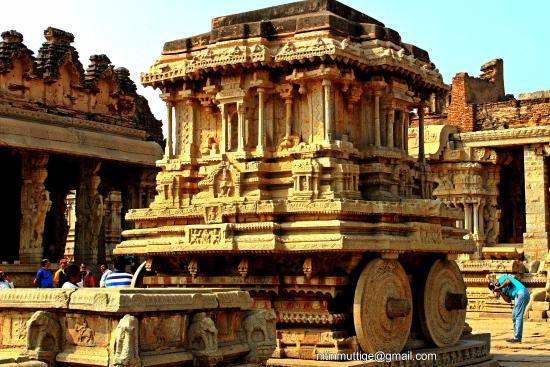
Favorite thing: The sites at Hampi are a UNESCO World Heritage Site and therefore attract many visitors - both Indian and foreign. The sites cover a very large area and there are many signs pointing out the directions to them so you shouldn't get lost. However, take a guidebook with you which should have a map of the area plus you can do some research by looking at the maps that I found on this very useful Hampi dedicated website:
http://www.hampi.in/download-maps-hampi.shtml
Written Sep 20, 2009
Favorite thing: When I first arrived in Hampi, the owner of the guesthouse that I was staying in, took me to the main temple, the Virupaksha Temple, where there is a small police building on the right after you walk through the main entrance. All foreigners have to register with the local police upon arrival which is a simple process of logging your details in a book. This is for security reasons as there has been theft from foreigners in the past - in fact there's a rouges gallery of crooks for you to peruse over just outside.
Written Sep 20, 2009
Favorite thing: Hampi’s climate is generally dry & hot. March to early June is the summer. Monsoon brings some wet weather that typically lasts from late June to early August. The colder period of the year is from November to February, which is considered the best time to visit. I visited at the end of January and temperatures were between 30-35 deg C but it didn't feel all that humid. It's best to bring plenty of sun cream and also a hat as there's virtually no shade when travelling between the attractions.
Written Sep 20, 2009
Favorite thing: Hampi is generally packed with temples (great and small), rocky terrain, dry, at time very dusty. If you can stand those rough terrains, you may start to enjoy those beautiful temples, cactuses grow abundantly between massive boulders, and the mighty Tungabhadra River really makes it an ideal place to unwind yourself.
Updated Apr 22, 2007
Fondest memory: umashanker wrote:
Gulal is a perfumed powder that is offered to godess.These colored powder is part of Sringar and symbol of joy we put on our forehead too and throw in air in relegious processions as a gesture of Joy.
In South India, there is a tradition of making beautiful Rangoli (floor decorations) by South Indian women using gulal. Rangloi of Gujrat is also famous for thier traditional patterns.
Updated Apr 22, 2007
Favorite thing: You must be wondering why I say those sh!t cakes are precious to the villagers. As you know not all nutrients are digested, and there are still lots of grass fibers remain in those cow dung. It can be used as fertilizer, fuel, seal down dusty streets and symbolic for green pasture in front of their houses.
More usage for cow dung (Etracted From Wikipedia)
Cow dung is also used to line the floor and walls owing to its insect repellent properties. In cold places, cow dung is used to line the walls of rustic houses as is a cheap thermal insulator. Cow dung has an excellent mosquito repellent property and is used by many companies to produce repellents. It was also used extensively on Indian Railways to seal smokeboxes on steam locomotives.
Updated Apr 22, 2007
Favorite thing: In the mainstreet of Hampi [it is more like a big main square] there are several stands where you can buy dye in every bright color. It looks beautiful, they arange it into a cone shape. These are the powders the indians dye there beautifully colored clothes with.
Written Jun 14, 2003
Favorite thing: If you walk towards the Vitthala Temple, along the riverside, you'll see a lot of work being carried out by members of the Archaeological Survey of India who are restoring many of the temples.
Written Sep 20, 2009
Favorite thing: Visit http://www.hampi.in for pretty much all of the info you will need
Written Mar 12, 2008
1 - 9 of 9
Sponsored Links
40 Opinions
2 Reviews and 48 Opinions We chose Hotel Bhuvaneshwari simply because of its proximity to the Hampi ruins. It turned out to be...
11 Opinions
Reviews and photos of Hampi attractions posted by real travelers and locals. The best tips for Hampi sightseeing.

Visit http://www.hampi.in for pretty much all of the info you will need
Q: It will help me if you could advise How many days it will take to see Hampi, Parrada Kallu, Badami, Ayhole,Hospete and other...

A: Hello, Based on our trip to Karnataka: 1 day for Badami & Ayhole 1 day to get from there to Hampi 2 days in Hampi itself. You can easily skip Hospet (the train...
Read 3 Replies
1
Hampi - natural beauty and ruins

I've got some interesting experiences in Hampi. I'd love to share with you the 39 tips I've written, the 183 photos uploaded, and 10 travelogues I've created.
2

Hampi, the forgotten jewel of India. Often overlooked by the traveller to India, for the more popular northern "sites", but i can assure you a visit will remain imprinted within your memories...
3

Strewn over a large area (about nine square miles) the ruins at Hampi offers a remainder of the greatest land in the whole world. Every rock, every path and every monument at Hampi speak the same...
4

I've got some interesting experiences in Hampi. I'd love to share with you the 14 tips I've written, the 49 photos uploaded, and 0 travelogues I've created.
5

As the capital of Vijayanagara Kingdom - which was supposedly at its peak between 14th and 16th centuries - the ruins are a shadow of the splendor of the bygone days. It is supposedly one of the...
Build your own Hampi page