Favorite thing: The OSHO Meditation Resort Commune offers daily meditation activities including Tai Chi, Vipassana Meditation, OSHO Kundalini Meditation, Nadabrahma Meditation, Chi Kung, Heart Dance and Silent Sitting Meditation as well as the world famous morning OSHO Dynamic Meditation and the OSHO Evening Meeting. They also have dance parties and Karaoke nights!
Fondest memory: Relaxing at the OSHO pool.
Written Oct 9, 2005
Favorite thing: Click to the following rated sites where you can know about the 'Pune Historical City'
1. http://www.virtualpune.com/
A entire resource on Pune city. The directory has
info on cinema tickets, news, art and culture,
business and jobs.
2. http://www.punecity.com/
3. http://www.unipune.ernet.in
Home page of the University of Pune, with info on
admissions, libraries, schools and departments,
faculty, staff, etc. There's also a section for
international students.
4. http://www.punepolice.com/
The official website of the Pune Police. Get
information on police stations, rules for
registration for foreigners, updates and news,
helpline and downloadable forms
5. http://www.searchpune.com/
Truly a comprehensive site on Pune. All the
regular information and plus some more.
6. http://www.punerealestate.com/
A one-stop place for your property needs in the
city. Besides listing most of the prominent
builders in the city and facilitating buying and
selling, the site promises to respond to any
queries in less than 24 hours.
7. http://www.punenet.com/
A guide to Pune with focus on culture, history,
etc.
8. http://www.yellowpagespune.com
The Yellow pages of Pune
9.http://www.indiatravelite.com/airway/puneairport.htm
About:
AREA: 146 Sq.Km. ALTITUDE: 598mm TEMPERATURE: Max- 40 C and Min-26 C in Summer, Max-29C and Min-19C in Winter.
RAINFALL: 70 CMS ( June to Sept )BEST SEASON: Throughout the Year.
CLOTHING: Summer-cottons, Winter-Light Woolen, STD CODE: 020
PLACES OF INTEREST (KM/MILE FROM STATION)
Aga Khan Palace (5 Km/3mile), Bund Garden(0.5 Km/0.1 mile), The Film and Television Institute(3 Km/1.8 mile), Osho Ashram-Koregaon Park (0.5 Km/0.1 mile), Shaniwar Wada(2 Km/1.2 mile), Sarasbaug (2 Km/1.2 mile).
Alandi-Ashtivinayak Temple(22 Km/13 mile), Bhimashankar(122 Km/75 mile), Karla (55 Km/34 mile), Khandala(70 Km/43 mile), Lonavala(64 Km/40 mile), Mahabaleshwar (120 Km/75 mile), Panchgani (98 Km/60 mile), Urulikanchan-For Nature Cure Hospital-(60Km/37 mile), Ahmednagar(120 Km/75 mile), Aurangabad(257 Km/160 mile), Nasik(213 Km/133 mile), Satara(120 Km/75 miles).
Fondest memory: Welcome to Pune
Pune has been known by a plethora of sobriquets. Popular among them: Queen of the Deccan, cultural capital of Maharashtra, pensioner's paradise and Oxford of the East. Pune is one of the historical cities of India with a glorious past, an innovative present and a promising future. The Pune Municipal Corporation administers the city. Its boundaries extend over four hundred square kilometres and it has a population of close to four million. Thus, Pune city has been developed into a Pune metropolitan area, just equal in area to that of Greater Mumbai. It is located 192 km (by rail) and 160 km (by road) from Mumbai and is 559 metres above the mean sea level. Being surrounded by beautiful hills and the Sinhagad fort, it has a temperate climate. Water, which is plentiful, is supplied to the city from Panshet, Khadakvasla and Varasgaon dams --all located about thirty kilometres from Pune. Pune is among the greenest urban areas in the country with more than 40 per cent of its area under green cover.
Pre-historic Pune
Human civilisations have prospered on the banks of rivers; Pune city too has flowered on the banks of the Mutha river originating from the Sahyadri range of mountains. Eminent archaeologist Dr. H. D. Sankalia and his colleagues from the Deccan College carried out excavations of the Mutha riverbed and banks. These researchers found evidence of human civilisations that existed 100,000 years ago along the Mutha river. Pune finds mention in some of the Puranas.
What's in a name?
Down the centuries, Pune has been ruled by several dynasties. The earliest evidence found (copper plates of 758 A. D. and of 768 A. D.) reveals that the Rashtrakootas ruled this region then. At that time, Pune was referred to as Punaka Vishaya and Punya Vishaya. Copper plates of 960 A. D. and 963 A. D. refer to it as Punaka Wadi and Punaka Desha. Here Vishaya means region. Later on, the city has been mentioned as Kasabe Pune. The Pune Gazetteer explains the term Pune as Punya - a holy place. In Hindu tradition, a confluence (sangama) of two rivers is sacred. Hence, this city, where there is a confluence of two rivers, is Punyanagari. After the Rashtrakootas, Pune was ruled by the Yadava dynasty. After the fall of this dynasty, it came under Muslim dominance till the middle of the seventeenth century.
Ancient monuments
Some of the remains of this period can still be studied. The first is the Pataleshwar Temple on the Jangli Maharaj Road. It is a temple of Shiva in rock-cut caves with over forty pillars, and a bull (nandi) in front of Shiva, with sixteen pillars. This dates back to the Rashtrakoota age and is close to one thousand years old. The second monument is the set of dargahs --Muslim places of worship. The senior and junior Shaikhsalla on the banks of the Mutha river, near the Shaniwarwada, are constructed on the earlier temples of Puneshwar and Narayaneshwar.
Historical Pune
***************
The rise of Shivaji:
With the emergence of Chhatrapati Shivaji,who founded the Maratha empire, Pune became known to the Delhi Sultanate. Shivaji, born in 1630, at Shivneri fort near Junnar just 90 km (50 miles) away from Pune, spent his early childhood in Pune at Lal Mahal, a palace built by his father Shahaji, where Shivaji's mother Jijabai lived for a decade. Shivaji was crowned in 1674 at Raigad. Dadaji Konddev, Shivaji's mentor, developed Pune city. He constructed a temple of Ganesha called Kasba Ganapati. This is the grama devata where invitations for all religious functions are first offered be it for a marriage, upanayana ceremony or any other functions. It was in this Lal Mahal that Shivaji attacked the Moghuls and defeated Shahistekhan, the uncle of Aurangazeb.
Eighteenth century Pune:
The Peshwa rule
After the death of Shivaji in 1680, his son Sambhaji ruled the Maratha kingdom. Aurangazeb tried to squash the Maratha kingdom and finally succeeded in brutally killing Sambhaji at Wadu near Pune. Aurangazeb named Pune as Muhiyabad. Aurangazeb, however, could not counteract the Maratha tactics and he died near Aurangabad. Pune city again rose to power during the eighteenth century, under the leadership of the Peshwas who virtually ruled the Maratha kingdom from 1713 to 1818. Balaji Vishvanath was the first Peshwa or prime minister, appointed by the king Chhatrapati Shahu who selected Satara as his capital.
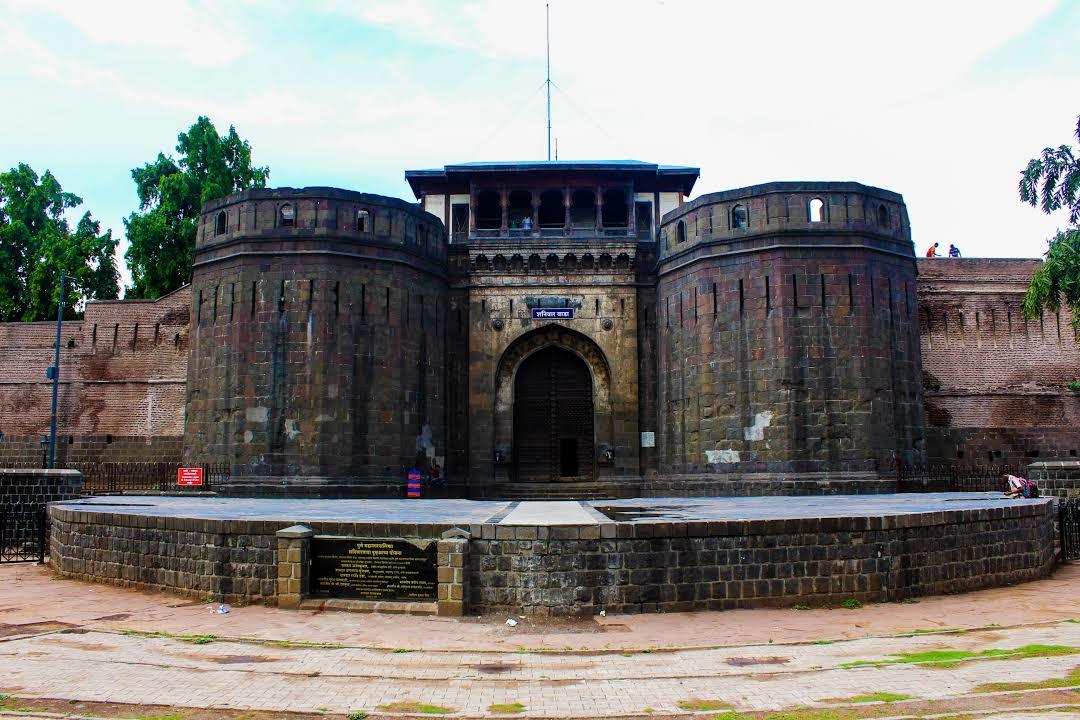
Pune gained importance during the period of the second Peshwa Thorala (senior) Bajirao who ruled from 1720 to 1740. During his time, the palace of the Peshwas - Shaniwarwada was built. This famous monument of Pune city has five doors. The main door is called Delhi darwaza. The Peshwas went out for their military campaigns through this door and were also received here when they returned after succeeding in the campaigns. The door next to it is called the Mastani darwaza. Bajirao married Mastani, a Muslim, and lived with her in this palace. She used to pass through this door when she went to visit Bajirao. To the east are two doors. One is the Jambhul darwaza and the other in the corner is the Ganesh darwaza. There is a Ganesh temple in front of this door. Ladies of the royal Peshwa family took this door to visit the Kasba Ganapati temple. To the south is the Narayan darwaza. From this door, the dead body of Narayan Peshwa was moved out. To the west there is no door, but there is a passage to reach the upper part of the wall of the palace. The various mahals or buildings were constructed by different Peshwas. There are still remains of a fountain with thousand outlets called Hazari Karanje. It was Thorala Bajirao who expanded the Maratha empire into north and central provinces. Nanasaheb Peshwa succeeded Thorala Bajirao Peshwa and ruled the Maratha kingdom from 1740 to 1761. He tried to control the Nizam and maintained peace. He was instrumental in urbanising Pune city and encouraged the setting up of Peths or wards in Pune. He also encouraged people of different vocations to establish their settlements. He constructed the famous Parvati Temple complex, a pride of Pune city. He designed a water supply system from Katraj Lake that lies to the south of Pune city. A number of temples and palaces were constructed during his time.
The Marathas suffered a setback in the battle of Panipat in 1761 near Delhi. Nanasaheb who never recovered from this setback, died the same year. Madhavrao Peshwa (1761-1772) succeeded him, During his short tenure, he controlled the Nizam and brought confidence among the people. However, he was confronted with family troubles started by his uncle Raghoba Peshwa. He died at Theur, near Pune, which is famous for its Ganpati temple (one of the Ashtavinayaks). Ramabai, wife of Madhavrao Peshwa committed sati and embraced death along with her husband. A temple exists today in her memory.
Narayanrao and Savai Madhavrao succeeded Madhavrao. Narayanrao was killed in an encounter with the soldiers employed by Raghoba Peshwa, uncle of Madhavrao, his predecessor. However, Raghoba Peshwa could not become a Peshwa, since he was sentenced to death by Chief Justice Ramashastri Prabhune on charges of plotting the murder of Narayanrao. Savai Madhavrao (1774-95) administered the Maratha kingdom with the help and advice of two groups --one headed by Nana Phadnis, a diplomat, and Madhavrao Holkar Mahadji Shinde the famous generals of the Maratha army. These Generals expanded the Maratha kingdom in the North and in Madhya Pradesh and challenged the Delhi Sultanate. During his time, he constructed the present famous Saras Baug Ganpati Temple, improved the Parvati temple complex and encouraged urbanisation of Pune city by establishing Sadashiv, Narayan and other Peths.
The Maratha power came to an end in 1818, when the British led by Mount Stuart Elphinstone defeated them and established the British Raj in this region. During this period, the French, the Portuguese and the British powers established contacts with the Peshwas, sent representatives for various functions. Pune and Delhi were the only centres of power during this century.
The British period:
Crucible of the freedom struggle
The British brought with them their educational and administrative systems. With the establishment of the Bombay University in 1857, numerous educational institutions were founded throughout the Bombay Presidency. Pune has been recognised as a seat of learning and the Deccan College (1851) led the educational movement in Pune. Tilak, Agarkar, Bhandarkar and other luminaries of the nineteenth century studied in the Deccan College. They studied in the English language, but a literary movement was started by organising the first Marathi literary conference in 1878. Justice Mahadev Govind Ranade, V. K. Chiplunkar and others took lead in this sphere of life. Tilak, Agarkar, Nam Joshi and Principal Apte founded the Deccan Education Society and its Fergusson College in 1885. The New English School (1880), the Nutan Marathi Vidyalaya (1883) and the MES Society's High School (1875) were started. Soon after, a high school for Indian girls was established in 1884. A new generation of educated Indians started the freedom movement under the leadership of Lokmanya Bal Gangadhar Tilak. He started two newspapers, the Mahratta in English (January 1, 1881) and the Kesri in Marathi (January 4, 1881). Through these newspapers, Tilak aroused interest in national education, national language, swadeshi and swarajyai - the four fold aims for independence. 'Swaraj is my birthright' was the slogan given by Tilak to the rest of India.
Gopal Krishna Gokhale is another builder of modern India who established the Servants of India Society and represented Indian interests in the imperial legislative council. Mahatma Gandhi considered him his guru. He was a liberal leader and was elected president of the Indian National Congress. Gopal Ganesh Agarkar was a social reformer and pleaded for social reforms like widow remarriage and education for women. Maharshi Dhondo Keshav Karve is yet another gem of modern India, who throughout his life fought for the upliftment of women, started a college for them and established the first Indian University for women, named SNDT Women's University. He was awarded the Bharat Ratna in 1958. Senior Wrangler R. P. Paranjape is another luminary from Pune who sacrificed higher salaries and worked as the principal of Fergusson College for over twenty years. Mahatma Jyotiba Phule started education for women and struggled hard for the upliftment of the depressed classes. Shrimati Anandibai Joshi was the first lady to complete medical education in the USA. Thus, we find the origin of various movements - social, religious, educational, political, economic and literary-, in Pune city.
The nineteenth century:
Impetus to education
As a result of the growing awareness, a number of institutions were started in Pune. The S. P. College (1916) and the Nowrosjee Wadia College (1932) were started to cater to the needs of different localities in Pune. Professional colleges were started - the College of Engineering in 1854, Agriculture College in 1908, Law College in 1924, followed by the Sassoon Hospital and Medical College. Numerous schools and high schools were started for the spread of education. Educational institutions from Pune attract students from all over India and hence Pune city is called a centre of learning - rich in experience and excellence, with a tradition of devoted teachers. The University of Pune was started on February 10, 1949. Tilak Maharashtra Vidyapeeth, Bharati Vidyapeeth, Deccan College, Gokhale Institute of Politics and Economics gained the status of Deemed University in the 1990s.
* This is just a part of the Pune city Information -
Written Aug 26, 2002
Favorite thing: Firstly, you absolutelly must try make your way to South India! It's amazing to travel from place to place and the scenary is just totally different in the different areas.
South India seemed a lot more 'relaxed' (well, as realxed as any place could possibly be in India).....
Fondest memory: Palolem Beach in Goa is an absolute must if you're in the area.....in fact, from what I've seen - I wouldn't considering any other beach!
It's in a bay and there aren't people trying to sell you stuff while you're sitting on the beach (like Vagator Beach)
There are plenty of little fishing boats and generally people just going about their daily lives and the toursits somehow blend in.
Written Aug 26, 2002
Favorite thing: Well ,are you visiting Pune first time ? If you are not an Indian I would suggest one to visit nearbye forts,and if interested in Education ? visit Pune University and Pune do have lot of educational reasearch schools too.See Ganesh festival which is a unique cultural activity .
Puneites for that matter Maharashtrians are Polite hosts only one has to start on his own to introduce himself a little strange for sranger ! but you can have cool trustworthy and longterm friendships !
Fondest memory: What do I miss about Pune when I am away from here ? A rickshaw driver talking in Marathi!,Marathi plays friends and more of all my home itself!
Updated Aug 26, 2002
Favorite thing: BIBI KA MAQBARA (Aurangabad)
This little mausoleum is famous for being a small version of the Taj Mahal. It deserves a visit, though you don't have to pay the entrance to make a photo from the gate (and that's what I did!)
Written Aug 25, 2002
Favorite thing: AJANTA CAVES
This carved buddhist caves have many more pictures than the ones of Ellora. They are like small 'Sixtine Chapels' of buddhism. Located some 100 kms away from Aurangabad, this caves were discovered in the 19th century by an english officer who was hunting tigers in this place.
Entrance, 10$. The best months to see them are august & september: low season, few people, green scenery (monsoons).
Written Aug 25, 2002
Favorite thing: ELLORA CAVES
This caves are located in several hills, some 30 kms from Aurangabad. 34 caves carved in the rock, from Buddhism to hinduism and jainism. The main attraction are the sculptures, the water fall and the Cave nº16, a huge temple carved out from the rock to form the biggest monolite building in the world.
The entrance is free to all the caves, except nº16, which costs 5$.
Written Aug 25, 2002
Favorite thing: AURANGABAD
For most of the travellers, Aurangabad is only the base camp for the visit to Ajanta & Ellora caves, which are 1000 & 30 kms away from here.
But the city has a lot to see, from Aurangzeb Tomb to Bibi Ka Maqbara (a small Taj Mahal) and the Panchaki, a water mill with a nice water pond. Aurangabad is a muslim city, and you can feel it in the air...
Written Aug 25, 2002
Favorite thing: OSHO ASHRAM (Poona)
Address: ask any rickshaw or taxi, it's a tourist attraction.
This world famous ashram is a quite curious place to see, and even to join, if you are rich enough (I'm not, and besides, I was not in the mood for sucha a 'happy-smiling-people' experience. You can have a 10 minutes tour to get an idea. No photos allowed That's why I made the drawing ;-))).
www.osho.com
Written Aug 25, 2002
Fondest memory: Like described in my India Travelogue, Poona is where I did most of my driving around. Just lots of great fun.
Here we are trying to pass a van, ending up in the opposing lane, only to have about 4-5 inches between our mirrors and the vehicule we are passing and the one coming our way.
Written Aug 24, 2002
Sponsored Links
5 Reviews and 208 Opinions This hotel is pretty much the fanciest one in Pune. It's not up to the standards of five-stars in...
1 Review and 55 Opinions Staying at Hotel Studio Estique is a marvelous experience. Very warm service and some excellent...
1 Review and 179 Opinions The Westin Pune Koregaon Park is first class, friendly, great service and great rooms. everything...
Reviews and photos of Pune attractions posted by real travelers and locals. The best tips for Pune sightseeing.

Like described in my India Travelogue, Poona is where I did most of my driving around. Just lots of great fun.Here we are trying to pass a van, ending up in...
207 members live in Pune
Q: Hi all, Groupon is really famous in the US but I am wondering if it works the same way in India as well. They have a very cheap...

A: Hi Sonya - welcome to VT! Both Ginger and Lemon Tree brands are very good budget (but value for money) hotels. The deal on sosasta does look very good. Just be sure to...
Read 3 Replies
1
CLINGING TO A FEELING CALLED HOME...

I've got some interesting experiences in Pune. I'd love to share with you the 9 tips I've written, the 20 photos uploaded, and 0 travelogues I've created.
2

This is the cultural city of india, also the land of peshwa. today due to the infrastructure between mumbay and pune, the travel time between these cities takes around 2 hours. previously when i was...
3
My Second Home - PUNE - State of Maharashtra

Pune \ Poona (as some call it ), the cultural capital of Maharashtra is just 170 Km from Mumbai. This city was the bastion of of the all-powerful Maratha empire. Under the reign of Shivaji, the 17th...
4

Before coming to India, I asked some Indian friends in Dubai, where I am basically based, to teach me few words of Hindi. And this is the 1st easy word for me, Namaste, is like I greet you with...
5

Pune is situated along the Sahyadri Mountains home to Shivaji's most impressive forts. Mahadji Shinde Chatri is around the corner from Sacred Heart town in Wanowrie. The construction began in 1830...
Build your own Pune page
Sponsored Links