This is the main Royal Palace where the Royal family of Jaipur still stays and runs the palace. If you are interested to see inside of this area, they will allow you to see some parts where they stay for an individual fee of Rs.2000/- or US$ 20. you are not allowed to take pictures also.
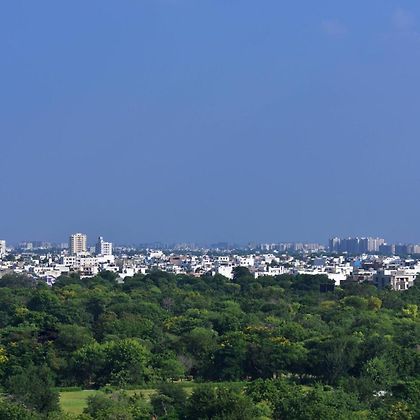
Chandra Mahal or Chandra Niwas is the most commanding building in the City Palace complex, on its west end. It is a seven-storeyed building and each floor has been given a specific name such as the Sukh-Niwas, Ranga-Mandir, Pitam-Niwas, Chabi-Niwas, Shri-Niwas and Mukut-Mandir or Mukut Mahal. It contains many unique paintings, mirror work on walls and floral decorations. At present, most of this palace is the residence of the descendents of the former rulers of Jaipur. Only the ground floor is allowed for visitors where a museum is located that displays carpets, manuscripts and other items that belonged to the royal family. There is beautiful peacock gate at the entry to the Mahal. It has screened balconies and a pavilion at the roof from where a panoramic view of the city can been seen. It is set amidst well laid out gardens and a decorative lake in the foreground.
Also seen at the top of the Chandra Mahal is the flag of the royal family, which is seen unfurled when the Maharaja is in the palace. It is a one and quarter sized flag. However, when the king is away, the queen's flag is hoisted on the building.
Written May 20, 2012
Unfortunately, no photography is allowed here, they are very strict about that. This place is well guarded by the Royal guards,who keep an eye on your camera and your movement. I don't understand the logic behind it but the place is very beautiful , where the King used to meet with other Royalties and British govt officials. The place has 300 years old carpet which is still very beautiful!
The 'Diwan-E-Aam' (Sabha Niwas) or the 'Hall of Public Audience' is an enchanting chamber, with the ceiling painted in rich red and gold colours, which still looks vibrant. It is a major attraction in the Mubarak Mahal courtyard. This chamber, functioning now as an art gallery, has exhibits of exquisite miniature paintings (of Rajastahni, Mughal and Persian art), ancient texts, embroidered rugs, Kashmir shawls and carpets. The ceiling is richly decorated. At present, it is an art gallery showcasing enthralling painted ceilings and rare ancient handwritten original manuscripts of Hindu scriptures (the Hindu holy scripture of the Bhagavad Gita handwritten in tiny script). Also seen in the art gallery is the Golden throne (called as Takth-e-Rawal) that was the seat of the Maharaja during public audience. It was mounted on an elephant or carried by palanquin bearers during the Maharajas visit outside the palace. At the entry gateway to the hall, two large elephants, each made out of single marble rock are on display.
Written May 20, 2012
Address: City Palace , Jaipur.
Diwan-I-Khas was a private audience hall of the Maharajas, a marble floored chamber. It is located between the armoury and the art gallery. There are two huge sterling silver vessels of 1.6 metres (5.2 ft) height and each with capacity of 4000 litres and weighing 340 kilograms (750 lb), on display here. They were made from 14000 melted silver coins without soldering. They are officially recorded by the Guinness Book of World Records as the world's largest sterling silver vessels. These vessels were specially made by Maharaja Sawai Madho Singh II, who was a highly pious Hindu, to carry the water of the Ganges to drink on his trip to England in 1901 (for Edward VII's coronation) as he was finicky about committing religious sin by consuming the English water. Hence, the vessels are named as Gangajelies (Ganges-water urns). There are a number of crystal chandeliers hanging from the ceiling (normally covered with plastic sheets to prevent dust collection), which are uncovered on special occasions
Written May 20, 2012
Please spend some time here to see the Royal Armory displaying weaponry since medieval age to 19th Century. The place has various kinds of swords, khanjars, stilettos, ceremonial swords, various types of guns from the earliest ones to the most modern, pistols, revolvers, smallest double shot pistols, camel guns, carriage guns and what not. A student of history will just be mesmerised to see this place.
The museum also displays a sword presented by Emperor Jahangir , weighing 5 kgs!
Photography is not allowed here too but I managed to take a couple of pictures from the lobby!
Written May 20, 2012
Address: City Palace , Jaipur.
Our guide Mr.Vikram Singh Nathawat took us first to this place, where Royal clothes and Royal used articles are kept. There is a lot you can see and buy the replicas of those articles. I check, the prices are just exorbitant for a small replica knife used by the Sawai Madho Singh. Though photography is not allowed inside but I did manage to take a few pictures before closing the camera.
Mubarak Mahal, meaning the 'Auspicious Palace', was built with a fusion of the Islamic, Rajput and European architectural styles in the late 19th century by Maharaja Madho Singh II as reception centre. It is a museum; a fine repository of variety of textiles such as the royal formal costumes, sanganeri block prints, embroidered shawls, Kashmiri pashminas and silk saris as part of the Maharaja Sawai Man Singh II Museum. A noteworthy display here is of the set of voluminous clothes worn by Sawai Madhosingh I, who was 1.2 metres (3.9 ft) wide and weighed 250 kilograms (550 lb) but interestingly had 108 wives.[
Written May 20, 2012
The city palace is very large but the main tourist area , where tourist are allowed in the following few places mentioned below. Those who are interested to see the Chandra Mahal wll have shell out Rs.2000/- or US$20 per person.
Entrance Gate
Mubarak Mahal
Chandra Mahal
Pitam Niwas Chowk
Diwan-I-Khas
Diwan-I-Aam
Maharani palace
Bhaggi Khana
Govind Dev Ji temple
Updated May 20, 2012
This is the most famous landmark of Jaipur city and still privately run by the Royal family. Perhaps that is why it is still in immaculate condition. They have converted the Palace in a museum under the permission from govt of India. The palace is open to tourists from 9 am to 6.00pm. Entrance fee is Rs.100/- for Indians and rs.250/- for the foreigners. Camera fee Rs.75/- for still camera but you are not allowed to take any picture inside the galleries and museum.
City Palace, Jaipur, which includes the Chandra Mahal and Mubarak Mahal palaces and other buildings, is a palace complex in Jaipur, the capital of the Rajasthan state, India. It was the seat of the Maharaja of Jaipur, the head of the Kachwaha Rajput clan. The Chandra Mahal palace now houses a museum but the greatest part of it is still a royal residence. The palace complex, which is located northeast of the centre of the grid patterned Jaipur city, incorporates an impressive and vast array of courtyards, gardens and buildings. The palace was built between 1729 and 1732, initially by Sawai Jai Singh II, the ruler of Amber. He planned and built the outer walls, and later additions were made by successive rulers right up to the 20th century. The credit for the urban layout of the city and its structures is attributed to two architects namely, Vidyadar Bhattacharya, the chief architect in the royal court and Sir Samuel Swinton Jacob, apart from the Sawai himself who was a keen architectural enthusiast. The architects achieved a fusion of the Shilpa Shastra of Indian architecture with Rajput, Mughal and European styles of architecture.
The palace complex lies in the heart of Jaipur city, to the northeast of the very centre. The site for the palace was located on the site of a royal hunting lodge on a plain land encircled by a rocky hill range, five miles south of Amber (city). The history of the city palace is closely linked with the history of Jaipur city and its rulers, starting with Maharaja Sawai Jai Singh II who ruled from 1699-1744. He is credited with initiating construction of the city complex by building the outer wall of the complex spreading over many acres. Initially, he ruled from his capital at Amber, which lies at a distance of 11 kilometres from Jaipur. He shifted his capital from Amber to Jaipur in 1727 because of an increase in population and increasing water shortage. He planned Jaipur city in six blocks separated by broad avenues, on the classical basis of principals of Vastushastra and other similar classical treatise under the architectural guidance of Vidyadar Bhattacharya, a man who was initially an accounts-clerk in the Amber treasury and later promoted to the office of Chief Architect by the King.
Following Jaisingh's death in 1744, there were internecine wars among the Rajput kings of the region but cordial relations were maintained with the British Raj. Maharaja Ram Singh sided with the British in the Sepoy Mutiny or Uprising of 1857 and established himself with the Imperial rulers. It is to his credit that the city of Jaipur including all of its monuments (including the City Palace) are stucco painted 'Pink' and since then the city has been called the "Pink City". The change in colour scheme was as an honour of hospitality extended to the Prince of Wales (who later became King Edward VII) on his visit. This colour scheme has since then become a trademark of the Jaipur city.
Man Singh II, the adopted son of Maharaja Madho Singh II, was the last Maharaja of Jaipur to rule from the Chandra Mahal palace, in Jaipur. This palace, however, continued to be a residence of the royal family even after the Jaipur kingdom merged with the Indian Union in 1949 (after Indian independence in August 1947) along with other Rajput states of Jodhpur, Jaisalmer and Bikaner.
Updated May 19, 2012
Address: Pink City, Jaipur.
The entrance fee is a it more than the other palaces in Jaipur. You get to see the vehicles used by the queens to go inside the palace, vehicles of the kings, canons, besides the big halls and ornate gateways. We did not engage a guide here and so my information is limited,
There is an instant photo option available where you get to wear turbans or traditional scarf, to get photographed with a backdrop of the palace. Cost of smallest size is 120 rupees. There are other attractive options. Do have a look at this facility.
Written Apr 29, 2012
A rather narrow passage leads one to the Pritam Niwas Chowk where four beautiful gates await you, the prettiest being the Peacock Gate. You are not permitted beyond towards the Chandra Mahal (Moon Palace) as the royal family resides there. Atop this Chandra Mahal, two royal flags will flutter should the royal family be in residence. To the right is the Diwan-i-Am (Public Audience Hall).
Built by Maharaja Sawai Jai Singh II, it consists of the Chandra Mahal, Mubarak Mahal, Mukut Mahal, Maharani's Palace, Shri Govind Dev Temple and the City Palace Museum. A part of the palace is out of bounds for tourists, the part where the royal family still reside.
First Written: Apr. 4, 2012
Updated Apr 4, 2012
Next to the Mubarak Mahal stands the Rajendra Pol with two elephants, chiselled from single pieces of marble, on either side of the entrance. Beyond this lies the Diwan-i-Khas (Private Audience Hall), built sometime around 1730 AD. It is a large hall with plenty of pillars but what interests most visitors are two large silver jars measuring 5 ft. 3 in. each, with a capacity of 8,182 litres. They were used by Maharaja Madho Singh to ferry precious Ganga water when he visited England to witness the coronation of Edward VII.
First Written: Apr. 4, 2012
Written Apr 4, 2012
Sponsored Links
Taj Rambagh Palace Jaipur
4 Reviews and 320 Opinions First Impression - Smartly dressed staff greeted us upon arrival and escorted us to the reception....
Hotel Arya Niwas Jaipur
4 Reviews and 324 Opinions HOTEL ARYA NIWAS, Jaipur Review Hotel Arya Niwas, Jaipur (Behind Amber Towers, Sansar Chandra Road,...
Hotel Pearl Palace Jaipur
3 Reviews and 579 Opinions I had been recommended to stay at Hotel Pearl Palace and as it seems to be a very popular place I...
City Palace tips and photos posted by real travelers and Jaipur locals.
Write a Review
Next to the Mubarak Mahal stands the Rajendra Pol with two elephants, chiselled from single pieces of marble, on either side of the entrance. Beyond this lies...
95 members live in Jaipur
Q: does anyone know how long does it roughly take to get the 'entry' visa for india take? im from ireland? cheers

A: hi i am going india to at the end of november and im from the UK. you can get the visa in 5 days through postal ways. get the form from the post office or download it...
Read 5 Replies
1

Jaipur is the largest city in Rajasthan and also part of the Golden Triangle which also takes in the cities of Delhi and Agra. There are several palaces and forts which pay homage to the past ruling...
2
Jaipur, the pink city of Rajasthan

Jaipur is in the middle of the golden triangle of the indian tourism which includes Delhi, Agra and indeed, Jaipur. This very impressing city isn’t really big, but is fullfilled of important sites......
3
The Pink City, Rajasthan's sunny capital

The city of Jaipur has long been associated with Indian royalty. Mulgal kings and Hindu Rulers have both considered Jaipur to be a focal point of their rule(s). Jaipur is also considered to be part of...
4
Jaipur-The City of Palaces,Forts&Gardens

Jaipur is first well planned city in India,only the walled city is Pink color. Its capital of Rajasthan state.Famous for Palaces, forts,beautiful gardens&shopping for jewellery.258 km from Delhi.Delhi...
5

I've got some interesting experiences in Jaipur. I'd love to share with you the 15 tips I've written, the 81 photos uploaded, and 6 travelogues I've created.
Build your own Jaipur page
Sponsored Links