They believe that once you die in Varanasi (Benares, Kashi), your soul gets free from the samsara - the reincarnation cycle, you can reach the nirvana and do not have to try and try all over again in the next life to get better. So that gives a religious Hindu a good reason to want to pass away in Varanasi. There are nearly 100 ghats - it means places, where you can perform your rituals - and each ghat is provided with a house for the local people coming from different parts of India, some built even 250 years ago by wealthy families and maharajas. The ghats are mainly dedicated to different states or parts of India and some of them still provide accommodation for their pilgrim devotees. As it is capitalism in India, it totally depends on the ones administrating each ghat, whether there is a fee for those "hotels" and how much it should be. The religious people come to perform different rituals of their life and the death is the last one of them, except that you do not perform it on your own, but mostly the male members of you family do it instead of you... Women "do not prefer" to attend the cremation ceremony, because "they tend to get emotional" and that would do no good to the soul leaving for nirvana. So long, see you in next life if you're not dying in Varanasi :)
The main thing which you go to visit Varanasi for is it's spiritual feeling, the great hindu rituals and customs, cremations, prayers, the sunsets and sunrises at the bank of Mother Ganges welcoming the god of sun Surya or giving thanks to the river godess Ganges, praising all the different gods of hinduism... Surrounded by hundreds and thousands of pilgrims. As the first feeling smashes your head with all the humming mantras ans singing and flower offerings and smells, all the poverty of beggars and yet the beauty of the colours you see... either you hold your breath back or you take it really deep.
But after a while, sitting in the pram on the river you notice that you are surrounded by a majority of foreign tourists with their flashing cameras and all the priests performing the night Aarti (ceremony) seem to be just above 20 years old. Or let's say young :) So you might wonder - is this for real? Or is it just a tourist trap? YES, IT IS for real and they would keep on doing this night and morning aarti even if no tourists came. There is no entrance fee for this breath taking "show". And the age of the priests is simply explained by a comparison to our Christian countries - we either do not have only elder priests.
In India, being a priest is a regular profession, supposing you have been born to the right family of the Brahmin cast. Kids are sent to schools - ashrams - at a young age and when they finish their degree, they can become priests. Some priests are freelancers, sitting on the bank of the river, waiting under an umbrella for their customers - religious people, who come to the city of lights Kashi to perform one of their important hindu rituals at the bank of the Ganges. The priest guides his client through the ritual, so there would be no mistake done an the ritual is valid in front of the gods. You can also find a different kind of freelancers on the ghats - barbers, beggars, fake Sadhus (aka the ascetic holy men), offering sellers (typically in an incarnation of a small kid with flowers)... All together it is magical, spiritual, a bit disturbing, mostly the beggar part and the cremation ghat Manikarnika. I'll write some more on Varanasi later on, i enjoy very much walking through the narrow lanes and the markets...
We were walking back to our hotel late one afternoon, and saw a dead cow, which had fallen off a ghat. Now this is not so unusual, but what stopped us in our tracks was what was happening.....there was a crowd of Hindus, with a priest, and they were having funeral prayers for the cow....and preparing it for cremation. It was bedecked in flowers. This is testament to the faith & respect that Hindus show to all living things.Particuarly cows.
There is often interaction between humans and animals in India. Monkeys are revered and protected because Hanuman is the 'Monkey God' They unfortunately also create mischief, stealing fruit from markets and grabbing clothes that are laid out on rooftops to dry.
Ganesh is the God of Health Wealth and Happiness- and is represented by an Elephant. Every home has a shrine (or depication) of Ganesh.
Bhang, like hashish, is a preparation of cannabis (both buds and flowers) that for some reason is government authorised. There are many outlets in which you can procure the substance, in either baked form or lassi (most guesthouses will whip one up for you, calling it a 'special lassi'). I find a store in town and start things off with a Bhang lassi. Although I am promised it will taste like a milkshake, it tastes more like clumps of dirt mixed with salted milk. It is absolutely disgusting, but the ominous shade of green is at least promising.
Not satisfied with the gross green shake, I decide to try a cookie as well, and am delighted to find that the baked goods come with a government authorised stamp - my type of souvenir! Despite being packed to the brim with bhang, the cookie itself is actually quite sweet. It's somewhere between shortbread and sugar cookie. The stores attract a lot of hustlers, trying to sell everything from opium to magic mushrooms, but I'll stick with the green stuff for today. Indian policeman look fierce, and clutch AK-47s with a casual elegance - talk about intimidating!
About two hours later, I stumble out of the cinema, feeling full the effects of mixing together both bhang products. I hail the first tuk-tuk that appears, and don't even bother to negotiate a price. I hand him the hotel card, and do my best to keep from passing out in the backseat. When I fail to do so, the potholes in the road and screeching halts common with Indian road conditions, jolt me back into reality head-first. Even though I am dropped off right next to my hotel, I still manage to wander off and get lost in the dark streets of the old city. I'm not sure if there's been a power cut, or if my eyes are just failing me when I need them most.
Bhang is fun, but don't mix the two. Either/Or should be the rule, and my bet is to go with the cookie - it doesn't even taste awful =P
I should probably make it clear at the beginning that according to the law in India, it is illegal to grow, consume or traffic cannibis.
However. This law is rarely enforced, at least for locals, and the use of it is common throughout India, particularly at Holi. There are even government licensed bhang shops in some regions.
There is a bhang shop just back from Manikarnika Ghat (the main burning ghat) - it says government licensed, but it's hard to be sure about it. A ball of bhang (a dark green, moist and sticky preparation of cannabis leaves and buds) about the size of a golf ball, that would probably be enough for about 8-10 people, costs the princely sum of 6 rupees. Yes. SIX. Now I know why the saddhus are always high!
A warning though - if you are planning to indulge, it would probably be advisable to do so in the relative safety of your hotel room. The ghats and backstreets are hard enough to navigate even without the effects of bhang, especially at night.
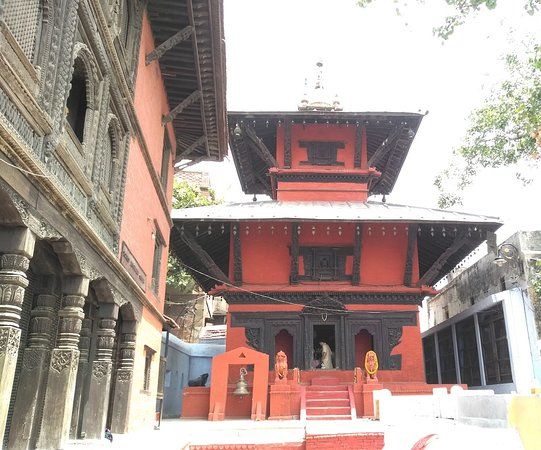
There are shrines next to (and often in) trees all over Varanasi, and indeed India. We spotted this one on emerging from one of the galis somewhere not far from Scindhia Ghat. Notice the little steps leading up to it, and the platform around it so that it can be circumambulated. The shrine itself seemed to be small lingam, therefore is probably associated with Shiva worship.
The walls of the ghats and the galis are covered with paintings, many of which are obviously just advertisements for hotels, restaurants and shops, but some are of gods and goddesses, like this beautiful one of Ganga riding a crocodile.
Because Varanasi is considered the best and most holy place in India to come to die, the backstreets behind the ghats are filled with houses for the dying, and during any walk through the galis it is almost impossible to avoid a funeral procession. Corpses, shrouded and covered with bright gold and red tinselled cloth, are borne on bamboo stretchers by chanting men... Ram Nam Satya Hai become familiar words.
A sadhu ('good man' in Sanskrit) is usually a Hindu who has given up the worldly life to practice ascetism and meditation, often as part of a wandering lifestyle although they sometimes live in temples and ashrams, huts or even caves. They frequently wear garments of orange, the Hindu holy colour, although many wear little, and some wear nothing at all (known as going 'skyclad')! They often have long beards, and long unkempt (frequently dreadlocked) hair. Some cover their bodies in ash, giving their skin a greyish hue, and many paint their faces, particularly the forehead, with symbols of their chosen god. Some may carry swords or tridents, also symbolic, and they can frequently be seen smoking hashish.
There are many genuine, devout, sadhus, however in Varanasi as in many other places in India there are people posing as sadhus as a way to make money, especially from tourists. I personally decided that any sadhu who offered to pose for a photo in exchange for cash wasn't genuine, and it was noticeable that many of these were the more lavishly dressed type.
I was in two minds as to whether to put this tip in the warning/danger category, as it can be a bit of a hazard to navigate around! Groups of boys and young men regularly play lengthy games of cricket on the ghats, particularly on a slightly more level area between Dasaswamedh and Manikarnika Ghats.
Sponsored Links
Sponsored Links
Comments