The "Gedong Songo" Hindu temple complex is among the most ancient in Java. They are thought to have been built between 730 and 780 AD by the Sanjaya dynasty, which probably also built the temples on the Dieng plateau.
Gedong Songo is Javanese for Nine (songo) Stone Buildings (gedong). Since Theo visited the site for the first time in 1971 he has been puzzled by the number nine. Then as now the round walk counted five locations, and these are locations of temple groups. So that if you count the temples seperately there are many more than nine.
The leaflet in somewhat poor English which they now hand out to foreign visitors states that the remains of the temples were discovered in 1740, and that in the time of Raffles it was named "Gedong Pitoe" meaning Seven Stone Buildings. Other sources suggest that people settled for the name Gedong Songo because nine is a special number in Javanese lore.
The Archeological Park is very popular for a day outing, not so much for the temples as for the location. The temples lie on the southern slope of dormant Ungaran volcano (2050 m) at a height of 1250 to 1300 m. When the weather permits, looking south one has a great view of Telemoyo (1893 m) and Merbabu (3142 m) mountains, which practically lie on one line. An additional attraction are remnants of volcanic activity and a hot spring half way on the the temple trail.
Round walk
Best plan your visit on a working day, if you do not want to share it with crowds of local sightseers.
Although the round walk is only 2.5 km long, you better count on 1.5 to 2 hours doing it at your leasure with stops at all five temple sites. The path is concrete paved throughout, and the five sites are well indicated. If you think the walk may be too strenuous, you can make it on horseback for Rp 75,000 (2010).
The first site with only one building lies very close to the entrance. But then the hard part begins, a pretty steep ascent to the second site at 1274 m above sea level. This site counts one restored building and another one just some rubble. For the next site one has to cross a small ravine before climbing up to 1297 m. Here are three restored buildings, with evidence that there have been more. The main building at site III is the most interesting of all, because it still features the full set of five statues in niches in the walls: Mahakala, Nandisvara, Durga, Ganesha and Agastya.
From the third site the main path leads down into a crevice with fumaroles and hot spring. Before going there, walk another 100 m uphill along an earthen path to see the statue of Hanuman among the pine trees. Hanuman the white monkey chief is one of the heroes in the Ramayana epos. Why his statue stands here and whether there is any connection with the temples, no one knows........
The fourth site, at 1295 m on the other side of the crevice, actually consists of three groups of temples close together. The main group consisted of eight buildings, but only one has been restored. Two smaller ones in the second group have been restored in 2009 while of the third group only rubble can be seen.
If you come on horseback, you still have to do the fifth and last site on your own legs, because horses cannot negotiate the stairs leading up to it at 1308 m. This group of temples lay spread out over two terraces, just one temple has been restored and still has the Ganesha statue in its east wall.
From site V the path goes zigzagging down. Halfway you can climb up a hill with gazebo for the best views south and east. Finally, like at Borobudur and Prambanan, before leaving the park one is directed through a maze of souvenir and food stalls, most of which are empty on working days.
Entrance: Local Rp 5,000, foreign Rp 25,000 (more on holidays?). Ask for a map of the park in case they forget to give it.
Parking: Car Rp 3000, motorcyle Rp 2000.
Directions: 28 km from Salatiga, a 50 min drive by car with the usual traffic. By public transport one can take a local bus to Ambarawa (16 km), then a minibus to Bandungan (6.5 km) and another one to the turnoff to the Gedong Songo site (3 km). From there it is a 2.3 km walk or ojek ride uphill. People also offer a ride on horseback all the way from Bandungan.
Updated Dec 25, 2011
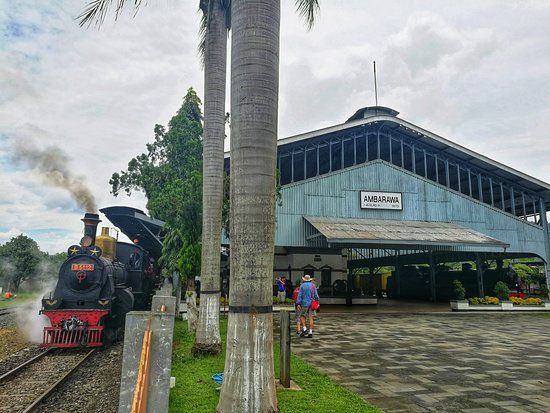
A must for steam-loc fans! The museum boasts 21 retired steam locs, the oldest one a Hartmann Chemnitz of 1891. Better still, there are two wood-powered locs in operation, featuring a pinion to negotiate steep slopes. You may charter a train for up to 80 people (two carriages) to bring you 9 km uphill (as steep as 6%) to Bedono and back, for just Rp 7,500,000 (2011 price). If you are not that many, seek to meet the deputy station master, mr Haryono. For Rp 100,000 per person he will give you a ticket on a charter trip where there are places left! See travelogue Ambarawa tourist train.
Ambarawa railway station, at an elevation of +474 m, was inaugurated in 1873 and closed in 1976, when it was decided to turn it into a museum. At the time it was rather derelict, but now it has been restored quite nicely and equipped to handle local sightseers who flock here on public holidays. If you want to avoid these, come during an ordinary weekday (consult the calender on our home page). On holidays a diesel-powered train for sightseers goes as far as neighbouring Tuntang station, fare Rp 15,000 (2011 price).
Entrance fee is Rp 5000 (2011).
Updated Jun 1, 2011
Address: Museum Kereta Api, Jalan Stasiun #1, Ambarawa
Phone: +62.298.591035
In colonial times, the nearest you could get to Salatiga by rail was Tuntang. From there you had to ride the last 9 km by car, horse-drawn carriage or the ESTO bus (ESTO = Eerste Salatiga Transport Onderneming = First Salatiga Transport Company). The ESTO buses are still going strong between Salatiga and Ambarawa. But the only trains still stopping at Tuntang railway station are the tourist ones coming the short distance from Ambarawa railway museum on holidays.
The colonial building has been well restored, but is mainly empty. Adjacent you find houses formerly in use by railway employees, numbered PJKA 1, PJKA 2 etc. (PJKA is short for the Indonesian Railway Company).
July 2010 breaking news: They are reconstructing the railway from Tuntang eastwards, which has been deserted since 1975. In the near future the touristic trains from Ambarawa Railway Museum will take you to Jelok power station and the nearby Goa Maria (Maria Cave).
Updated Aug 7, 2010
Address: Tuntang village
how if there's no quota to charter an old train to have nostalgic trip in ambarawa train museum? the operator offer this small diesel lorry to direction ngampin and jambu. about 10 - 20 km away. it's fun and the children love to try :)
Written Apr 25, 2006
Address: ambarawa train museum
the nostalgic train trip ending at bedono train station and from this point the loco bring us back to ambarawa train museum. i like this old small station that not be used anymore. all in white and green colour. we stop here just about 10 minutes before heading back to ambarawa.
Written Apr 25, 2006
Address: bedono, few km from ambarawa
no matter it's a cloudy day or sunshine day, along the way from ambarawa train station to bedono with the old train will be great. greenery padi fields with mountaineous range in the distance make the trip very pleasant. i still can remember my friends' sounds "owwww, so sweeeet" or "ahhhh, very good landscape!!" everytime they look outside the windows.
Written Apr 25, 2006
Address: ambarawa old train
although the train line has closed, this museum have attraction to operate a cr-56 I. a steam loco made-in 1907, 3rd class rack track coach with wooden carriages. make it like a nostalgic trip about 1.5 hours enroute ambarawa-ngampin-jambu-bedono with scenic views along the way. the operator said, many senior travelers, both locals and foreigners like to try this attraction.
by this time writing, for charter is about idr 2,5 million for up to 100 passengers. you'll be lucky if you can collect visitors in the area with the same aim: trying an old train :) ask few days in advance to the train station.
Updated Apr 25, 2006
Address: museum kereta ambarawa
Phone: (62-298) 91035
also known as koening willem I spoorweg, opened in 1873 and now became an exhibition place for steam locomotives built between 1891 - 1928.
the most historical item that touched me much .... here's 'laying' "hell carriages" [gerbong maut in my lingo]. carriages that brings indonesian heroes in the dutch occupancy and let them die inside. my condolences goes to their families who left behind .....
Written Apr 25, 2006
Address: stasiun kereta api ambarawa
can not stop smiling whenever reading the signboard "welcome to bukit cinta, rawa pening". why? since "bukit cinta" means love hill in my lingo. absolutely this is a modern - newly name, not something ancient that i like to pronounce it :) but oh well, doesn't matter .... the scenery is nice after the mist roll-out in early morning. also a good object for photography. heading to the lake of rawa pening.
Written Apr 25, 2006
Address: bukit cinta, rawa pening
all of the locomotives located in open air museum of ambarawa train station museum. entrance fee idr2,500
Written Apr 25, 2006
Address: museum kereta api ambarawa
Reviews and photos of Ambarawa attractions posted by real travelers and locals. The best tips for Ambarawa sightseeing.

all of the locomotives located in open air museum of ambarawa train station museum. entrance fee idr2,500
2 members live in Ambarawa
Our members can help!
1
Ambarawa, Bandungan and Ungaran mountain

Ambarawa is a small town at 17 km from Salatiga along the main road. The slow buses of the pre-war bus company ESTO (Dutch: Eerste Salatiga Transport Onderneming = First Salatiga Transport Company)......
2
train is forever and sunrise over the lake

"ambarawa just 2.5 hours from jogjakarta. here in the museum, seems time standing still. the station will showing you 21 loco which already served in honor for the army of the republic of indonesia....
3

I've got some interesting experiences in Ambarawa. I'd love to share with you the 1 tip I've written, the 2 photos uploaded, and 0 travelogues I've created.
4
Ambarawa Fort Willem for a special reason

We went to Ambarawa for a special reason. My father, as a young boy, was kept prisoned here in an camp for the Dutch people, guarded by the Japanese militairs. That was 60 years ago, now he wanted to...
5
Ambarawa...a small town which i loved...

oops...again and again no pic avalaible. be patience... sOme Day i will upload my all pic i have... oke we cont.,, from Semarang - Java of course, you need waste your time for 30 min along, go to......
Build your own Ambarawa page