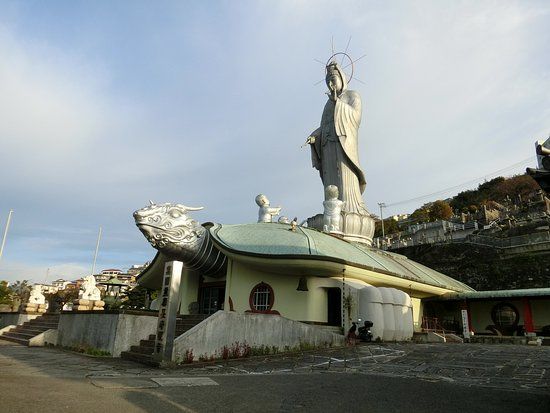
Perched atop a hill at the entrance to Nagasaki Port is a church constructed in 1897 welcoming
foreign ships to what was once a Christian town. Near the location of the church down below it is
a statue of Our Lady on the Cape.
2-148 Kaminoshimamachi, Nagasaki City
Written Nov 5, 2011
Phone: 095-865-1028
Sometime during your visit you should take some time to walk the city and see the daily life. One place worth going is the cemetery on the mountain side. The higher you go on the hill, the older the graves become, with their etchings, stone work and style. But also, the higher you go, the better aerial view of the city you gain. If memory serves me correctly, the graveyard that we walked was on the eastern side of the city, facing the west.
Updated Jan 31, 2008
It is estimated that there were about 70,000 and 20,000 Korean people living in Nagasaki-ken and Nagasaki city area, respectively.
According to research by Nagasaki City, about 12,000 of those people were exposed to the atomic bomb explosion on August 9, 1945.
On the rear of the monument is the inscription: “For the Koreans who were brought to Japan against their will and exposed to the atomic bombing while engaged in hard labor, and for their bereaved families. August 9, 1979”
Written Jun 5, 2007
In ancient Greece, all warfare was suspended and a sacred fire lit during the Olympic Game held every four years.
As a result, the Olympic Flame came to be regarded as a symbol of peace.
In August 1983, with the cooperation of government of Greece, a torch was lit from the sacred fire in Olympic and brought to Nagasaki, the last place on Earth to suffer the horror of nuclear destruction.
It was highly unusual for the Olympic Flame to be carries overseas for reasons other than the Olympic Games.
In 1987, a tower to enshrine and protected the Olympic Flame was built through efforts by local citizens, who pledge to keep the flame burning “until all nuclear weapons are eliminated worldwide”
The monument is imbued with the pledge that, as long as this flame is burning as a symbol of peace, nuclear war will never occur and Nagasaki will remain the last place to suffer the horror of nuclear destruction.
The wall around the tower is embellished with roof tile fragments exposed to heat of atomic bombing as well as ceramic plaques carrying peace message.
Written Jun 5, 2007
The damaged Torii ( stone archway on the path to a Shrine ) by the atomic bombing is located about 800 m southeast of Ground Zero.
The pillar and beams on the side near Ground Zero were slapped down by the blast, leaving only half of the structure standing.
This strange damage was caused by exposure to a brief but tremendous blast stone.
The blast wind shifted the beam at the top of Torii, grazed the surface of pillar facing Ground Zero and erased the names of donators that had been engraved there.
One of the few relics of the atomic wasteland still standing on its original site, this Torii speaks silently of the awesome power generated by the atomic bomb explosion.
[Back to Nagasaki-City]
Written Jun 4, 2007
At the bottom of the steps leading down from the front of the Nagasaki Atomic Bomb Museum in Nagasaki Peace Memorial Park is “Monument of a Child Praying for Peace” depicting a girl wearing a kimono and holding a folded paper crane.
At that time of the atomic bombing there were several schools in the Ground Zero area and some 10,000 school children are through to have perished in the bombing.
On the 20th anniversary of the atomic bombing, donations were collected widely from children who express their wish for peace, and this statue was unveiled on August 9, 1967 and remains to this day as a symbol the aspiration for eternal peace.
[Back to Nagasaki-City]
Direction : A 10 minute walk from Matsuyama Tram Station
Updated Jun 4, 2007
Atomic Bomb Museum was opened in April 1996 as part of the 50th anniversary project for the Nagasaki atomic bombing.
The museum replaced Nagasaki International Cultural Hall, where a number of artifacts related to the atomic bombing were exhibited.
In addition to these artifacts, the museum exhibits a number of photograph that depict the devastation caused by atomic bomb showing the lead-up to this tragic day, the history of the development of nuclear arms and our desire for peace.
[Back to Nagasaki-City]
Direction : A 10 minute walk from Matsuyama Tram Station
Admission fee : 200 yen
Opening hour : 8:30am to 5:30pm
Updated Jun 4, 2007
Phone: 095-844-1231
When you look to the right facing the Ground zero Monument see a section of damaged brick wall from the former Urakami Cathedral.
The church was located about 500 m northeast of the Ground zero, on the same site as the modern refurbished Urakami Cathedral.
The construction of former building began in 1895 and continued until 1925, when the twin steeples reached completion.
Known at that time as the largest church in Orient, the imposing red-brick structure was devastated by the atomic bomb explosion, and a large number of parishioners were killed.
In 1958, part of the damaged eleven-meter-tall southern wall was moved to Nagasaki Peace Memorial Park.
[Back to Nagasaki-City]
Address: Matsuyama-machi Nagasaki-city
Directions: - A 5 minute walk from Matsuyama-mach Tram station
Updated Jun 4, 2007
Phone: 095-829-1171
With the completion of the Peace Fountain on August 3, 1969, a monument inscribed with an epitaph was constructed in Nagasaki Peace Memorial Park.
The Pease Fountain reminds us of tragic scene unfolded shortly after the atomic bomb on Nagasaki at 11:02 am on Aug 09, 1945.
Many people were burned deeply and died, crying and groaning for water.
When people recovered their peaceful life in 1965, a campaign for a Peace Fountain was launched.
Recorded on monument are the names of the founders including the People’s Congress for Prohibition of Nuclear Weapons and Promotion of Peace and Committee for the Construction of Peace Fountain.
Part of the epitaph reads as follows:
To those who visit this peace today: May you offer prayers to console the souls of those killed and to promote peace.
[Back to Nagasaki-City]
Address: Matsuyama-machi Nagasaki-city
Direction: A 10 minute walk from the Tram Matsuyama-machi Station.
Updated Jun 4, 2007
Phone: 095-829-1171
Nagasaki Prefectural Art Museum was opened in 2005 and is located in a corner of Nagasaki Seaside Park.
It is a new type of museum which not only exhibits works of art, but also holds various events whilst acting as a base for lifelong learning.
The museum also has a café and museum shop.
Written Jun 3, 2007
Sponsored Links
1 Review and 20 Opinions We found the location to be close to Nagasaki station and close to the bus terminal drop off point. ...
1 Review and 0 Opinions 4000 yen/night(excl tax) Toilet and shower room are outside room. Beautiful view of Urakami...
1 Review and 1 Opinions This hostel is conveniently located close to JR Nagasaki Station. The cost is 2800 yen per night....
Reviews and photos of Nagasaki attractions posted by real travelers and locals. The best tips for Nagasaki sightseeing.

Nagasaki Prefectural Art Museum was opened in 2005 and is located in a corner of Nagasaki Seaside Park.It is a new type of museum which not only exhibits works...
4 members live in Nagasaki

Q: Hello, We will visit Nagasaki by ship, and was wondering if the cruise ship terminal is very far from the city centre of Nagasaki....

A: The cruise ship should be arriving at the southern edge of Downtown Nagasaki, if my research was correct. It isn't quite close enough to walk everywhere for many people,...
Read 5 Replies
1
Nagasaki, is the most beautiful port town in Japan

Nagasaki has opened its door to overseas such as Portugal, Dutch as well as Chine since old days, so a lot of historical and cultural assets still remain in the city.
2

Nagasaki has an early history of Chinese and Western influences because of its position as a southern port of Japan in the island of Kyushu. After 1641 when Japan went into self-imposed isolation,...
3

Opened by the Portuguese in 1571, Nagasaki flourished as a busy trading port and center for Christian missionary activities. In 1641, after the adoption of a national ban on Christianity and the...
4

Do you ever heard about Nagasaki? I think so, when we study the history and World War II, Nagasaki is one of two cities that was destroyed by atomic bomb. Actually I don't know how the building there...
5

On our recent visit to kyushu we were based in Fukuoka but bought a three day Northern Kyushu rail pass for 7000 yen and visited Nagasaki for the day. Nagasaki has a long and interesting history. It...
Build your own Nagasaki page
Sponsored Links