Ayutthaya was founded in 1350 and was the second capital of Thailand after Sukhothai for 417 years during which time it was a very prosperous Kingdom. In 1767 the city was attacked and burnt down by the Burmese army forcing the people living there to abandon the city.
Ayutthaya was never rebuilt and the area has been declared a UNESCO World Heritage Site since 1981.
We had booked a day tour to Ayutthaya from Bangkok which included a cruise and lunch with Grand Pearl cruises along the Chao Praya River. First thing I will say is everything we did was fantastic but there is just not enough time to fully see the ruins of the Ancient City of Ayutthaya.
We were on a join in tour and it was so rushed with spending so much time at Bang Pa-In Palace that we hardly had anytime looking around Ayutthaya. So I would suggest not doing a tour that includes the Palace or the Cruise on the way back.
Go there yourself, Ayutthaya is only 76 kilometers north of Bangkok, so you can look around and stay as long as you like as there is just so much to see and do in the area.
This will be a multi part tip of the assorted sights around the Ayuthya Historical Park.
Wat Phra Si Sanphet was built in the early 14th century by the Ayuthaya Thai Kings, The Wats were made from Ceylonese style (present day Sri Lanka) pagodas were built during the 15th century to enshrine the ashes of three Ayutthaya kings. The Wat also was rumored to have which once contained a 16m standing Buddha that was covered in 250 kg of gold. Unfortunately the Burmese conquerors felt sacked the place and melt down the golden buddha.
The architecture of Ayutthaya is a fascinating mix of Khmer (ancient Cambodian style) and early Sukhothai style. Some cactus-shaped obelisks, called prangs, denote Khmer influence and look something like the famous towers of Angkor Wat. The more pointed stupas are ascribed to the Sukhothai influence. For new arrivals who had limited their visit to Bangkok, similarities may be noted with the riverside Wat Arun, an 18th-century structure that was built in the so-called Ayutthaya style, a melding of Sukhothai Buddhist influences and Hindu-inspired Khmer motifs.
Entrance fee to the wat is 30 baht and is opened from 9:00 am to 5:00 pm everyday
The city is located at the junction of the Chao Phraya, Lopburi and Pa Sak rivers, and on the main north-south railway linking Chiang Mai to Bangkok. The old city is on an island formed by a bend of the Chao Phraya on the west and south sides, the Pa Sak on the east side and, on the northern side, the Klong Maung canal. Serving as the Thai capital for 417 years (1350 1767: Kingdom of Ayutthaya), it was once glorified as one of the biggest cities in Southeast Asia. During the 17th century Today, there are but groups of crumbling ruins and rows of headless Buddhas where once an empire thrived.
At the Ayuthaya City Center, before entering the Wat Si San Pet area, you will see a small wat, called Viharn Phra Mongkolbophit. It is located just before the entrance to the destroyed Wat Phra Si Sanpet. The entrance is free and it is a buddhist shrine so you must remove your sandals and shoes before entering it as a sign of respect. There is a large Bronze sitting buddha inside which originally stood outside the gates of the Grand Palace here of the Ayuthaya Kings. The bronze image had previously been damaged by lightening and was restored in the Rama V period and was restored by the late thai field marshal phibun.
If Wat Pho in Bangkok has a golden reclining buddha, Ayuthaya has a brick and mortar Reclining Buddha at the Ayuthaya Historical park, located at the Wat Lokayasutha Ayutthaya. The size of the reclining buddha here is smaller at 36 meter as compared to the 46 meters at wat pho. It is known as Phra Buddhasaiyart, The area at ground level beneath the head is covered in tiny squares of gold-leaf which have been paced there by local people and buddhist tourists offerings . Flowers and incense are also presented as offerings. Phra Buddhasaiyart has been restored on a number of occasions in modern times. Most recently, the flooding of late 2011
There are a few wat mahathats around thailand but the most famous of them all and is onb the post cards and fridge magnets of thailand is the wat mahathat in Ayuthaya as it has the famous head of the buddha enclosed by a banyan tree. Wat Maha That at was a royal monastery and the spiritual center of the city and was built in 1374. Wat Maha That was restored and remodeled many times in the later Ayutthaya period, until it finally collapsed in 1904. There are many ruins and structures around the wat that is of the ayuthaya and old sukhotai and a bit of khmer style.
Opens: 9:00 am to 5:00 pm everyday
admision is 25 baht per person at the ticket counter
This wat is surprisingly one of the few structures in Ayuthaya that were not destroyed by the Burmese Army during the fall of the Ayuthaya Empire. In fact the Burmese used the location from which to fire canon into the fortified City. Originally it was called Wat Phra Meru Rachikaram and was constructed about 1503 during the reign of King Ramathibodi. The things to see inside are the Main Ordination hall and the smaller shrine to a Mon Buddha. In 1835 and again in 1838 it was renovated during the reign of Rama 111 of the Bangkok Chakry dynasty. Accordingly the art, structures and decorations are of different styles.
opens: 6:00 am to 6:00 pm everyday
admission is free
The architecture of Ayutthaya is a fascinating mix of Khmer (ancient Cambodian style) and early Sukhothai style. Some cactus-shaped obelisks, called prangs, denote Khmer influence and look something like the famous towers of Angkor Wat. The more pointed stupas are ascribed to the Sukhothai influence. This wat is the most famous of all the Wats at Ayuthaya.
Ayuthaya's scattered temples and ruins have been declared a World Heritage Site and among the most popular to visit is the Wat Chai Watthanaram. This temple was built by the builder of the Summer Palace at Bang Pa In, King Prasatthong in 1630 A.D. as a royal monastery for himself and his descendants. This king was previously a commoner (her mother was a commoner), in charge of military affairs. It is believed that he built this wat to legitimise his status. It was used for religious rites as well as a cremation site. The wat consiss of a principal prang standing 35 metres high on an elevated terrace (built using khmer style, which was popular to use during those times) with four smaller prangs on each corner of the terrace. There is a gallery or verandah marking off the area of the main prang. There are eight more prang in the gallery area which contain the remains of twelve crowned Buddha images and on the outside walls, stucco decoration depicting scenes from the life of Buddha.
Only 70 kilometers north of Bangkok, Ayutthaya is a UNESCO World Heritage Site that is well worth a day trip. King U-Thong founded the city in 1350 and, at that time, was the capital of the Ayutthaya Kingdom. A bustling heart of commerce in its heyday, Ayutthaya was destroyed by the Burmese in 1767 and now serves as a modern-day historical center. Magnificent ruins dot the landscape, open to the exploration of visitors from all over Thailand and the world. The city is easily accessible by train or bus from Bangkok and, once there, a bicycle tour is probably the best bet for getting between the most notable sites.
Day trip Ayuthaya
For a good day trip, head north to Ayuthaya.
If you have three quarters of a day to spare and are interested in seeing the ancient capital of Thailand you can consider a day trip north on the train to Ayuthaya.
The city was sacked by the Burmese in 1767 after being the capital of the kingdom since 1350. As a result it is now a collection of ruins spread over about 10 square kilometres with a town of 40,000 people inside it.
Transport to Ayutthaya
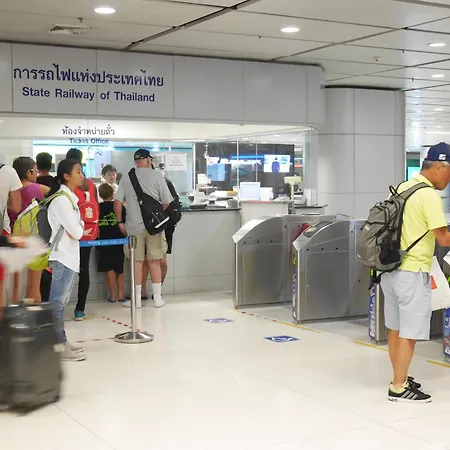
To get there , I caught the train from the main train station HuaLampong which is at one end of the subway system. After getting off the subway, you walk about 5 minutes through an underground walkway to escalators, which take you up to the main rail station for Bangkok. Here trains leave to the provincial areas. It is a large station , air-conditioned and with a tourist desk to help you find where you get your tickets etc. I was directed to the counter and paid 15 Baht for the one and half hour train ride (third class) to Ayuthaya. There are first and second class trains which are air conditioned, but I found the third class train OK, seats were soft, windows open and they had toilets but I did not use. Enterprising people ride the train selling cold drinks and snacks.
Getting Around
When you get to Ayuthaya station you climb down from the train and are approached by Tuk Tuk drivers wanting you to book them for the day. There is a board setting out the Tuk Tuk rates which helps but they want 300 baht per hour which I though was a bit steep. Also, the TukTuks are not as comfortable as Bangkok , but rather mini cattle trucks where you sit on benches side on, it makes looking around a bit difficult. Paying by the hour also means you want to rush through the ruins as the meter is ticking. If there are more than two of you, this may be the best way to go but if you are on your own or with one other, I recommend hiring a motorbike taxi and negotiating each ride to each site. Alternatively hire a Tuk Tuk to each site and pay him off each time.
So, what to see.
There are ruins everywhere around the town and they can get a bit repetitive if you want to do all of them. On the half day trip you will get to see 4 or 5 of the better ones.
First on the list should be Wat Phra Si Sanphet. As this is the largest and most elaborate of the temple ruins to see. Cost for entry to this and most of the other ruins is 30 Baht. The Tuk Tuk I took (excuse homonyms), dropped me off at the back and you should plan to walk out the front. This was the Royal palace from 1350 to 1448. After having a look around (minimum 30 minutes) there are many stalls for tourists if you want to have a wander. You can walk down a long wide path from this ruin to a busy front entrance where tuk tusk and motorbike taxis are waiting. I walked across the road past tourists seeing the sights on elephants to
Wat Pra Ram
Another B20 entrance and interesting to wander around for 15 minutes but don’t go out of your way to get to it.
Next , head to Wat Mahathat.Built in 1374 here you can see a large number of Buddha statues and a key photo point is the Buddha head embedded in a tree. Also of interest here is the walk in stupa and the variety of stupa which can be seen. The ‘corn cob’or rounded top ones are Khmer style Stupa, the pointy ones are either Sri Lankan Prang (round base and round all the way up) or Thai Chedi (square base and round from the base up. All three styles can be seen here.
Next head north to Wat Na Phra Meru. This is more of an in-tact temple which survived the sacking by the Burmese, the chapel houses a rare 8 meter by 4.4 meter statue of Buddha as a prince in royal robes before he was enlightened. You can take photos inside this temple and be sure to look into the very little chapel next to it. Finally have a quick look at Wat Lokayasutharam- a huge reclining Buddha in the same pose as the one at Wat Po in Bangkok but larger. The authorities wanted to house it to protect it but the locals said no as this was the form it was in and they thought the tourists prefer it this way. The locals arrange to clothe it in the massive saffron robe you will see over it
Phom Phet Fortress- a small ruin of a fortress on the river , takes 5 minutes to see and not really worth it
There are many , man other ruins to explore but this made for a full day by the time I got back to Bangkok.
Read more: http://forum.virtualtourist.com/forum-1445238-1-Travel-Bangkok-1-forum.html#ixzz1Jg7hfJzv
The cruise we went on was run by Manohra Cruises and we spent 2 nights on board the converted rice barge, the Manohra Song. It was a big highlight of the holiday for us and I’d definitely recommend it for anyone who’s thinking of spending a week or so in Bangkok. The boat was lovely and the crew couldn’t do enough for us. The food was amazing, in both quality and sheer quantity – breakfast, lunch, afternoon tea and dinner were all freshly prepared on board by the boat's chef.
We also had our own personal guide who accompanied us around all the different places we visited along the way and her knowledge of Thai history and culture really helped to bring each one alive for us. I’ve never really been keen on guided tours in the past, but her stories, descriptions and the little songs she sang to us made the trip so much more interesting than if we’d just been wandering around alone, wondering what we were looking at!
Some of the places we visited along the way were Wat Arun, the Royal Barge Museum, Wat Bang Na and the Summer Palace. In Ayutthaya itself, we had a guided tour of the preserved ruins, temples and local market, followed by a ride on an elephant. This was a new and rather bizarre experience for me, since the ride took us along the modern city streets and it felt really strange to be sitting on an elephant waiting for a gap in the traffic to cross the road!
Sponsored Links
The Oriental, Bangkok Bangkok
25 Reviews and 1044 Opinions its an experience one must have...stay there at any cost. its totally worth it in every way u can...
Peninsula Hotel Bangkok Bangkok
24 Reviews and 1317 Opinions I was on business trip of Bangkok and get a chance to stay in Peninsula for a 3 nights. I was...
Shangri-La Bangkok
37 Reviews and 1800 Opinions I am a frequent flyer when it comes to Bangkok and several other destinations in the Asia pacific...
Sponsored Links
Comments