I suppose, technically speaking, Baan Sao Nak is a museum, although it really does not feel like that. The name literally means "House of many pillars" and that is exactly what it is, supported by 116 of the things, although the ravages of time have dictated that they are now strengthened by concrete supports. The building was erected in 1895 by one Mong Chan Ong Chandraviroj, who was a wealthy teak producer brought in from Burma due to his expertise in the field.
The structure itself is a mix of Lanna (Northern Thai) and Burmese styles. It would be worth visiting for the structure alone, but the inside is an absolute treasure trove. It is not so much like entering a museum as entering the half-abandoned home of your grandparents. The exhibits are eclectic to say the least. 1920's gramophones sit alongside old hunting trophies, aged telephones and photos of the former residents graduating from University. It really does feel as if you are intruding slightly on someone's family history.
The nature of the architecture is such that, because of the teak pillars, as above, the building has an open area underneath, and this is used for formal lunches and dinners. The owners are very proud of the fact that in 1979 Crown Princess Mahachakri Sirinthorn, who lunched there. Such is the reverence of the Thai peole for the Royal Family that this is a very big deal.
Updated Apr 4, 2011
Address: 6, Ratwattana Road, Ta-ma-O, Lampang, 52000
Phone: +00 66 (0)54 227653
Lampang has at least two night markets to my knowledge, and readers of my other tips know I love a good Asian market, so this one was ideal. It is the one on the North side of the river Wang (i.e. not the main part of town), just off Th. Ratsada and, as you can see from the photo, is predominantly food orientated. As well as buying the raw ingredients, there are a number of very good food stalls. It sets up about dusk and goes on until about 11p.m. although some of the stalls will have closed by then. If you are a market fan, this is the place for you.
Written Jan 28, 2010
Of the 31 Burmese style temples in Thailand, Wat Sri Chum is the largest and it is indeed an impressive structure. The building itself is obviously in the Burmese style as are the images inside. The construction is half brick and half wood in the castle style.
Inside are several very interesting murals depicting the life of the Buddha.
You owuldn't know it to look at it now but the temple was relatively recently (1992) partially destroyed by fire, with the restorations taking seven years, and a very fine job they have done of it. This place is probably less visited that the Suchadaram complex but it is well worth a visit.
Updated Jan 27, 2010
Address: 198 Dhippawan Road, Suan Duak area, Lampang 52100
Phone: +00 66 (0)54223769
Website: www.watsrichum.com
Guidebooks mention the Lanna Museum within the complex of Wat Phra Keow Don Tao, included in the ticket price of that Wat, although at the time of my visit in December 2009 the place was closed. I made enquiries of a member of staff there and he told me that some Government official had decided for no apparent reason that most of the artefacts previously housed there would be better off in Bangkok, which is where they were taken. This caused some apparent resentment amongst the citizenry of Lampang although it seems nothing can be done, and there is currently no projected date when, or even if, they will be returned. The photograph shows the slightly forlorn sight of the closed museum.
Written Jan 25, 2010
Wat Suchadaram
Adjacent to, and more or less in the same complex as, Wat Phra Kaew Don Tao is the much smaller but equally attractive Wat Suchadaram, and like so many religious structures in Southeast Asia this place has a nice if somewhat gruesome legend attached to it.
In the early 1800's an old lady called Mae Suchada, for whom the temple is named, had a melon patch here. One day she came upon an oddly shaped melon and presented it as a gift to a passing monk, despite there being a great famine at the time. Upon opening the melon, the monk found a large emerald which Mae Suchada, with the help of a little divine intervention, helped him to shape into a Buddha image. The locals were somewhat suspicious that the relationship between monk and melon farmer was not quite wholesome and promptly beheaded the poor woman, thereby precipitating another famine. Realising they had probably made a none too shrewd move, the erected the wat in memory of the old woman who they now realised was favoured by the Gods.
The 20 baht entrance ticket for Wat Phra Kaew Don Tao (see seperate tip) also covers this wat. Again, a mobility impaired visitor could have reasonable views of the outside but there is no apparent disabled access to the buiding itself. Open daily from 0700 - 1800.
Written Jan 25, 2010
Wat Phra Kaew Don Tao
The tale of the magnificent Emerald Buddha which now resides in Bangkok is effectively one of travel, and Lampang features for 32 years of this odyssey, specifically the rather attractive Wat Phra Kaew Don Tao, of which the locals are rightly proud. The legend runs thus.
In 1436 the sacred image was being transported by King Sam Fang Kaen in great procession from Chiang Rai with the intention of placing it in Chaiang Mai, his royal seat. It is said that on nearing Lampang the elephant carryhing the image made off towards the town of Lampang and refused to be dissuaded despite the best efforts of the mahout. Given the status afforded to elephants in Thailand, the King decided it must be some sort of divine sign and the image remained in this wat until1468 when it eventually completed it's journey on to Chiang Mai.
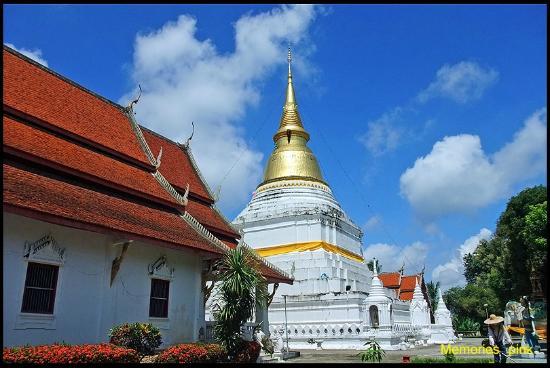
Although the image is no longer there, the visitor can still see several buildings, some built in typical Burmese style and it is a pleasant complex to visit.
Admission is 20 baht and includes entrance to the nearby Wat Suchadaram and the Museum (see seperate tips). Unfortunately, the site is not really suitable for mobility impired visitors as there apear to be no wheelchair alternative to the various steps. Open daily from 0700 - 1800.
Written Jan 25, 2010
In these modern times when everybody has mobile 'phones to tell the time (wristwatches being so passe now), a good old-fashioned clock tower is something to see. I know I cna think of many examples from Europe and specifically my home country of Northern Ireland. In fairness, the clock tower in Lampang is not particularly spectacular by day. To be honest, it could do with a bit of a wash and brush up but at night it presents quite an impressive sight and makes for a decent photo opportunity. On a more prosaic level, I found navigating Lampang a bit of a problem on a scooter, although I have a good sense of direction, and this place makes for a good landmark should you get lost.
Written Jan 15, 2010
If you exit the temple compound via the southern gate (the main staircase entrance is to the east), you'll come to another compound. Walk along the path underneath the trees and you'll come to a few buildings. Each one of these is a museum. One displays mostly festival paraphernalia plus some Buddha images. Another contains a whole range of items such as coins, banknotes, Buddha images, silver betel nut cases, laquerware, bronze ware and ceramics. The third features shelves of Buddha figures, manuscripts and more ceramics.
Written Nov 28, 2009
Wat Phra That Lampang Luang is one of the most spectacular wats in Thailand and was, indeed, one of my favourites. Set atop a small hill around 20km from Lampang, it dates back to 1476 and is believed to be one of the oldest wooden buildings in Thailand. The central viharn is open-sided and held up by two rows of massive teak pillars. The murals within remain in reasonably good condition and tell stories from court life. The wat is home to two important Buddha images, Phra Jao Lan Tang, which was cast in 1563 and is enclosed in a golden mondop towards the rear of the viharn and Phra Jao Tan Jai, which sits behind it. Also behind the viharn is a very big 24-metre high chedi that dates back to 1449. The entire complex is surrounded by a high brick wall and the main entrance is via a large staircase, the arch of which is topped by beautiful and intricately carved lintels depicting intertwined dragon heads dating to the 15th century. The complex also includes a few museums which are worthy of a visit.
Written Nov 28, 2009
The National Elephant Institute, which was formerly known as the Thai Elephant Conservation Centre until it changed its name in 2002, is located 33km north-west of Lampang on the main highway to Chiang Mai and is probably the main reason why most visitors come to Lampang.
The main objective for the establishment of the National Elephant Institute is to develop elephant conservation in a sustainable way and preserve local traditions for future generations. The Institute also aims to improve the tourism business, in which there is an extensive involvement of elephants in tourism-related activities, for the benefit of elephants as well as tourists.
The main reason for coming here is to see the daily elephant shows which take place at 10am and 11am. The show starts with a parade of about 12 elephants of different ages/sizes with their Thai or foreigner mahout (handler) sitting on top around their necks. The show consists of several displays with logs such as pulling, carrying, pushing etc in a number of different ways as they would be used in the wild. Then the elephants performed music by playing different instruments with their trunks and then some of them painted flowers using brushes in their trunks (which you can then buy from the shop - see my shopping tip). The show lasts for about 45 minutes and then you can and feed them bananas and bamboo sticks. You then have the option to ride them around some of the lovely 122 acres of land that the institute has - a short 10 minute ride costs 50 baht. I've included some video of the show on my Lampang page.
Shows: 10am & 11am. Admission: 50 baht.
Written Nov 26, 2009
Website: http://www.thailandelephant.org/
Sponsored Links
4 Reviews and 64 Opinions This hotel is placed in a very quite and beautyfull area. Staff are very kind and helpfull. Rooms...
1 Review and 26 Opinions
19 Opinions
Reviews and photos of Lampang attractions posted by real travelers and locals. The best tips for Lampang sightseeing.

The National Elephant Institute, which was formerly known as the Thai Elephant Conservation Centre until it changed its name in 2002, is located 33km north-west...
6 members live in Lampang
Our members can help!
1

Lampang is located about one hour southeast of Chiang Mai, and makes for a pleasant stop over on your way to Sukhothai. I did not visit the town proper which is renowned for its horse-pulled...
2

I've got some interesting experiences in Lampang. I'd love to share with you the 20 tips I've written, the 75 photos uploaded, and 1 travelogue I've created.
3
Apparently I have not been there!

I am led to believe that the Thais call this place Horse Cart City and have a saying that if you have not ridden in a horse and cart in the place, you have not really visited. On that basis, I haven't...
4
Lampang - City of Roosters & Carriages

Lampang was once known as Kukutthanakorn, or City of the Roosters. The name was derived from a local legend that describes a visit by the Lord Buddha. Beforehand, the god Phra Indra was worried that...
5

I've got some interesting experiences in Lampang. I'd love to share with you the 1 tip I've written, the 2 photos uploaded, and 0 travelogues I've created.
Build your own Lampang page
Sponsored Links