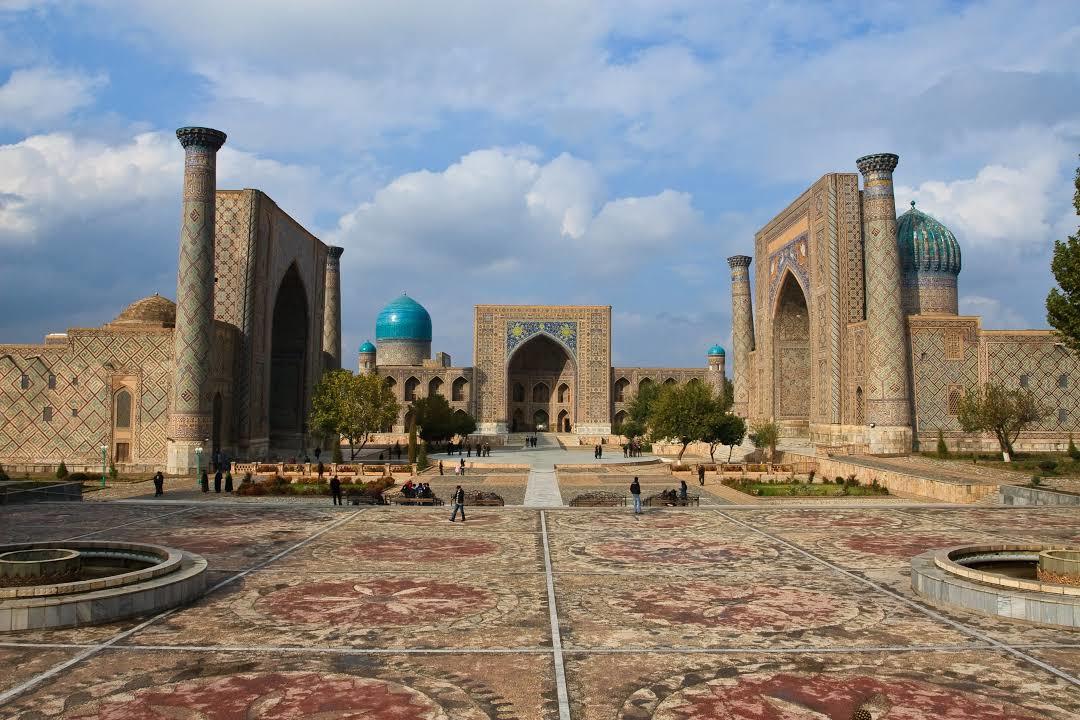
Samarkand Favorites

 
by ReubenLA
 
  •   Favorites
    by ReubenLA
  •   Favorites
    by ReubenLA
  • ...Bibi Khanum
      ...Bibi Khanum
    by TheWanderingCamel
  • Tradition 2
      Tradition 2
    by TheWanderingCamel
  • Unrestored
      Unrestored
    by TheWanderingCamel
 

Most Recent Favorites in Samarkand

Sort by: Most recent | Most helpful

Write a Review
How long did we stay?
TheWanderingCamel profile photo

3.5 out of 5 starsHelpfulness

TheWanderingCamel 2538 reviews
4 more images

Favorite thing: Photo: Domes of the Tilya-Kori Madrasah

I've been asked this question a lot.

On our first visit we stayed for 3 nights, arriving from Bukhara at about 4 in the afternoon. That gave us about an hour to take a first look at the Registan. We returned next day with our guide for a longer visit and also visited the Ulugh Bek observatory, the bazaar, Bibi Khanum mosque and mausoleum, Shah-i Zinda and the Gur Emir at some length, and made short stops at the summer mosque, the Kazret Khyzr mosque and the Khodja Akrar medressa - a very long day but par for the course for most tours.
We spent the second day on a trip to Shahrisabz - an all day affair, 3 hours each way by road.

Returning for a second visit, I was determined to have more time in the city and not to be so rushed, so 4 nights were booked. Our plans went slightly awry when a cancelled flight and a car breakdown meant we arrived after 8pm instead of the 3pm that was intended. I had thought we should spend that afternoon at the Registan, without a guide, leaving all the next day for other sightseeing. Instead we spent the whole of our first morning at the emsemble - as well as the delay with our transport I hadn't reckoned on the passion for shopping some of our group developed!

So -
Day 1 was the Registan, the bazaar, Bibi Khanoum, Gur Emir and the Rukhabad mausoleum.

Day 2 took us to Panjakent in Tajikistan and, on our return, an early evening visit to Shah-i-Zinda

Day 3 morning found us in Urgut for the fabulous bazaar, then it was back to Samarkand and Afrosiab, Ulugh Beg's observatory, Daniel's Tomb and a late afternoon visit to the paper mill at Konighil.

As we were staying in Shahrisabz there was no need to rush away in the morning so we had a couple of hours after breakfast to go off and do what whatever.

Fondest memory: It was all much more leisurely than our first visit and, thanks to our wonderful guide, Sasha, who was so generous with his time, spending far longer with us each day and meeting up with us after our return from Penjikent - something that he was not booked to do - we really had a wonderful time.

Staying at a different hotel worked well for us also. On our first visit we were right near the Registan and we found ourselves wandering down to the square on early morning walks as well as the hours between the end of the day's sightseeing and meeting up for dinner. This time we were on University Boulevard, a quite different area but just as pleasant with the fine buildings of the University and the Russian part of the city all around.

What should you do? That's going to depend on how you come to Samarkand. Tours have their set programmes and even those that only have one day in the city will certainly take in the Big 6 - Registan, Shah-i-Zinda, Bibi Khanoum, Gur Emir, Observatory and the bazaar.

If, like us, you're on tour but one where you have set the itinerary - do your homework and make sure the tour company knows exactly what you want included. It can be very difficult, if not downright impossible, to add some excursions (Tajikistan for example) to your itinerary once you've arrived.

Independent travellers will have even more freedom and will be limited only by the time they have at their disposal. Just be sure that if you think you might want to make that excursion to Tajikistan you have a multiple entry visa before you leave home.

Updated Jan 22, 2012

Related to:
 Architecture
 Backpacking
 Road Trip

Was this review helpful?

A tussle
TheWanderingCamel profile photo

3.5 out of 5 starsHelpfulness

TheWanderingCamel 2538 reviews
Decay
4 more images

Favorite thing: Step inside the carpet workshop in the Shir Dor medressah at the Registan and, once you've admired the skilled workers at their looms (photo 4), look around you at the walls and ceiling of what was once one of the medressahs lecture rooms. Patched cracks, faded and age-grimed paintwork, broken and missing tiles all around - you could be mistaken for thinking this is a roomn that has been forgotten in the process that has seen the grand ensemble restored to its former magnificence.

Not so! Leaving this decay was a deliberate decision on the part of the restorers to leave a reminder of what time and neglect can do, a scholarly exercise that will allow future generations to understand what has ben achieved. Whether it will remain in this state is debatable however as the man in Tashkent and more commercially minded bureaucrats push for more and more financial gain to be wrung out of this national treasure. At present, the historians are winning but given the demolition of the adjacent museum as it has been deemed "too modern" for the Registan precinct who knows what the next decision will be.

Updated Dec 30, 2009

Was this review helpful?

An invitation to lunch
TheWanderingCamel profile photo

3.5 out of 5 starsHelpfulness

TheWanderingCamel 2538 reviews
Join us
1 more image

Favorite thing: We didn't have time to visit the State Museum of Cultural History of Uzbekistan (to give it its full title) the first time we visited the city so, before we left for Shahrisabz and leaving the others to do some last minute sightseeing (aka shopping) at the Registan, two of us set off across the road to take a look.

Workmen everywhere, doing what workmen on public building works do best - not a lot. We noticed something interesting over in one corner of the central courtyard so we wandered over to take a look. A couple of women , one busy peeling and chopping vegetables, the other carving chunks off a piece of meat, the fellow with them stirring the pot perched in a makeshift stove. Lunch for the workers - come back when it's ready and join us. It smelt good but we couldn't wait, Shahrisabz was three hour's away and we wanted to be there by 1.

I have since found out that what we thought was restoration work is in fact demolition! It appears the man in Tashkent has decided that the modern (the museum was built in the 70s) building is out of keeping in the context of the Registan!

Written Dec 8, 2009

Was this review helpful?

A little black tassle
TheWanderingCamel profile photo

2.5 out of 5 starsHelpfulness

TheWanderingCamel 2538 reviews
Tradition 1
2 more images

Favorite thing: I'd noticed the way the lots of the older women trimmed the bottom of the trousers they wear under their long tunic dresses - a band of embroidered braid with a little black tassle on the inner seam - very cute. Then in the market at Urgut we saw stalls selling the braid, embroidered and with a loop at one end and fringinging at the other - all ready to be sewn into place. We also saw plain black braid, ready for hand-embroidering. The machine-embroidered braid is used for everyday wear - the hand-embroidery is saved for best. I loved this little bit of frippery on even the most elderly ladies - shades no doubt of the days when they were young and the little tassle at their ankle was as flirtatious as propriety allowed.

Most of the younger girls trim their trousers with machine-sewn embroidery in silver or gold - not nearly as cute as that little tassle must have been on a well-turned ankle.

Written Dec 8, 2009

Was this review helpful?

Fell In Love With the Magic of Samarkand!
ReubenLA profile photo
ReubenLA 2 reviews
1 more image

Favorite thing: Samarkand and Bukhara are two of the most magical places I have ever been to! I have traveled to these two cities 4 times now and each time I go, I come back with an amazing sense of spiritual fulfillment!

Fondest memory: Having a bath at the Jewish Quarter Bathhouse in the old city.
Staying at Bahodir Guest House and being pampered by the gracious owners and employees of this humble guesthouse!

Written Nov 11, 2009

Related to:
 Historical Travel
 Archeology
 Budget Travel

Was this review helpful?

Samarkand Internet Cafes
John195123 profile photo

2.5 out of 5 starsHelpfulness

John195123 1363 reviews
Spayder Internet Cafe

Favorite thing: There are a bunch of internet cafes, I suppose, but we went to the Spayder, by which I think they mean "Spider". Whatever the name, I think it's in the Lonely Planet (can't remember the address) and is pretty good. It's down a flight of stairs in a dimly-lit basement and has decent computers. Rates are decent.

Written Nov 9, 2008

Related to:
 Backpacking
 Road Trip
 Budget Travel

Was this review helpful?

Ulug Beg, the astronomer King
josephescu profile photo
josephescu 882 reviews
Ulug Beg
1 more image

Favorite thing: Perhaps the heavens determined his enquiring nature by birthing Mohammed Taragal on 22 March 1394, during the vernal equinox. Tamerlane soon recognised his grandson’s talents, for he named him Ulug Beg, i.e. “grand duke”, and took him on campaigns to the Caucasus and India. In 1404 Spanish ambassador Clavijo attended the 10 year old’s wedding feast; 5 years later his father made him viceroy of Samarkand, lord of Transoxiana, while he ruled Persia from Herat.

The young man’s love of mathematics, history, theology, medicine, poetry and music gave Samarkand a reputation for learning and culture that drew the Turkish astronomer Rumi Under this tutor did Ulug Beg find his favourite science.
From 1424 to 1429 he ordered the construction of an observatory without equal in East or west, on a scale to ensure unprecedented accuracy and make Samarkaand the stargazing capital of the 15th century. With a circle of experts Ulug Beg plotted the coordinated of 1018 stars (the first such undertaking since Ptolemy), devised rules for predicting eclipses and measured the stellar year to within one minute of modern electronic calculations. Ever alert for flattery, he accepted no observations until honest debate secured agreement. His memory was exceptional – when a librarian reported his hunting logbook lost, Ulug Beg instantly dictated the full list of kills, almost to perfection, as the logbook proved when rediscovered.

Fondest memory: Like Galileo 2 centuries later, Ulug Beg challenged religious orthodoxy with statements of bold secularity, even heresy: “Religions dissipate like for, kingdoms vanish, but the works of scientists remain for eternity”.

Ulug Beg’s father ruled Herat as an ideal Muslim monarch, devout and strong, whereas his son’s court revelled in the feasting, song and dance of Tamerlane’s days. Ulug Beg was supported by the official clergy and built various madrassahs and mosque, but he failed to diffuse the growing hostility and power of Sufic dervishes. On his father’s death in 1447 events simply overtook the new head of the troubled Timurid realm, exposing him as lettered scholar, not decisive ruler.

Blamed for the unruly behaviour of his son Abdulaziz and defeated several times in battle, Ulug Beg was seized in October 1449 by his other son, Abd al-Latif. A secret court of dervishes dispatched him on a redeeming pilgrimage to Mecca. He had only reached a village outside Samarkand when he was beheaded with Abd al-Latif’s connivance. The observatory was razed to the ground as the “cemetery of forty evil spirits”, yet just 6 months later the severed head of the patricide sone was displayed on his father’s madrassah.

Ulug Begg’s fellow scientist Ali Kushji fled to Constantinople, where the martyred ruler’s Star Atlas was published to great acclaim throughout the entire Arab world. Although these table became known in Europe only in the mid 17th century, superseded by Tycho Brahe’s discoveries around 1600, Ulug Beg’s observatory was still being imitated in India in the 18th century.

Written Dec 8, 2007

Related to:
 Architecture
 Historical Travel
 Arts and Culture

Was this review helpful?

Tamerlane, conqueror of the world
josephescu profile photo
josephescu 882 reviews
Tamerlane
2 more images

Favorite thing: “as there is only one God in Heaven, so there should be only one king on earth” – was a chronicle’s explanation of the fearless ambition that raged form India to Russia , smashing Urgench, Baghdad, Damascus, Heart and Delhi. Meticulous planning enhanced classic nomadic warfare, concluded by brutality on an unprecedented scale. With the plunder of slave artisans of conquered lands, Tamerlane raised his capital Samarkand to its greatest heights.

The last nomadic emperor to shake the world was born in 1336 to a minor chief of the Barlas clan near Kesh, just south of Samarkand. The first of countless legends reports the infant Timur – “iron”, a common name in Central Asia was born with blood filled palms, an omen predicting his hands would slay many. His family was of Mongol stock, part of the ruling dynasty of the fragmented Chagatai Ulus which followed the Mongol storm of Genghis Khan, but settled into local Turkic and Islamic culture.

In 1360 court chronicles introduce Timur to history as the astute young man who welcomed a Mongol invasion and succeeded as Barlas’ chief. Mixed fortune filled the next decade with adventures by wit and sword. From arrow wounds to his right leg and arm grew the appellation of Timur-i-Leng, Timur the Lame, and the English corruptions of Timburlaine or Tamerlane. When he caught his assailant 20 years later, he had him strung up for target practice. By 1370, after clever political and military manoeuvring, he became lord of Transoxiana and master of Samarkand. Lack of direct descend to Genghis Khan limited Tamerlane to the title of Amir (commander), for Turco-Mongolian tradition necessitated rule through a puppet khan. Marriage to his rivals’ Mongol widow promoted him to the title of “royal son in law”, and after hid death a mythical genealogy carved on his tombstone traced common ancestry with the illustrious Genghis khan.

Fondest memory: An early title, Conqueror of the World, showed Tamerlane shared his forebear’s boundless ambition over the next 35 years he personally led his mounted archers as far afield as Moscow and Delhi, less than the Mongolian realm but still the greatest extent ever conquered by a single ruler.

“The whole world is not enough for two kings”, he explained as he plundered Khorezm, Khorasan, Persia, Syria, Asia Minor and Russia, sacked cities like Baghdad and Damascus lent their names to villages near Samarkand where he fashioned an imperial capital beyond compare with the loot and craftsmen gathered on campaign.

His brilliance as a strategist and the loyalty of highly mobile troops overcame any opposition. Estimates suggest 17 million people died in a trail of blood and suffering, marked by pyramids of skulls, that surpassed even Mongol barbarity.

Despite their success, Tamerlane’s conquests appear haphazard and repetitive, compared to the clean sweep of Genghis Khan, for he rarely consolidated them with permanent administration. Only in the last years of his life did Tamerlane carve out fiefs for his descendants, yet his jealousy of power and the cohesive role of his charisma built an empire that could not longer survive him. His career had pervasive influence. Defeat of one time protégé Toktamish in 1395 so weakened the Golden Horde that Russia came to discard the Mongol yoke, eventually annexing Tamerlane’s heartland itself. Capture of Ottoman Sultan Bayezid the Thunderbolt in 1402 delayed the fall of Constantinople for half a century, allowing Greek scholarship the time to reach Italy and birth of the Renaissance.

Although he encouraged agriculture and irrigation, concentration of trade on Samarkand and decimation of other centres reduced the economic base for other empires, exacerbated by the fall of the Silk Road.

Written Dec 8, 2007

Related to:
 Arts and Culture
 Historical Travel

Was this review helpful?

History
nepalgoods profile photo

3.5 out of 5 starsHelpfulness

nepalgoods 1339 reviews
1 more image

Favorite thing: The name "Samarkand" means: samar = fertile; kand = settlement.

The city is older than 2500 years and is one of the oldest cities of the world. It has always been a center of trade and culture. It has been the capital of historical Sogd 4th century B.C. In this times Samarkand was called Marakanda. Alexander the Great conquered Marakand in 329 B.C.

During the Chinese Han-Dynasty (1st century AD) the area stood under the rule of the Chinese emperors. Later centralasian rulers and dynasties ruled the city: Sassanides, Hephtalides, Turk, Samanides, Seldshuck, Choresm.

Finally Samarkand came under the rule of the Mongols under Timur. It became Timur's capital. Trade, art and science bloomed in the next few centuries. The city was a very important center for the trade of the Great Silkroad. And it became the most beautiful city of the then known world.

From 17th to 18th century Samarkand was almost forgotten. In 1868 Samarkand became part of the Russian Empire. Since 1991 Samarkand is the capital of the province of Samarkand.

Today Samarkand has about 500000 inhabitants. It is a modern city with industry, modern buildings and wide streets. But the city center is still dominated by the beautiful buildings of 15th and 16th century.

Updated Nov 1, 2007

Related to:
 Road Trip
 Architecture
 Historical Travel

Was this review helpful?

Changing money at Afrosiab Hotel
toonsarah profile photo

4.5 out of 5 starsHelpfulness

toonsarah 2342 reviews
Uzbek currency

Favorite thing: One thing we had a few difficulties with in Uzbekistan was finding somewhere to change our money. The best option was often our hotel, but in Samarkand the Zarina didn’t offer this service. So instead we headed to the nearby four star hotel, the Afrosiab Palace. The exchange bureau there closed at 8.00 in the evening, and we arrived a bit later so thought at first we might have to return the next day. The security guard however spotted us lingering by the desk, trying to make out the Russian language sign that would tell us what time it would re-open in the morning, and offered to help. His help was more than welcome, as it consisted of taking us behind his desk (though still in full view of the hotel lobby!) to conduct a black market exchange.

This is common practice in Uzbekistan, and we’d done the same some days earlier in Khiva. I was surprised to learn that the rate for these black market exchanges seemed to be as fixed as the legal rate, and only a little lower (1,200 som to the dollar rather than the official 1,250). Each time we lost only a couple of £s on the deal, and we knew that our friendly helper would change the money at the official rate when the exchange office opened the next morning, so that his probably meagre salary would be augmented– so it seemed to me that these deals were a win for all of us!

Written Sep 13, 2007

Was this review helpful?

Top 3 Hotels in Samarkand

Hotel Afrosiyob Palace

 2 Reviews and 16 Opinions  Hotel Afrosiyab is a modern highrise buillding. It does not look very nice from outside. But it... 

 Hotels in Samarkand

The Place

Reviews and photos of Samarkand attractions posted by real travelers and locals. The best tips for Samarkand sightseeing.

Experience Samarkand
  Share your Travels  
 

The People

4 Members Live Here
 
Our Members Say
 profile photo

 One thing we had a few difficulties with in Uzbekistan was finding somewhere to change our money. The best option was often our hotel, but in Samarkand the... 

4 members live in Samarkand


Question about Samarkand?

Our members can help!

postQuestion_button

Top Samarkand Writers

1

Mirror of the World,

TheWanderingCamel profile photo

 Garden of the Soul, the Centre of the Universe, these are just some of the names given to Samarkand by those who saw it in its days of glory. The beautiful blue domes, creamy stone walls and... 

2

Samarkand - Central Asia's Eternal Beauty

Trekki profile photo

 Samarkand was the fourth Uzbek city I visited, after Tashkent , Khiva and Bukhara , on my way to Tajikistan and Pamirs . Please make sure that you also read what Leyle of the WanderingCamels wrote...... 

3

Take the Golden Road to Samarqand

Elisabcn profile photo

  During three millennia Samarqand, located in the valley of the Zarafshan river, was the main trading and cultural center of Central Asia. Samarqand, one of the most ancient cities of the world,... 

4

Splendour of the Silk Road

toonsarah profile photo

  “It’s too much for my eyes” (Els, one of our travelling companions, at the Shah-i-Zinda) After Khiva and Bukhara, Samarkand seems big and full of bustle, but unlike Tashkent it retains more... 

5

Magical City

nepalgoods profile photo

 Samarkand was the final stop on my tour through Centralasia. The city is an absolute highlight, much more a city with life and people than Bukhara, which always seemed to me like an open air museum. ... 

View all rated pages

View newest pages

Build your own Samarkand page