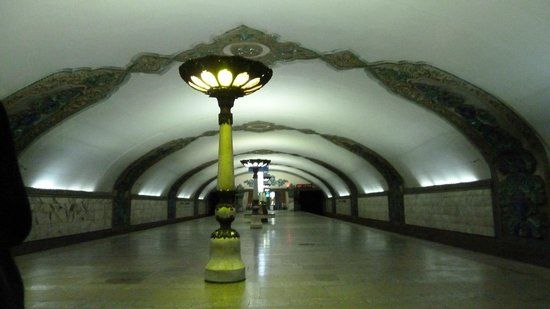
Favorite thing: For all that it is a city of 3 million people, Tashkent has a lovely laid-back air. The bazaars are busy and bustling, and in the evenings Broadway is jumping (literally it can seem with the loud music the Uzbeks love) but there is shady street after street in the Russian part of the city, all but deserted of traffic much of the time and you can walk for miles through wooded parks hearing little more sound than the water playing in fountains. Chaikhanas make great places to stop and watch the world go by, for tourists and locals alike. Little boys splash around in the pool outside the Mustaqlilk Maydoni Metro and old men play chess under the trees near Temur's huge equestian statue in Amir Temur Square.
The park that runs from the Opera House Square, past TsUM and along towards Kosmonavtiar metro station is the place to come if browsing among books is one of your things - there's a book market set up there most days. If sitting back on cushioned couches and drinking tea is more your scene, check out the chaikhana in the middle of the park - with its individual airy pavilions and choice of comfy Western-style armchairs or traditional Uzbek takhtas, it's a great place to rest those sightseeing-sore feet.
Updated Dec 3, 2009
Favorite thing: Have been back to Tashkent about 4 times over the past year for work. Regarding currency exchange - any of the hotel's have a good exchange place - normally open 24hours a day - apart from meal breaks - they will even provide a box for the bricks of cash they give you. The Dediman and Intercontinenetal are the best. Also you can exchange in the Bazaar's but obviously won't get receipts for your exit. Have never come across anywhere not having enough Soum - bucket loads everywhere - the sticky bit is the quality of the USD notes - too old, or marks on them - and suddenly they have no exchange.
For cash advances - The Intercontinental and Uzbekistan Hotel have ATM's dispensing USD cash using Mastercard - with a 1% commission. The Asaka Bank (Abdulla Kakhara Street) also does Mastercard cash advances for 1% commission - very friendly there - but a little out of the way (2000 soum taxi from centre). Visa card US cash advance is possible at the UZKDB bank (formerly UZDaewoo), next to Uzbekistan Hotel. They charge 2% commission. There are a few other banks doing Visa. The remaining ATMs' around town will accept visa but give soum notes - not sure of the maximum.
One thing to be aware of is if you are using a visa or mastercard debit card - ie loaded up with cash. This is a fairly new way of carrying cash - and does not work in Uzb yet except at ATM's - not at the banks. Something to do with it not having any embossing on it.
Fondest memory: If you are short of things to do in Tashklent - particualry inteh summer - get to Bobor park - great food, entertainment and fun - lovely people - try the waterfall restaurant - ask at a hotel - this is one of the most amazing places to eat at the base of a man-made waterfall in the back streets of town; great western food at the J Smoker up near the university; and of course broadway (every taxi driver knows).
Written May 28, 2008
Favorite thing: Despite the size and importance of Tashkent, the airport is terrible. The customs check is old fashion, luggage claim is very small and so crowded. If you landed with few more airplanes, now the nightmare starts. The luggages are checked strictly, you need to declare how much money you carry, etc so exiting the airport becomes a real pain. It took 2 hours for me to leave the airport. Run friend run, for the front place in queue.
Written Mar 24, 2008
Favorite thing: In 1865 Tashkent was given to the Russian Military Gouvenor by the cities Eldest. IN 1867 Tashkent became the capital of the Generalgouvernement Turkmenistan.
In this time Tashkent had about 80.000 inhabitants. There were two parts of the city: the old town with adobe houses and old mosques in the west and the modern part with rectangular streets and Russian colonial style buildings in the east.
In the severe earthquake of 1966 many buildings mainly in the old town were destroyed. Many streets and buildings were now build in Russian style, which still is the most significant style in Tashkent.
Since 1991 Tashkent is the capital of the independant Republic of Uzbekistan.
Written Sep 22, 2007
Favorite thing: Tashkent was already mentioned in a Chinese script of the 1st century B.C. Well, they used another name, but scientists are sure, that this city was located where today's Tashkent is. Many people say, the name "Tashkent" means "Stone City". But Tashkent has been a city of adobe houses most of its history. Today scientists say, that the word Tashkent comes from the word "tschatsch" in the Sogdian language, which means "a hilly place".
Tashkent was Turkish until in 8th century the Arabs conquered the city. 1220 Genghis Khan took the city. A time of quarrels between the Khans of this area followed. in 16th century came a time of wealth under the rule of the Schaibanide Khans. Trade and art flourished.
After the fall of the Schaibanide Dynasty Tashkent was under the influence of Kazakh Khans and later was part of the Kokand Khanat until 1865.
Written Sep 22, 2007
Favorite thing: Tashkent has more than 2 mill inhabitants. It is the capital of the Republic Uzbekistan. Its wealth and importance comes from the ideal location. It is the HUB for most airlines going to Central Asia. Major trainroutes cross in Tashkent: to Moscow (3360km), to Novosibirsk (2630km), Turkmenbashi (1864km) and Duschanbe (1069km). Of course already in the times of the Big Silkroad Tashkent was a center of trade and cultural exchange. In a way you can say, that Tashkent is located at the old border between an area of nomadic people and settled urban population.
Today Tashkent is still an important city of trade and industry. The first university in Centralasia was founded 1920 in Tashkent. Now the city has about 30 science institutes, 18 universities, 30 colleges, 200 libraries, 11theatres and more. since 1999 Tashkent also has an Islamic University. There are also many museums, a zoo and a botanical garden, which are worth a visit.
It is a pity, that Tashkent always looks a bit underrated compared with the famous cities of Smarkand and Bukhara.
Updated Sep 22, 2007
Favorite thing: Les scientifiques estiment que Tachkent existait il y 25 siecles, des premieres colonies rares jusqu'a la megalopole moderne avec ses immeubles de haute taille, les avenues populeuses et le flot des automobiles. Quand dans la nuit tu arrives ves la ville, la lueur des feux occupe la moitie du ciel. Tachkent est mentionne dans " A vesta" et dans les sources anciennes chinoises. Elle est nee dans la vallee de la riviere Chirchik, a la frontiere de l'oasis et de la steppe comme un lieu de rencontre entre les agriculteurs et les eleveurs du betail, la population sedentaire et les nomades.
The scientists estimate that Tachkent existed him there 25 centuries, of the first rare colonies until has the modern megalopolis with its buildings of high size, the populous avenues and the stream of the cars. When in the night you happen to ves the city, the gleam of fires occupies the half of the sky. Tachkent is mentioned in " A vesta " and in the Chinese old sources. It is born in the valley of the Chirchik river, has the border of the oasis and the steppe like a place of meeting between the agriculturists and the breeder of livestock, the sedentary population and the nomads.
Written Apr 12, 2007
Favorite thing: Asia has long been the birthplace of conquerors of the world. One of the greatest of these was a man who commanded both fear and respect in Asia and Europe during the fourteenth century: Tamerlane. This name, by which he was known in Europe, is actually a corruption of his name in Persian, Timur-i-Leng, meaning "Timur the Lame." The word Temur is Turkic for "iron": it was an appropriate name for the man who, in his lifetime, rose from being a prince in a small Turko-Mongol tribe to become the ruler of an expanding empire that stretched from Delhi to Anatolia. His life was, in the words of one modern scholar, "one long story of man, who centralized three parts of the world: the south, the west and the east."
Fondest memory: Un des remparts principaux de l'Etat dans cette région est Amir Temur. Dans la deuxième moitié du XIVème siècle, il unifia et créa un Etat puissant avec sa capitale, Samarkand. En 1380 Amir Temur effectua des campagnes militaires dans d'autres pays. Par la suite il conquis l'Iran, la Caucasie, l'Iraq, la Syrie, la Turquie et l'Inde du nord.
La création de l'Etat centralisé en Mesopotamie d'Asie Centrale nommee Moveranakhr, l'élimination du morcellement créèrent des conditions favorables pour le developpement de l'économie sabotée par des Mongols. Grâce a l'énergie politique d’ Аmir Tеmur les instituts de la direction d'Etat, sociale et militaire furent perfectionnés. Les développements de la science, l'architecture, l'urbanisme, la litterature, les arts plastiques et appliqués a l'époque du règne de Тimour et de ses heritiers furent un phénomène unique à l'échelle mondiale.
Updated Apr 12, 2007
Favorite thing: Some websites will give you further reading and information. Some are of travel agencies, but they still have a lot of interesting information.
In my opinion the best website about Tashkent anyhow:
Sairam Tours - Tashkent
Travel Agency Orexa
Dolores Travel website
Visit-Uzbekistan website
Fondest memory: .
and :-) of course:
make sure you read what Leyle of the WanderingCamels wrote about Tashkent .
She was the one who “brought” me to Uzbekistan and Tashkent with what she wrote here on VT.
Written Feb 3, 2007
Favorite thing: A recent conversation with a friend led me to the idea to make a short summary of opening hours and prices, to give you a rough overview of the costs you can expect for Samarkand. This all is as of summer 2006 and my travel style, which involves basic to medium accommodation and two meals per day plus snacks. And of course, visiting the sights.
But as I did spend more days in Tashkent than most of you will do, I reduce my calculations to a stay of 1 1/2 days (1 night).
Opening hours:
mostly from 9 am to 5 or 6 pm on “normal” days. Expect different hours for Fridays, as this is the “Sunday” in the Islamic world. In Tashkent, a lot of museums are closed or have shorter opening hours on Tuesdays.
Travel expenses – for 1 days plus 1 afternoon/evening – per person:
Accommodation costs (1 nights): 15 USD (including breakfast);
Food costs: 20.000 sum (equals 15 USD), this includes one upscale dinner.
Snack and water costs: 5 USD;
Costs for visting sights including camera fee:
well, as the fees vary upon what you chose, I can’t calculate. Museum of Fine Arts is 3000 sum + 4000 sum camera fee.
Transport from Tashkent to e.g. Samarkand in shared taxi: seat 10 USD)
Transport from Tashkent to e.g. Khiva by plane: 60 USD.
Updated Feb 3, 2007
Sponsored Links
2 Reviews and 68 Opinions As I know, the InterContinental Hotel is less that Europian standart, but it really good one. There...
4 Reviews and 64 Opinions Tashkent Palace Hotel has been the Le Meridien. It is a nice 4-star-hotel in Russian style. It looks...
17 Opinions
Reviews and photos of Tashkent attractions posted by real travelers and locals. The best tips for Tashkent sightseeing.

A recent conversation with a friend led me to the idea to make a short summary of opening hours and prices, to give you a rough overview of the costs you can...
23 members live in Tashkent

Q: Hi! I read here that it is forbidden to make pictures from the metro in Tashkent, is that true?? I love the metro and always...

A: Unfortunately yes, as underground stations are considered to be military installations. You could probably manage it if no guard was about but having said that,...
Read 3 Replies
1
Tashkent - full of life, color and so much charm

Tashkent is the city, you’ll most probably arrive and depart from if you plan to visit Uzbekistan. I was here in summer 2006, in the beginning and end of my trip through Uzbekistan and Tajikistan. In...
2

Just 40 years ago Tashkent was little more than a huge pile of rubble - the result of two major earthquakes and hundreds more tremors that destroyed the city almost completely. A tiny remnant of the...
3

Tashkent is the capital of the Republic Uzbekistan, located at the foothills of TIanshan Mountains. Already in the times of the Big Silkroad Tashkent was a center of trade and cultural exchange. In a...
4
A soviet-styled capital hiding some true charm

I have been in Uzbekistan for a little over a month, and spent most of my time in Tashkent. Tashkent is a huge soviet-styled city... No wonders when one knows that the 1966 earthquake has demolished...
5

Once an outpost along the Silk Road trade routes to the far east and most recently a former Soviet Republic make Tashkent a very interesting and exciting city offering a varied mix of cultures....
Build your own Tashkent page
Sponsored Links