When you are trekking to the villages of the ethnic minority people of Sapa, you will notice water mills such as those shown in the photos. Due to limitation of electricity and abundance of water, water is used as a form of energy to drive these mills which in turn will help to grind food stuff down to powder of juices.
Written Jan 28, 2007
The local ethnic minority women carry baskets behind their backs all over the place, especially to the Sapa market where they will buy various stuff to bring back to their villages. This is an important means of carrying stuff in Sapa.
Written Jan 28, 2007
During trekking, you will see some schools among the various villages. The children of ethnic minority people are given a chance for education but a big percentage of them will not take it hoping to earn a living when they are young. It is a pity that they do not see the importance of education, as this is an important means for them to get a better living and raise above poverty.
Written Jan 17, 2007
Because the various villages are located far from Sapa, the villages have to walk along distances across some rough and hilly terrain before reaching Sapa. You will appreciate this when you are trekking to the villages and some sections of the trek may be tough for those who are not so physically fit. Some even carry heavy loads and this makes it much difficult, but they are used to it and are very fit.
Written Jan 17, 2007
The people living in the villages are generally self sufficient as they grow their own rice, vegetables, and have their own poultries, pigs etc. Most of them live in isolation of the outside world and the nearest towns where they can go and do some shopping are Sapa or perhaps to Laocai where they can buy more goods from China since Laocai sits at the border between Vietnam and China. As for water, the river is the main source for drinking, bathing, washing etc. During wintertime when the weather is cold, I wonder how they bath as there is no electricity or heater in the house to speak of. Very tough life in a poor area of Vietnam.
Written Jan 17, 2007
Village life is very tough in the regions surrounding Sapa. The living conditions of the ethnic minority groups are very poor and basic, with wooden houses where 3 generations of people squeezing into it without electricity, water etc. Furthermore, they need to walk along distances across hilly terrain to Sapa to visit the market and buy their daily stuff. Life is getting better due to tourism but the majority of the money goes to the tour operators and hotels. Therefore you can see many ethnic minority women selling handicrafts to tourists in the hope to earn more money. Although they can be a nuisance sometimes, you must always remember that they are trying to make a hard living and you can help them by buying some souvenirs from them.
Written Jan 17, 2007
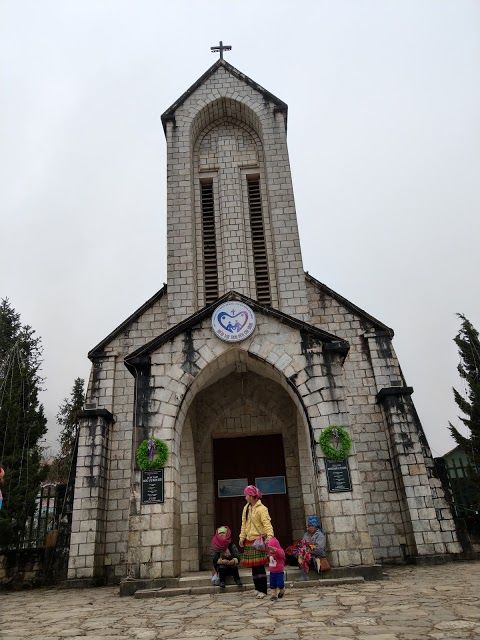
On Saturday night, if you are in Sa Pa, go to the old Church.
Here if you are lucky, you will still see young Hmongs from nearby villages gathering here and looking for their life partners through courting by singing. And if their songs harmonize, a marriage knot will soon be tied.
Unfortunately, due to the ever increasing watching tourist cameras, this may have disappeared or moved elsewhere.
Written Oct 19, 2006
Water buffaloes in Sapa, like their lowland counterparts, played an important part of the agricultural livelihood of the ethnic Hmong in Sapa.
The water buffaloes plough the rice fields. Of course, these buffaloes can also be beast of burden and provde milk, beef, hide and source of organic fertilizers.
What a useful animal the water buffalo is.
Written Oct 19, 2006
While walking through Hmong villages, we could see indigo plants growing and hemp being dried for spinning yarn and weaving into yarn.
Making clothes from hemp is a painstacking slow progress. It is continues to be a traditional process while cotton can be cheaply imported.
Written Oct 19, 2006
While the Hill Tribe people are quite isolated and many retain and prefer their traditional dress you will see many fun signs of modern civilization.
The first thing you’ll notice is their preference for oversized brightly colored umbrellas. In fact, you seldom see in Montagnard woman without here umbrella. The other sign is a proliferation of plastic shoes and rain boots. Both of these are due to the rainy climate in the hills.
Government run schools and medical clinics are also popping up in the hill tribe areas. I am pretty sure that this is a recent development since none of the young montagnard guides I spoke with had ever been to school.
Many young Montagnard girls are also choosing to be “career women” instead of submitting to arranged marriages when they are young (12 to 15 years old)
Vietnamese traditions are also sinking in...I was invited into a half dozen houses and all of them had the family alters of the Vietnamese.
Updated Nov 24, 2003
Comments