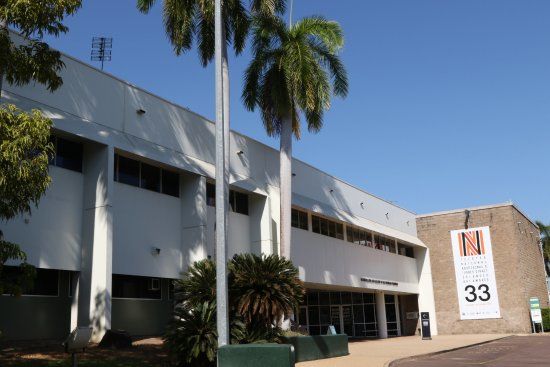
Favorite thing: I experienced the excellant travel booking and internet service of Global Gossip when in Cairns, so I was happy to see that it is also in Darwin.
If you want to make a travel booking or use the internet (and they provide a card you can top up and use anywhere in Australia)....then look no further than Global Gossip.
Written Nov 22, 2009
Favorite thing: We enjoyed an excellent tour through parts of the Northern Territory with specialist tour company AAT Kings which is a part of the group which includes Trafalgar Tours.
No complaints about the tour, excellent Tour Guide who became part of the tour and often arrange to accompany passangers during free time. Our tour included several days in Darwin, a day trip to Litchfield National Park, a trip to Katherine via Adelaide river with a 2 night stay in Katherine. We then continued onto Kakadu National Park for 2 nights.
The tour included many entries, 3 boat cruises including Katherine Gorge, Kakadu wetlands, and the Yellow Waters.
Web Address: www.aatkings.com Toll Free: 1300 556 100 (Australia)
Updated Aug 27, 2009
Favorite thing: You must try a Darwin Stubby... Two litres of beer...
It's mostly a tourist gimmick - and a quite expensive beer. The beer is not served at the local pubs, but you can buy it at groceries stores or souvenir shops in Darwin.
I was told that the Darwin Stubby is the biggest beer bottle in the world.
Updated Oct 15, 2008
Favorite thing: Comfort Inn Asti Darwin is reasonable. I would not suggest Holiday Inn for the price. Palms City Resort would be my first suggestion followed by the Travelodge Mirambeena Resort Darwin is good for the price and has lovely gardens. If you are looking for quality places those would be my 2 suggestions.
Written Jul 5, 2008
Favorite thing:
Do not forget to drink with MODERATION... even if the aussie beers are very tempted.
Each Australian state have its own proud:
Tooheys (NSW), my favorite by the way
XXXX (QLD), my favorite too by the way
Cascade (TAS), my favorite too too by the way
VB (VIC), my favorite too too too by the way
Coopers (SA), my favorite too too too too by the way
Emu (WA), my favorite too too too too too by the way
??? (NT), ouf I'm saved I did not taste the local beer as I never go there (yet)... should come back soon ;-)
Fondest memory:
My first virtual local beer ;-)
Written Jun 16, 2008
Favorite thing: Let’s start at the start. The Aborigines have lived in Australia for at least 40,000 years. Whoever was next to visit is somewhat doubtful, there are suggestions that a Chinese exploration fleet may have reached Australia’s shores in the 1400s. I rather believe that the Portuguese, great sailors and explorers, would have looked around in the 1500s - especially as their colony in Timor was a relative swim across the ocean and the Macassan fishermen were visiting from about that time: but the Portuguese were secretive and left few records. There is no doubt the Dutch visited in 1606 and their later explorers named Arnhem Land in 1623. Even the French, on lengthy scientific and exploratory voyages, travelled around the coasts in the early 1800s.
The British, focussed on asserting their colonial claims to the entire continent, were keen to pre-empt any other national aspirations, so establishing a colony at Australia’s “Top End” became a priority. In doing so, they ran into far more difficulties than they had to the south. Here’s the list of failed attempts at a colony:
● Fort Dundas, established on Melville Island in 1824 and abandoned in 1828
● Fort Wellington, at Raffles Bay, lasted only from 1827 to 1829
● Fort Victoria on the Cobourg Peninsula came closest to success, but still lasted only from 1838 to 1849.
● A settlement was established at Escape Cliffs, 75km from the present Darwin, in 1864 – it lasted only until 1867.
All the previous attempts to establish a colony had been military. In 1869 the new colony of Palmerston (later renamed Darwin) was established. South Australia had assumed responsibility for the north from New South Wales in 1863 and needed an administrative centre. The Palmerston colony (nothing to do with the new Darwin suburb of Palmerston) took on more significance in 1872 when the Overland Telegraph was built and an undersea cable connected Australia via Darwin to the rest of the world.
Fondest memory: Nothing remains of the first settlements and the ruins of Fort Victoria are quite inaccessible. Fortunately, on our trip through Arnhem Land we were able to see the marker cairn at Smith Point on the Cobourg Peninsula, erected in the 1840s to warn shipping headed for Fort Victoria of the location of a dangerous reef.
Updated Jun 9, 2008
Favorite thing: I’ve mentioned that Darwin is very tropical. That unfortunately means it is in the climatic region frequented in the “Wet” by tropical cyclones (also, in some regions, known as hurricanes or typhoons). Cyclones pass through the region yearly, usually offshore and with little effect.
Cyclone Tracey was not a lady though – at Category 4 she provided Darwin’s second defining event. She arrived on Christmas Eve, 24 December 1974, with the 8km diameter eye passing right across the city. Winds were estimated to have reached 280 km/hr, but the Weather Bureau’s anemometer was destroyed before the peak. At the time, Darwin had a population of about 48,000 people living in 12000 houses – it is estimated that only 400 houses escaped undamaged, with most totally destroyed. Evacuations reduced the post-Tracey population to about 6,000 but most of the city was rebuilt by 1978 and population growth resumed, with self-government for the Northern Territory also achieved in 1978.
The first of my photos, taken of a photo in an insurance company window, shows the typical damage to a typical Darwin house such as in my previous tip. The second photo, from an explanatory public sign, shows the effect spread over an entire suburb, with debris everywhere and all trees stripped back to bare trunks. Tracey levelled the city more effectively than had the Japanese! Luckily, casualties were fairly low as many people were away for holidays at the time and the cyclone traversed the city at night, when few were in the streets. The third photo is of an information sign, illustrating the changes in Darwin’s population since the 1930s – sorry about the shadows!
Updated Jun 9, 2008
Favorite thing: Tourists don’t travel to the “Top End” to see suburban Darwin, so I suspect fairly few visit these areas. On the other hand, there is little reason for most Darwin residents to visit the city area, unless their employment is there. The result seems to be a distinct separation into “two Darwins”, one inhabited by transient backpackers and tourists, the other by the “locals”.
Because we were off to the “VT Survivor” trip, we had some heavy-duty shopping to arrange before we left: things such as buying camping chairs, not to mention a seeming mountain of groceries (most of which we used). So we took our vehicles to one of the main shopping malls, at Casuarina in the “Northern Suburbs” (at 2 near top of the map with preceding tip).
As we drove through the suburbs, and also at the shopping mall area, I gained the distinct impression that the “suburban Darwin” is distinctly more akin to the rest of Australia than the impressions given by the city area. Inside the shopping mall, apart from less emphasis on winter clothing, we could have been in any other Australian city – much the same ‘feel’, much the same shops from the usual chains. We all lunched there – the standard “shopping mall” catering applied.
But ….Have you ever felt intimidated by women in shopping malls pushing shopping trollies? If you have, don’t get in the way of a team of VT ladies on a “Survivor” grocery-buying trip! LOL
Main photo: Approaching the Casuarina shopping mall
Second photo:Casuarina shops
Third photo:Heading into the shops
Fourth photo:”The list says we still need…”
Fifth photo:Beware teams of VTers with shopping trollies!
Updated Jun 3, 2008
Favorite thing: I’ve mentioned in my 'Introduction' page that Darwin sprawls. That results partly from the city’s layout. The old part of the city is on the peninsula near the wharves, and several suburbs are nearby. But substantial amounts of land are occupied by defence facilities and the airport is to the north – so the suburbs continue beyond the airport and a new suburban area, called Palmerston, is situated away to the east.
After the havoc caused by Cyclone Tracey, most suburban housing is relatively new, though some older style houses have been rebuilt with appropriate reinforcement should another large cyclone come along. The suburbs seem to be expanding with the population, but what really struck me was the booming construction of inner-city apartments. These would have been unimaginable only a few years ago, but I presume they are a reflection of affluence resulting from the resources boom in the Territory, coupled with changing lifestyles which place more emphasis on social interaction than on the traditional “house and garden”. Alongside the city, a new prestige area has sprung up around the marina at Cullen Bay (14 on the map). Meanwhile, both the government and private developers are spending heaps to develop the area between the city and the old wharves for ‘harbourside living’.
Main photo: Darwin map
Second photo:New apartments springing up
Third photo:Old and new Darwin
Fourth photo:Upmarket mansions, Cullen Bay marina
Fifth photo:New Cullen Bay apartments loom over the marina.
Updated Jun 3, 2008
Favorite thing: By the 1930s, Darwin had grown to a population of several thousand. Gold and other minerals had been discovered inland when the northern railway was built, there was a meatworks and a pearling fleet, and the first aviators had established it as an important aerodrome. With the global political situation becoming more shaky, the Government began to develop a military base there.
Australia will never forget the 19th of February, 1942, because that was when two Japanese air raids virtually levelled the township - the first ever foreign attack on Australia. In the first, 188 aircraft (more than at Pearl Harbour, and from the same carrier group) arrived in the morning. 21 ships were sunk or badly damaged in the harbour, most of the wharves were destroyed and much of the town was levelled. Most casualties were sailors on shipping, but a direct hit killed all 9 staff of the Post Office and the explosion of a munitions ship killed 22 wharf labourers. The little aerial defence consisted of eleven American P40 Kittyhawks, by chance at the airport while in transit elsewhere. Five were able to become airborne for the first attack, but none remained for the second attack of 54 bombers several hours later. Fortunately, with the Japanese advance southwards, the Government had earlier initiated a civilian withdrawal (the last left by air the day before the air raids), leaving only about 2000 civilians in town.
There were the first of a total of 65 air raids on Darwin, the last occurring late in 1943. By then, Darwin was no longer the ‘front line’, but it remained a major military base and staging post – and the war remains one of the defining events of the town’s history. Information plaques such as in the photos are located at several places in the city.
Updated Jun 2, 2008
Sponsored Links
6 Reviews and 138 Opinions Very nice pool area.
2 Reviews and 144 Opinions There are two Holiday Inns right next to each other. I stayed in the “poor cousin” which was OK....
3 Reviews and 127 Opinions Just the best position for us. Right on the esplanade for the front entrance and straight through...
Reviews and photos of Darwin attractions posted by real travelers and locals. The best tips for Darwin sightseeing.

By the 1930s, Darwin had grown to a population of several thousand. Gold and other minerals had been discovered inland when the northern railway was built,...
118 members live in Darwin
Q: Hi there, In two weeks we're going to Perth. From there we start our trip by camper to Exmouth, Broome and Darwin for a month....

A: March is the end of the wet season, but it's still very wet. To get an idea of how the weather is in the wet season have a look at the current situation...
Read 4 Replies
1
Darwin (where i live and now my home) 1997 -

TIME: Greenich mean time plus 9 1/2 hours. CLIMATE: from November to April is the monsoonal wet season when most of the on average 1651mm of rain falls and humidity increases into the high 90's. Also...
2

Situated on the shores of Van Dieman Gulf, Darwin is Australia's northern-most city. A capital city even, though not of a state but of a territory. When first established, in 1869, it was named...
3

I've got some interesting experiences in Darwin. I'd love to share with you the 38 tips I've written, the 151 photos uploaded, and 3 travelogues I've created.
4

Darwin is a very popular holiday destination for us "southerners" to escape our winter blues. Many overseas visitors and backpackers come to Darwin as it is the gateway to world famous Kakadu National...
5
Capital City Of Australia's Northern Territory

We arrived in Darwin on the 1st August for a 10 day holiday taking in several of the major attractions of the Northern Territory. After a few days in the city we visited Litchfield National Park, then...
Build your own Darwin page
Sponsored Links