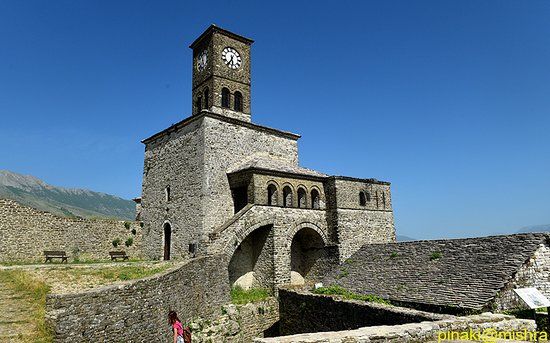
For the best views of Gjirokastra, head up to the castle. It's a hot, strenuous walk up if the sun is shining, so get an early or late start. Upon arrival, your 200-leke admission fee buys you access to most of the castle, including a gloomy hallway lined with artillery and the castle walls with scenic views of the town below. There is also an American spy plane on the grounds; locals say it was shot down during the Cold War but the official Tourist Information website says it just had to make an emergency landing near Tirana back in 1957. For an extra fee you can visit the prison, which was built at the request of King Zog (really!) and now houses a weapons museum. The on-site cafe was not open during my visit; I'd recommend buying water in town before your visit.
If there's one thing the former Ottoman Empire loves, it's a good ethnographic museum. Ethnographic museums typically showcase the culture and lifestyle of a particular group, and in Gjirokastra's Ethnographic Museum you can see how an actual 19th-century family in Gjirokastra would have lived. The building was constructed only in the 1960s (in the traditional style), but the site used to house Albania's communist dictator, Enver Hoxha and his house. In high season the museum is open mornings and late afternoons, with a long afternoon pause. Admission is 200 leke.
The square is named after Çerçiz Topulli (1880-1912), a national hero that fought for the independence of Albania together with his brother Bajo Topulli. I have found that in 1908, he led an uprising against the Ottomand and that he played a main part in the battle of Mashkullora, a mountain village 7 km north to Gjirokastra, outside of the valley, in the direction to Tepelena. However, I have been unable to find any information about the battle of Mashkullora, all the sites on the web about Mashkullora being in Albanian. However, I have found “Këngë për Çerçiz Topullin” (song for Çerçiz Topulli), a video where Irini Qirjako sings "Te Rrapi Ne Mashkullore" (The plane tree of Mashkullora) while the video tells the story of Çerçiz Topulli. It shows a terrible fight that should be the battle of Mashkullora and finally, Çerçiz Topulli is shot in the street by a passerby. I hope that some one will be able to explain better!
Another monument on Çerçiz Topulli square reminds the sad memory of two Gjirokastrian young women, Bule NAIPI and Persefoni KOKËDHIMA, that were hanged by the nazi during WWII as they were suspect to help the nationalists against the invaders. The anonymous sculptor has represented them just before they were hanged. Their face is terrible with determination and makes you shiver…
Palorto district is a little further up in the mountain than Varosh.
Photo 1 shows a part of the Palorto district, with a lot of trees and bushes growing around the houses. In the background, the soil is rocky and bare. This is one of those ravines that scare the slope of the mountain. Such ravines, inside the city, split one district from the next one and explain why it is often easier to go from one district to the bottom of the valley than to go to the neighboring district, at the same level on the mountain.
Photo 2 is a close up that shows an interesting example of typical Ottoman style house. The large house is made of three parts: two towers on each side, linked by an open but covered terrace on the top level.
Photo 3 is not very good. It is an enlargement of a 1998 photo that shows a house of the same type but with a double arch instead of a single in the middle.
Photo 1 shows Zekate house from Hotel Kalemi. Zekate house is an interesting example of typical Ottoman style house. The large house is made of three parts: two towers on each side, linked by an open but covered terrace on the top level. Zekate house is private and not open for visits but I have read that it might be open in the future.
Photo 2 shows the entrance into Zekate house
I have taken Photo 3 out of the excellent book “Albania” by Philip Ward (1983, Philip Ward and the Oleander Press). Given that it was printed 26 years ago I allowed myself to paste it here. Should there be a copyright objection, I would remove it at once. It is not the plan of Zekate house but of n°13, Rruga Muhamet Bakiri. It is another traditional house with about the same plan.
Keeping in condition the old traditional houses is expensive. Some are repaired but others are just left and decay by themselves. Their owners may have settled in more comfortable (and cheaper) apartments in the new city, or emigrated to nearby Greece or even further. The photos show one of such houses crumbling down. If no repairs are done soon, it will be lost forever.
Hotel Kalemi offers a wide view on the old and the modern city as well as on the castle.
Photo 1 shows the valley in the background with an interesting house standing in the middle on a shelf. It would be interesting to spot it and view it from closer.
Photo 2 shows the extremity of the castle (its clock tower) with in the background the Lunxherisë range of mountains that top at 1536. On May 17th, they were still covered with snow.
Photo 3 shows the whole castle with in the foreground, in the middle, Hotel Çajupi
Photo 4 shows Hotel Kalemi that is the large white house in the middle of the picture. In the foreground the two large buildings are a school with posters hanging (see other tip)
Shaded under a plane tree, the "kafe", shot in 1988, looks exactly like a Greek "cafeneion". There are amazingly the same people (enlargement on the second photo), sat on the same chairs, drinking the same café or the same glass of water, or not drinking anything but just chatting for hours.
No wonder as there is a strong Greek speaking population in Gjirokaster.
The photo could as well have been shot in Kastoria, 100 km away, as the crow flies, with a strong Albanian speaking population!
These three photos were taken in 1988 and I have been unable to find again this place in 2007.
Photos 4 and 5 were shot in 2009. The kafe, which stands on the street that goes on the left, down from the pass (the street that goes to Sheshi Çerçiz Topulli square goes on the right) has not much changed since then !
In Varosh, we spotted several ancient buildings that were subject to repairs. Though repairs in the traditional style are expensive, several houses have been repaired recently or are in the process of reparation. The photos given here show two of them.
Sponsored Links
Sponsored Links
Comments