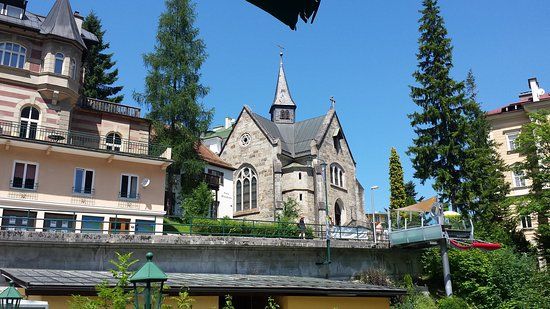
Also Bad Gastein developed, probably thanks to the fact that authors of the Romantic wave, in the early 19th century, discovered the charms of the Alps, so the high peaks, the deep narrow valleys and the waterfalls became an attraction. Wildbad Gastein had many illustrious visitors, among them the Emperor Franz Josef, the Empress Elisabeth (the famous "Sissi") who wrote four poems about this place, Prince Bismarck, Johann Strauss, Franz Schubert. King Wilhelm IX of Prussia (later the first Emperor of Germany) spent many holidays here. He was so fond of Bad Gastein that he appointed painters to capture the beauty of the landscapes he liked most.The flow of visitors increased when a railway was built. The Hohen Tauern Railway was completed in 1909, but Bad Gastein could be reached already in 1905. Several public buildings and hotels were built at that time, and their style is rather homogeneous, also because most of them were designed by just two architects: Josef Wassiken, from Salzburg, and the Italian Angelo Comini.
In the early 20th century the list of famous guests included King Georg of Saxony, Lord Balfour, King Karol I of Romania, Sigmund Freud, Arthur Conan Doyle, Arturo Toscanini, Somerset Maugham, Mrs Roosevelt. Then there was the "anschluss" (the annexation of Austria to the 3rd Reich) in 1938, and then the war. In the last months of the II World War Bad Gastein was used as an emergency headquarter for the government.
After the war Bad Gastein resumed its business, and the increasing popularity of skiing gave a new turn to tourism in this area.
Updated Sep 3, 2007
These valleys have been inhabited since ancient times. The latin name of this valley, as mentioned in medieval documents, was Gastuna. By the 16th century the reputation of its warm waters and their therapeutic power was widespread, and many people travelled here for this reason in the summer. At that time the name of Bad Gastein was Wildbad Gastein.
In 1807 the emperor Franz I inspected the place personally, in order to decide about projects to build infrastructures to take advantage of the spas as an economic resource. The thermal springs were at an altitude of 1000 metres above sea level, on the slopes of a steep mountain, so it seemed convenient to convey the water to the village of Hofgastein, which lies in the valley. That village, whose name became Badhofgastein, is still nowadays a thermal resort.
Written Sep 3, 2007
Visitors from other countries may find the opening times of Austrian shops to be very short. This can cause inconvenience especially when one wants to buy foods and drinks, so I am posting some information to help you plan your shopping.
There are two supermarkets in Bad Gastein, Billa and Eurospar, both open from 9 am to 6pm Monday to Friday, and 9 am to 5 pm on Saturdays. Both are closed on Sundays.
There is also a grocery shop with totally different opening hours, because it is meant to meet the needs of those who want to go to pic-nics or excursions. In fact it opens from 7 to 11 in the mornings, and then from 4 pm to 7 pm, seven days a week. It is not a big shop, but you can find the essentials there. The address is Kaiserhofstrasse 6. There are signs directing to it, but when you get there it is hard to find, because you cannot see it from the street. In fact it is inside the Kaiserhof. You need to go in through the main entrance, turn right and walk through the lobby. The Hapishop is past the reception.
Written Aug 21, 2007
Sights in Böckstein: Our favorite Maria zum Guten Rat Pilgrimage Church (constructed from 1764 - 67, the most important early Classical work in the SalzburgerLand). In this beautiful church the domed ceilings has frescoes depicting group of miners.
Altböckstein Montane Museum and the Altböckstein Montane Settlement (Medieval mining community).
The 14th century Paris Church in Dorfgastein has been partly remodeled in Baroque style. The Pfarfkirche in Bad Hofgastein is late Gothic Parish Church dating from the late 15th century, but it has a fine Baroque altar.
Mystery Church near Klammstein (in the natural cave, see the Gastein Valley above). It is one of the most important caves of Hohe Tauern and the largest of the Salzburger Central Alps (guided tours Tue – Sun 100 ATS).
Updated Sep 1, 2002
1 - 4 of 4
134 Opinions
79 Opinions
21 Opinions
Reviews and photos of Badgastein attractions posted by real travelers and locals. The best tips for Badgastein sightseeing.

Sights in Böckstein: Our favorite Maria zum Guten Rat Pilgrimage Church (constructed from 1764 - 67, the most important early Classical work in the...
Q: I don´t know which one of those hotels to choose. Could you recommend me one? http://www.hotzebra.com/hotel.php?id=74315 or...

A: Could you give the hotel names rather than a link to a booking site, please?
Read 5 Replies
1

The title of my page is the title of a walz by Johann Strauss, who composed it during a stay in the nice old little town of Bad Gastein
2
Badgastein and the Gasteiner Tal

Land Salzburg is a traveler’s paradise. The highest mountain range in Austria, the Hohe Tauern, lies on the southern fringe of Land Salzburg. The Hohe Tauern national park, the biggest national park...
3

Bad Gastein is a spa town in Austria situated in the middle of the National Park Hohe Tauern at 1,000m above sea level.
5
Badgastein, grandeur from the past

Badgastein was one of the first touristic centers of Austria. Several royal persons stayed in the hotels of Badgastein. At has a whole different characteristic than other alpine towns. At something...
Build your own Badgastein page