Brest lies astride the Mukhavets River, that is known to Bresters as "the river". The river flows west through the city, dividing it into north and south, and meets the Western Bug in the Brest Fortress. The river flows slowly and gently. You can hop into a tube that looks like a big rubber doughnut and take a relaxing float down this river.
July 28 is observed as the day of the city, its birthday. That is the day when the city and the people of the city look especially nice. Brest is the third oldest city in Belarus. First it was mentioned in old Russian chronicles in 1019.
A lot of festivities take place in all parts of the city during several days.Parades of knights, balloons and tiny flying machines show, concerts and sports events in the open air attract many guests from other cities
That is a must to see Brest at this time. The peak of the festivities is on the last Sunday of July
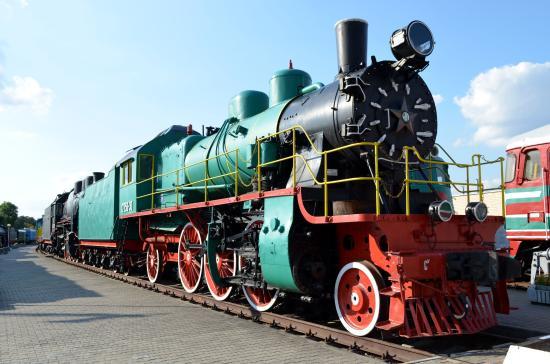
The museum was opened in 2002. It is quite unique as it was the ever first railway museum in Belarus. The display is in the open air, on the rails.
The collection comprises various locomotives like a choo-choo, cargo and passenger cars dating back to the 40s 50s of the last century. All of them are functional. Sometimes they are used for shooting movies or some tourist events. It's easy to find the museum.
City park, about 30 ha, is a nice place for a walk in Brest. It features dozens of rare species of trees. Visitors will see a big disco club, a concert stage in the open air, an amusement park and 2 lovely ponds that are called here Upper and Lower lakes. In 2004 the lakes have been reconstructed, even its bed was paved with cobblestones, the shore has a flamboyant embankment with nice wrought grids. CafĂ© “U Ozera (By the Lake)” is on the beautiful shore of Upper lake trimmed by the weeping willows. A canal connects 2 lakes
There's a very nice orthodox church just close to the bus station, in the heart of Brest old town.
I don't know the name of this church and to which saint it is dedicated, by the way it doesn't look very old, probably from the 19th century, and it's perfectly restored and kept.
Another very nice place among the pretty streets of Brest.
I know in Brest there's also Belarus' biggest orthodox church, built in the last few years, and I also saw it from the bus. It's out of the centre, in some commie-block district and I've no pictures of it, but surely it's quite impressive.
Starting from the Lenina, going to the bus station, you have to cross good part of Brest old town, which is formed by perpendicular streets lined with nice houses of the 19th/20th century. All houses of that time are rather small, with 2, max 3 floors, and most of them are very well restored with pretty colours. Some streets, like the Pushkinskaya (if I rember well) are partly pedestrianized, and everywell there are restorations, or have already been restorated in order to have a good pavement, treets and beautiful houses.
Walking around the centre of Brest is really pleasant, it's a pity I didn't have enough time to walk around a bit more and take many more pictures.
There's a very nice website full of pictures of the streets of Brest, so I suggest to take a look, if you are interested:
Streets & Squares of Brest
This is the first street in Brest you will walk along if you come by train. After passing on the bridge over the railway you are in Lenin street, and you understand at once you are not in Poland or EU anymore, not only because of the name, but also because of the big statue of the "Father of the Land".
It's not the most beautiful street in Brest, I'd rather say it's rather unappealing, but it's just the main street and you'l surely pass through it!
On the right side coming from the station there's the City Park, while in front of it there's the Gostinitsa Bug (see Hotel tips).
At the corner with Masherova street you can see a big rock which commemorates the first record of the town, dating from 1019.
In front of the public building of the Regional Administration you see on the pictures, there's the big Lenin Square with a catholic church devoted to the Exaltation of the Holy Cross. It dates back to the 1850 when all the other catholic churches of the old town were destroyed in order to build the fortress. It was bombed during the war, reconstructed in the 50s to host a museum and brought back to catholic believers in the 90s.
Brest is a many-confession city. Catholics and orthodoxies live there. Catholicism was kept here since times when Brest belonged to Poland. It is professed by Poles living in Brest. Orthodoxy is the basic religion of Russian and Byelorussians living there.
There are temples of both faiths in Brest. During last years the new orthodox temple was constructed and meets us each time when we go to "the Warsaw bridge".
For the first time I visited Brest in 1969. Those years the name of Brest was connected first of all with the Brest fortress. In the first days of Great Domestic war (June 1941) this fortress became a stronghold of resistance of the Soviet armies to fascists on the western front.
Heroism of defenders of the Brest fortress causes admiration. More than two months they kept fascists at walls of a fortress and did not surrender! Brest received a name of a hero-city owing to heroism of defenders of the Brest fortress.
Therefore I visited a fortress in 1969 and always dreamed to visit it again. It is insulting, that it did not manage to be made till now though I happen in Brest travel every year.
"The Warsaw bridge" is guilty I didn't come to Brest fortress all these years!
Excuse my ancient pics of 1969...
But the fortress and memorial are really worth visiting!
Brest citadel is enormous and waits for you to see all the history. You should read about the history before you go, otherwise it's just nice and big, but will give you nothing. Or you should visit the place with a tour-guide.
If you are not from Belarus, then it is probably easy for you to find out the other opinion about the history of Belarus and the creation of citadel.
When I find good sites or books, I'll let you know!
Sponsored Links
Sponsored Links
Comments