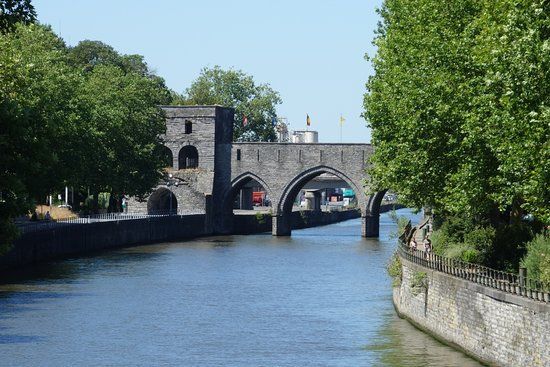
Favorite thing: Although born in Northern France, the Scheldt river (Escaut, as it is known locally, or Schelde in Flemish) is one of Belgium's main rivers. It is not very long but, after crossing the entire Flanders, it forms a very large estuary where the port of Antwerp is located, which happens to be the most important in Belgium and one of the busiest in Europe. This estuary is part of a larger delta formed by the Meuse and the Rhine.
In Tournai, the Scheldt looks pretty insignificant, rather like a canal, but its banks are lined with trees and make a pleasant promenade. The river splits the historical centre in two almost simetrical halves (although almost all the sights are in the Northern bank) and is spanned by several bridges (only one being historical - Le Pont des Trous).
Updated Jan 26, 2007
Favorite thing: Being one of Belgium's oldest cities, Tournai has a very rich history: already an important city in the Roman Empire, it became later one of the main cities in the County of Flanders. As former merovingian capital and birthplace of Clovis, the French Monarchy always considered Tournai as its craddle and, as a matter of fact, the city still bears the fleur de lys in its coat of arms. Under Henry VIII, Tournai came under the sovereignity of England. Later on, it was part of the Low Countries and, with them, was in the hands of different Empires: Spain, Austria, France and Holland.
Updated Aug 28, 2006
Favorite thing: This church can be found on one side of the Market Square. The statue in the foreground is of Christine de Lalaing, princess of Epinoy. She organised the defense of Tournai when it was besieged by the Spanish in 1583.
Updated Jul 31, 2005
Favorite thing: The most beautiful building on the market square is the cloth hall. It was the medieval center of the cloth trade. It started as a wooden building in the 13th century but has been rebuilt many times. It now houses temporary exhibitions.
Updated Jul 31, 2005
Favorite thing: Tournai has a beautiful belfry. It stands at the end of the Market Square and is 70 metres high. 257 steps will lead you to the top where you will have a great view over the Market Square and other great monuments.
Updated Jul 31, 2005
Favorite thing: Follow the signs to the centre of the city and you will end up in the Market Square, a nice triangle square, partly car-free. Enjoy a drink on one of the many terraces on the square while admiring the surrounding architecture.
Updated Jul 31, 2005
Favorite thing: It is now official; since the end of august 2004, Tournai has its own brewery again, la Brasserie de Cazeau. It is not located in the city center but in Templeuve, one of its 29 communes.
Beer has been brewed at this place since 1753. In the past, there was several wells to pump the water directly from the water table. Unfortunately it is not deep enough and since there are lots of farmers in the area, this water is now polluted with fertilizers and can’t be used anymore to make a beer…
Naturally the beer produced has been called “Tournay”, this is the name of the city using the old spelling (with a ‘y’ instead of the ‘i’). It is a gold-colored beer matured in bottle. It is then normal to find some remaining yeast at the bottom of the bottle. With 7.2% alcohol and a bitter taste, this could become a popular beer in the area…
From the end of October 2004, tour can be organized (from 5 to 50 persons), a local shop will be open every Friday from 4 to 7pm and every time there is a public brewing (check the website for the schedule), beer can be tasted as well…
www.brasseriedecazeau.be
brasseriedecazeau@yahoo.fr
info@brasseriedecazeau.be
+32472970953
+32476605548
Updated Aug 30, 2004
Favorite thing: This painter from the 15th century, mostly known as Roger van der Weyden, is one of the masters of the early Renaissance painting.
He was born in Tournai around 1400, that's where he entered the studio of Robert Campin, another well known master of this period.
He later became a city painter in Brussels in 1436
In the local museum of Fine Arts, you could admire one of his painting, the Virgin and Child with Jean de Gros.
This statue by Wolfers (1936), standing close to the cathedral, has directly been inspired by another of his painting, St. Luke Drawing a Portrait of the Virgin Mary, also known as St. Luke Madonna.
Updated Jul 4, 2004
Favorite thing: Louis Gallait is a famous painter of the 19th century. He was born at Tournai in 1810, produced his first picture when ten years old and entered the Académie of Tournai in 1823. He will then move to Antwerp, Paris and then back to Bruxelles where he will die in 1887.
A complete room of the fine art museum is dedicated to this local painter. Two of is masterpiece are shown there: the Abdication of Charles V and The Last Honors paid to Counts Egmont and Horn.
This statue stand in the park close to the town hall.
Updated Jul 4, 2004
Favorite thing: In the middle of the Grand Place stand the fine statue of Christine de Lalaing, princess d'Epinoy.
At a time when we were still fighting for religion, she defended Tournai during the long siege of 1581.
At that time, Tournai was mostly protestant. Alexandre Farnese linked to Philipe II, the catholic king of Spain, attacked Tournai with more than 20000 men.
The city resisted for two months but finally fall down. Farnese, impressed by the Tournaisian bravery, gave the order not to sack the city (custom practice at that time) and to let the protestants retreat with honour.
To answer Nicole's question during the VT meeting, she died in 1582 but still not sure how...
Written Jun 28, 2004
Sponsored Links
1 Review and 12 Opinions If I had to chose a hotel in Tournai and could afford it, I would probably stay in "Hotel...
1 Review and 20 Opinions A good hotel but a little dull I think. The hotel is, of course, near the cathedral and within the...
Auberge de Jeunesse de Tournai
1 Review and 0 Opinions Obviously, living in Tournai, I never had to stay in this youth hostel. However what I can say is...
Sponsored Links
Comments