Favorite thing: The tourist information is at the main square (although at the Tourist Hotel there is also a center). You can get maps and free brochures at the office at the main square and staff is very friendly, mainly young students. The main street is Thith March street, a street that goes to the fortress. Along this street you can find an internet agency (which is actually also a computer game centre) but the internet connection can sometimes have troubles, at least as I was there, dued to problems with the communication tower at the hills of Belogradchick. In the street mentioned, you can also find ATM’s and a supermarked. The First East National bank is near the Hotel Belogradchik Skali, here you can change currency.
Favorite thing: The Magura cave is hollowed out in the Rabisha hill (461m above the sea level). It is small monocline, which is part of the Belogradchik anticline. The cave formation started 15 million years ago. The Torton River hollowed out in the limestone strata the impressive halls and galleries. The total length of the galleries, discovered until now, exceeds 2000 m. Latest archaeological excavations show Magura Cave has been inhabited by Thracian tribes for centuries during the Bronze age. The Triumphal Hall, that is the first hall, was a settlement for many people. There are also finds of the Iron Age, especially ceramic remains. A small museum inside the cave shows the artifacts found in this cave. At the place of today's artificial lake was a small natural lake, always full of water, even during dry years. A grave of a young girl, buried during the Roman times, as the legend says, was discovered on a high platform at the end of the hall. The crossed arms of the skeleton and the two bronze bracelets indicate, that the funeral might be of Early Christian age.
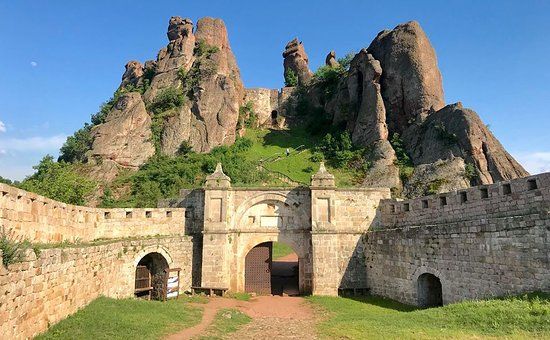
Favorite thing: The fortress has walls that are 12 m. high and 2.5 wide at their foot. The fortress consists of three castle yards separated by massive metal gates. There are guard-rooms, three gun grounds, three gun-embrasures, 365 gum-slots in the rocks, granaries and ammo depots. In the southwestern part of the middle yard there is a well. In the citadel there are two reservoirs for snow and rain water. The outer defense of the castle represented an outer circle made out of buried wooden stakes and knitted baskets filled with stones and gravel. The fortress occupies a territory of 10211 square kilometers. The last time the fortress witnessed war activity was during the war between Bulgaria and Serbia in 1885. The Belogradchik fortress impresses not only with its history but also with its aesthetics. The castle walls are decorated with columns, niches and reliefs with stylized images of plants and animals. The arches of the entrances are decorated with combination of red and white rocks.The fortress was restored and opened for visitors after it had been proclaimed a cultural monument. It is serviced by the Historical museum-Belogradchik.
Favorite thing: The citadel is a ancient stronghold that had been built among the unreachable rocks, when the Balkan Peninsula was within the confines of the Roman Empire (III century A.D.). The Romans took advantage of the inaccessibility of the rocks in construction of the fortress. They built only 2 solid walls to north- and southeast. The other “walls” are 2 great 100 meters high rocks. The fortress was used as a watch-fortress. Not far from the fortress have been found remnants of a Roman aqueduct. In its northwestern part has been preserved a dungeon, probably built by Bulgarians.In the second half of the 14-th century, the Bulgarian ruler Ivan Sratzimir expanded the existing fortification. He also built two walls (Southeast and Northwest) and put a garrison inside. In his reign, the Belogradchik fortress became the second-best in size and importance after the Vidin fortress, which was his main castle.In the end of the 14-th century the Bulgarian land was conquered by the Ottoman Empire, and in 1396 the Turks took over the Belogradchik castle. The riots in the area forced the Turkish authorities to widen and fortify the building. In the beginning of the 19-th century they made insignificant repairs and fortifications without changing its medieval look. The period 1805 - 1837 is known for the huge reconstruction and enlargement of the fortress. It was accomplished in the "contemporary" building standard. By that time the fortress received its European look. By that time the fortress' main improvements were built. In 1850 during the crush of the Belogradchik uprising against the Ottoman rule the fortress played negative role. The Belogradchik leaders were captured, taken out of the fortress through one of its tunnels and decapitated
Favorite thing: Belogradchik is an old settlement, originated as early as I century when the Romans built a fortress among the rocks. After that, this fortress and the settlement were ruined many times and built again by Byzantines, Bulgarians and Turks. A Turkish register by 1454 testified about the Bulgarian town here. In 1837 the fortress was finished in it present-day appearance. In the period of the Ottoman reign Belogradchik was a small agrarian – craftsmen town. A peasant revolt began here in 1850, but it was cruelly crushed and the last defenders of the fortress slaughtered. The name of the town comes from “Belija gradej” ( white building) of the fortress. After the Liberation (1878) Belogradchik becomes gradually a tourist center above all, which attracts thousands of visitors from the country and abroad, because of its Belogradchik rocks, one of the most beautiful natural landmarks in Bulgaria
Favorite thing:
You can approach the rock-area via the citadel, when you come at the parkingplace near the entrance, don’t go to the left (where you enter the citaladel) but go straightforward, and then walk around the backside of the citadel on your left side, where you find a path that goes down into the skali-area. Another way of approaching the rocks begins at the opposite end of the main street, opposite the Hotel Belogradchishkite Skali , where concrete steps lead down into a dry valley overlooked by some of the more spectacular rock formations. A path continues along the valley floor for several kilometres, providing views of a whole series of extravagantly weathered pillars, two of which are associated with misogynistic legends : the Nun , who was supposedly turned into stone for becoming pregnant by a knight; and the Schoolgirl , who was likewise afflicted after she was deserted by her husband.
The number of rock eagles and other hunting birds frequenting the Belogradchik area is said to be on the increase, although the only ones you're likely to catch sight of are the stuffed versions housed in the village's small Natural History Museum
Sponsored Links
Sponsored Links
Comments