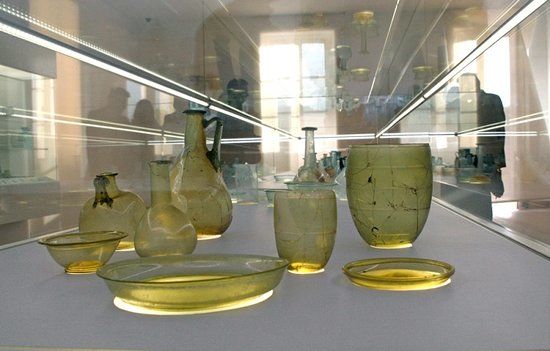
Almost every courtyard, inside of the old cores of Mediterranean cities, is hidding something valuable and worth of seeing. When strolling around be curious and do not hesitate to enter if the door is open. Remember, open door is invitation to enter, but even closed door could be open if knocking.
The town of Zadar has rich and long history which hasn't been entirely studied. Several years ago remains of the church Stomorica have been discovered only by chance. Zadar has been completely destroyed, several times in its long history, and many written documents just disappeared. There are in course some new excavations, next to Bablja kula, discovering remains from something what could have been cemetery from Roman times, but let wait and see what the historians will tell about.%s?
The huge neo-Classicistic building from the beginning of the 20th century is former Institute of St. Dimitri. It is dominating point of Zadar panorama from the sea. Within the institute, the Chapel of St. Dimitri was recently renovated. The University of Zadar, with over 600 years of tradition, was renewed in 2002 and now situated in the former institute.
Adjacent to the building of the Institute St. Dimitri is the Chapel of St. Dimitri. It is an unusual example of neo-Classical architecture in Dalmatia. The chapel was completed in 1906 by Viennese architect Karl Susan and is notable for its unusual central cupola.
The former church building, consecrated in 1280, belonged to a Dominican Monastery. In 1396, in this monastery, the very first and the oldest university of Croatia was founded by the friars of the Dominican order. Actually, the founder of Iniversity Iadertina was the supreme head of the Dominican order Raimund de Vinies from Capua. The tradition of more then 600 years classifies Zadar as the city with the oldest university cities in Europe.
Napoleon took Zadar in 1805 and he abolished the Diminican order, turned the church into a barraks, and shut down the university. Later on, and in particularly during the World War Two, the university was pulled down.
On behalf of the 600 anniversary of the university the local authorities have reconstructed the monastery in 1996 and it is home now to Zadar's popular and internationally acclaimed Puppet Theatre.
They say they have nicest Riva, the waterfront promenade in the country and I guess they're quite right. It's wide, spacious, shaded by side with park like green belt with benches and borders to historic facades of the city; it begins by the Liceum and ends by the Greeting to the sun. Its pavement is pleasant texture of small fractures of rock which is by the edges strenghtened with stone, beyond it - sea and views towards islands. Mankind of all walks and statuses, local and foreign, gaze and contemplate at the sunset, which is spoken about in superlatives (such as' the most amazing sunset in the world'... hm) but on a rainy day ... it's still one of the best walks in the city, with little less romantic rain showers or with gentle rains. To see how the drops end in the sea water has some charm, too.
There is more than the unusual woman wearing spike heels of 5-6" and tight jeans. This is the culture, and I must say, it sure makes them stand out in the crowds. There is upscale shopping in the old town, so you see a lot around the tour spots.
This beautiful promenade was constructed in 1.874 after the city walls were torn down. At the top west end, you'll find one of the most fantastic sunsets you can enjoy apart from other interesting spots such as The Greeting to the Sun and the Sea Organ (see next tips).
When I went to Zadar, August '09, there were hundreds of people strolling, stands with items to sell, food and live music; a great experience.
Note: It's a long explanation and I have decide¡d to take it from the web.
After the world-known Sea Organs, Zadar has become wealthier with one more urban installation. On Istarska obala, at the very end of the Zadar peninsula, next to the famous Sea Organs, shines the Greeting to the Sun made by the same architect Nikola Bašić.
The Greeting to the Sun consists of three hundred multi-layered glass plates placed on the same level with the stone-paved waterfront in the shape of a 22-meter diameter circle. Under the glass conduction plates there are photo-voltage solar modules through which symbolic communication with nature is made, with the aim to communicate with light, just like the Sea Organs do with sound.
Simultaneously with the "most beautiful sunset in the world" the lighting elements installed in a circle turn on, and, following a particularly programmed scenario, they produce a marvelous, exceptionally impressive show of light in the rhythm of the waves and the sounds of the Sea Organs.
The photo-voltage solar modules absorb the sun energy and then transform it into electrical energy by releasing it into the distributive voltage power network. It is expected for the entire system to produce around 46.500 kWh yearly, being, actually, a small power plant from which energy will be used not only for the Greeting to the Sun installation, but also for the lighting of the entire waterfront. This energy will be three times cheaper than the actual one, and the project itself is a unique example of connecting the use of renewed energy sources, energy efficiency and city space arrangement.
In cooperation with prof. Maksim Klarin from Zadar Maritime School, the names of the saints after which present and previous churches on the peninsula have been named are carved in the ring surrounding the Greeting to the Sun. They are sanctae Anastasiae, sancti Donati, Simeonis Ivsti, Chrysogoni and Zoili, and also Hieronymi, Lucae, Platonis, Eliae... Next to their names and the date of their feast day are the declination and the altitude of the sun, the length of the sunlight on that day and in that place on the waterfront. Thus the connection is emphasized between Zadar and the Saint Grisogonus Calender, who contributed greatly in marking time and astronomic navigation at its very beginnings.
The Greeting to the Sun installation, as a model of the solar system with its appertaining planets, is connected to the Sea Organs whose sound is transposed into a show of light that starts performing on the Zadar waterfront after sunset. In creating the lighting effects, the installation will be able to receive other outer, spontaneous impulses through modem connection, while the lighting pictures will adapt to different occasions.
The attractiveness of the Sea Organs, for which the esteemed Zadar architect Nikola Bašić has received numerous international and national awards, has charmed not only Zadar and Croatia, but also the entire world, and there is no doubt that Zadar has acquired a new and excellent attraction with its Greeting to the Sun.
Where?: At the end of the Zadar peninsula, on the west, next to the sea organ and facing the sunset.
The Sea Organ is situated near the new cruiser port, as a part of Zadar's Riva, and can be observed as a differently shaped part of the coast which consists of several stairs that descend into the sea. The stairs extend for about 70 meters along the coast, under them, at the lowest sea-tide level, 35 pipes of different lenght, diameter and tilts were built in vertically to the coast and they raise aslant until the paved part of the shore and end in a canal (a service corridor). On the pipes there are LABIUMS (whistles), which play 7 chords of 5 tones. Above the canal there are perforated stone stairs through which the sound comes out, the air pushed by the sea.
Note: Excerpt taken from the web.
Where?: Zadarska riva, at the end of the Zadar peninsula, next to the Sea Organ.
I really don't know if this is a local custum or not, or a custom among the tourists, the only things I do know, are: There were lirerally hundreds of people watching the sunset amd it was absolutely amazing!
Sponsored Links
Sponsored Links
Comments