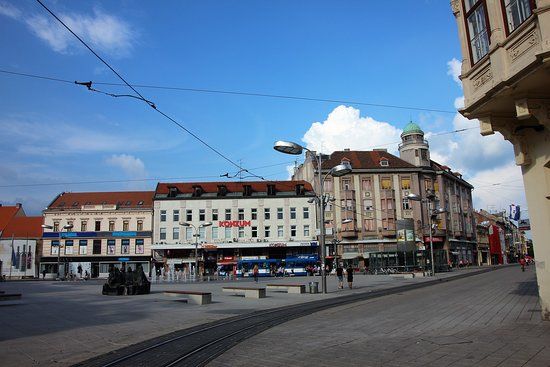
Favorite thing: Trg Ante Starcevica, the A. Starcevic Square, is located in the Upper Town. It is the main square of the town, and administartive and business center of Osijek and whole region of Slavonija.
Most buildings on the sqare date from the late 19th and early 20th century. The city centre preserved intrigate Austro-Hungarian Baroque in its older quarters.
Updated Jan 17, 2012
Favorite thing: Due to its strategic and military importance, the Austrian authorities have built Tvrdja (huge fortified complex) between 1712 and 1721. The fortress was designed by architect Maximilian de Gosseau. It was built, in a first place, in order to controll and defend the southern border of the K und K monarchy.
Updated Jan 17, 2012
Favorite thing: Tvrdja is a unique urban and military complex that lies in the heart of the town.
Most of the buildings on the central the Holy Trinity Sqare and around it, were designed in Baroque style.
Updated Nov 21, 2011
Favorite thing: The Main Guard building, built in Baroque style, closes the the west side of the Holy Trinity Square.
In the ground floor there are arched porticoes, while on the rooftop stands the clock tower.
Updated Nov 21, 2011
Favorite thing: In the middle of the Holy Trinity Square stands the monument of the Plague, erected in 1729 by general Petras' widow.
The former building of the Military Command, from Austrian times, stands rifgr behind the Plague pillar.
Updated Nov 21, 2011
Favorite thing: This passage way leads from the defending city walls into the central part of the fortress.
See the bricks structure of the walls build in several rows in order to protect against the bombing.
The region of Slavonija is a plain country with no stones at all, therefore all the buildings and city walls were built of bricks.
Updated Nov 21, 2011
Favorite thing: This Baroque stalyed building represents the former military barraks from the time of Austrian authorities of Osijek. It used to be inside the city walls on its eastern side which was demolished during the centuries.
The barraks were heavily damaged in Serbian attacks in 1991, but now it is completely rebuild.
Updated Nov 21, 2011
Favorite thing: This is one of the defending towers of the fortress of Tvrdja. Actually, it is the only one left and well preserved. The tower is overlooking river Drava and was built in order to controll free navigation over the river.
Updated Nov 21, 2011
Fondest memory: A small group of us had lunch at a B&B in the small village of Bilje, not far from Osijek. We had a lovely lunch on an outdoor patio, with our host holding forth on Balkan politics while his niece served the meal. It included plum brandy made by a friend of his and served in a Valvoline bottle . (When the friend gave it to him, he said, “This is not for your car.” I tried it—Whoof!!)
He drove an ambulance during the war and saw too much, he said. He got 15 minutes warning when the war started. A friend called and told him, “Run! They are here and killing everyone.”
He had a nice house that he built himself over 4 years. It was completely destroyed in the war, but he has rebuilt it. He showed us photos, which were about the only things he saved when his house was bombed. He had pictures of the house before and after it was bombed. It was an interesting afternoon!
Written Oct 23, 2010
Fondest memory: Fifteen years after the war in Croatia, war scars are still visible everywhere: on street pavements, on old facades, on plots of land where grass now rules.
Osijek was the largest city that was directly on the front line. For months in autumn and winter 1991/92 there was only one or two roads leading to/from the city. It was encircled by Serbian and Yugoslav army forces that occupied most of the northern, eastern and southern suburbs. The city was heavily bombed for months, and it is amazing that despite the large number of civil causalties remained functioning "normally" throughout the siege: trams were running, hospitals working, bakeries making bread, local shops being open....
War scars on facades are being repaired in a rate that is both amazing (when one is aware of the scale of destruction) and too slow. The hardest scars - those on people of Osijek, take the longest time to heal.
Written Jun 29, 2006
Sponsored Links
2 Reviews and 20 Opinions I am sorry, this is going to be one of those "I am writing this hotel tip although I never stayed...
2 Reviews and 6 Opinions We only were able to stay their one night, but the Waldinger was a rather exceptional hotel. Hotels...
2 Opinions
Reviews and photos of Osijek attractions posted by real travelers and locals. The best tips for Osijek sightseeing.

Fifteen years after the war in Croatia, war scars are still visible everywhere: on street pavements, on old facades, on plots of land where grass now rules....
39 members live in Osijek

Q: hi guys, I arrive at Osijek airport on Sunday, May 23rd at 4pm. I need to get to Banja Luka in Bosnia that evening. I have...

A: Where you arrive from? Using Ryanair arriving 15:55 from Frankfurt/Hahn? OK... This is the web site of the bus station in...
Read 17 Replies
1
Osijek - buildings, parks & monuments

"You know - that weird monument.... My weird cousin from Zagreb finds it interesting... And after he told me the idea behind it, and the story it represents.... It looks a little less weird now.... I...
2

Osijek is a very lovely old city in Slavonija, fit in the midst of the Slavonian plain! It's a typical Austro-Hungarian style old town, with cute colourful houses, flowers on balconies, large......
4

Osijek, situated on the right bank of the river Drava, is the administrative and economic centre of Eastern Croatia. The history of the town goes back in Roman times when the emperor Hadrian raised......
5

No time to write more or photos etc, but this was the best city that we visited in Croatia and it was really really really hard to leave...
Build your own Osijek page
Sponsored Links