
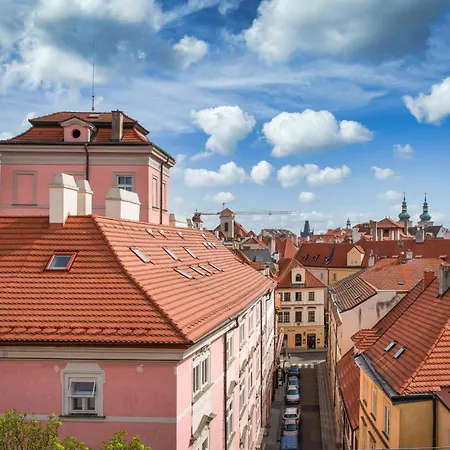
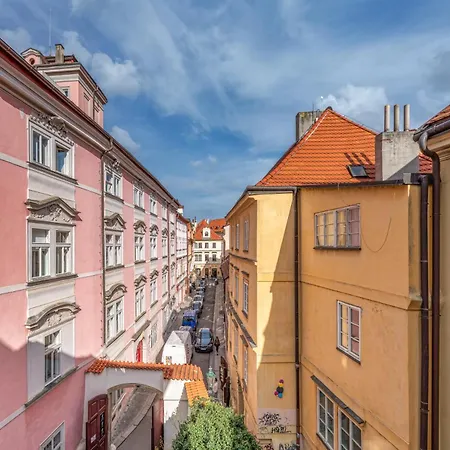
This is a short street with several colourful small houses. They were originally built in the 16th century for the castle guards.This street was named after the goldsmiths who went to live there in the 17th century.
Most of these houses are nicely furnished as they could have been long ago. Some other are used as souvenir shops.
It is said that Franz Kafka lived at n. 22 for some time.
You need to get a Prague Castle ticket to gain access to this charming historical street, but I thought it was entirely worth it! The little houses on this unique street were built in the early 16th century to house the king's guards and servants. However, by the 19th century, the area had fallen into a sad state of disrepair and the once charming houses were taken over by bums and criminals. In the 1950s, the Golden Lane came back to life when plans were made to restore the entire street. At that point, most houses were turned into bookstores and souvenir shops, and some also feature small exhibitions.
The street's name refers to the presence of alchemists in the 16th century who set up laboratories in the area to conduct experiments in an effort to turn lead into gold (needless to say, they did not succeed!). Perhaps one of the street's most famous former residents is Franz Kafka, who once lived at No. 22. Another well-known building to which visitors have access is Daliborka Tower, a 16th century prison built to hold members of the nobility in custody. Visitors can climb down to see the prison's dungeons, which still feature some torture instruments.
Golden Lane (Zlatá ulička) is a narrow ancient street within thePrague Castle complex. Dating from the 15th Century, Golden Lane is lined with 11 historic houses. Nowadays it is a popular section of the Prague Castle complex and it attracts its fair share of tourist.
Many of the historical houses have become souvenir shops like number 22. It was once homes of the writer Franz Kafka's sister, where the writer spent many evenings and the Nobel-laureate poet Jaroslaf Seifert.
http://www.pragueexperience.com/places.asp?PlaceID=964
THIS TIP WAS TIP OF THE DAY: TIP OF THE DAY ON FACEBOOK 08-02-2012
A special atmosphere reigns in the little street by the Prague Castle, called the Golden Lane. It is lined with small picturesque houses, that look rather like doll´s houses than people´s homes. They are coloured and the origin of some of them goes back to the 16 th century. The renowned writer Franz Kafka lived in the Golden Lane for some time during the World War I.
History and legends of the Golden Lane
Originally, there was just a wall behind the Prague Castle. As time went by in the 15 th century, first modest houses were built along it. The original name of the street was Goldmakers Lane, so most of the first inhabitants were probably Prague goldsmiths. These houses were demolished in 1591. Six years later, Emperor Rudolph II. let the 24 Prague Castle´s fusiliers build their houses there.
Also craftsmen and servants lived in the Golden Lane later. According to legends, Emperor Rudolph II. had some of his court alchemists accomodated in the Golden Lane, where they tried to turn metal into gold. That could also be the origin of the name “Golden Lane”.
Franz Kafka and other famous people in the Golden Lane
Since the 19 th century, the houses were mostly rented. There were some important Prague writers among the renters, including Franz Kafka. He lived in the house no. 22 with his sister Ottla in 1916-17. He wrote some short stories for the book A Country Doctor there. Apparently, the Golden Lane by the Prague Castle is where he found inspiration for his book The Castle.
Another writer, the Nobel prize winner Jaroslav Seifert lived in a now demolished building between the Golden Lane and the Dalibor Tower (Daliborka) in 1930s.
The house no. 14 was a home of the fortune-teller Madame de Thebes since 1918. She used to crystal gaze and tell fortunes from cards. She was killed by Gestapo at the end of the World War II., reportedly because she foretold that Adolf Hitler will die soon.
Golden Lane at the present time
The houses in the Golden Lane were nationalized after the war and later restored and painted, between 1952 and 1955. Nowadays, there are mostly souvenir and book shops there.
Probably the oldest house in the street is the one with number 20. It looks almost the same as it did in the 16 th century.
The original regulation to build the houses only in an arch of the wall is demonstrated by the house no.13, the only one that does not protrude into the Golden Lane.
Golden Line is little street with small picturesque houses. They are colored and the origin of some of them goes back to the 16 th century. The original name of the street was Goldmakers Lane, so most of the first inhabitans were probably Prague goldsmiths. Franz Kafka lived in the house no 22 with nis sister Ottla in 1916.-1917.
If you come after 18 h entrance is free.
Golden Lane is known from 15th century, when goldsmiths, servants and craftsmen had opportunity to live here. Later, in 20th century, Franc Kafka lived at one of houses and wrote his work “Castle”. As legend tells, Emperor Rudolph II allowed alchemists to live here as well, so name “Golden Lane” probably appeared due to goldsmiths or gold-seeking alchemists.
The oldest house on Golden Lane now is from 16th century. Lane is full of book, souvenir shops. It is really a unique place.
The question is: why these houses are so small? Were people so small before? Maybe it is because of servants (lower class) was living here (lower class – lower life conditions)? And…maybe houses are small to create an inspiring feeling for artistic people (eg. for Kafka)?
This is a little street in the Castle area with many shops where people can buy souvenirs. The idea of this lane is to show different handicrafts of the previous time. I was there a week before Easter so everything was covered with flowers and colored eggs.
In the Golden Lane some famous writers have also lived, among which Jaroslav Seifert and Franz Kafka. Kafka lived for some months with his sister to the number 22 in 1916-17.
According to the legend the alchemists and the adventurers worked in the alley and they tried to produce gold for Rudolph II. In reality such laboratories were found in Vikarka, the little street between the Cathedral of St. Vitus and the Tower of the Dusts.
Golden lane is situated in the northern part of Prague castle. Probably some goldsmiths lived here in 16. century, then the name of it. The houses, doors are very small, which shows how high people were that time. The most famous is house 12, where Franz Kafka lived for a short time and also many czech famous novelists and writers like Jaroslav Seifert used to meet.
The lane is very short, full of tourists and houses are colored and cute. There are shops and souverinrs in all houses. At the end is Daliborka tower, served as a prison.
At the end of the Prague castle tour. There is a row of souvenir shop's called the golden lane. They seem to be quite reasonable for the average souvenir shopper. A couple of things that stood out was the book's that I bought about the folklore and fable's. Another thing that was reasonable were the ceramic bell's, they were small so they fit in your luggage. Happy hunting!
Sponsored Links
Pension Unitas & Art Prison Hostel Prague Prague
5 Reviews and 450 Opinions Pension Unitas is built in the building that housed prisoners of the former Czech Secret Police,...
Aria Hotel Prague
7 Reviews and 692 Opinions innovative musical theme, great location in Mala Strana, except that it is nextdoor to the American...
Arcadia Residence Prague
1 Review and 765 Opinions This is absolutely a great choice for family and budget travellers. The residence sits in a quite...
Sponsored Links
Comments