Favorite thing: Glass is an amorphous noncrstalline solid and has great plasticity which increases with temperature. Working sand (a silicon dioxide source) into glass undoubtedly was discovered (invented) around primitive kilns or hot fireplaces (about 3000BC). The Romans developed the manufacture of glass and their artefacts include many glass containers, some of them colored.(Probably again accidentally discovered, the result of metal contaminants around the kilns, later by trial and error). Glass technology (like sculpture) disappeared around 500AD and was reintroduced from the Orient about 750. Strong plate glass was much later. At first (and still used) thin plates of alabaster admitted light through narrow windows. The Venetians perfected crystal glass in the 15C.
At Chartres the thechnics of making stained glass windows became a major art form. It had already been used sparingly in Augsburg where two small windows of early 12C exist in place (which we have not visited) and more extensively by Abbot Suger in St. Denis (1140-45).(It is probable that these craftsmen went on to Chartres).
The small pieces of colored glass are held together by lead strips and mounted in an iron frame which provides support, wind resistance and part of the design, extending that of the stone tracery in which they are set. Stained glass as windows, lamp shades and decoration continue to this day with artists like Lafarge and Tiffany, or Chagall and Matisse in Nice and Vence (The Rosary Chapel). The Glass serves the religious purposes of the Cahtedrals but is not confined to the Bible. The Rose windows have a mixture of religious symbolisms, and some windows emphasize the meaning and regularity of life as the Zodiac and in the Labors of the Months.
Fondest memory: The Hundreds of Stained Glass Windows.
Written Apr 7, 2007
Favorite thing: Henry Brooks Adams (1838-1918) was the fourth son of a congressman and ambasador to England as well as grandson and great-grandson of two presidents. Aside from a stint as an Assistant Professor of History at Harvard and a multivoume seminal work in American History, he led a pasive life at the edge of high level politics. He was relatively rich as the result of inheritance and investment prowess. He wrote sparingly on the "science of historical theory" until he was 75 when he first privately published his "travel book" titled "Mont-Saint-Michel and Chartres (1904) and an autobiography of his intellectual growth "The Education of Henry Adams" (1918), both publicly printed at that time and reprinted continually thereafter. They are each leisurely reads. The Chartres book is also a fine introduction to the 11-13C.
If you are to enjoy Chartres Cathedral to its fullest (not to just glance at and be bedazzled), please buy a guide book( the bigger the better) at the cathedral bookstore and be sure to bring binoculars. At the bookstore inquire about the tours given by the remarkable Malcolm Miller and try to go with his group. Be sure that the book(s) you buy are by him. If he is not there you may be able to purchase one of his videos. If you are up to it, read about Chartres on the train ride out from Paris. Tear out and bring with you the pages from the appropriate Rick Steves, Blue Guide or Michelin (most of my guide books are bound by heavy rubber bands at home). Enjoy!
Fondest memory: The West Front Statues
Written Apr 3, 2007
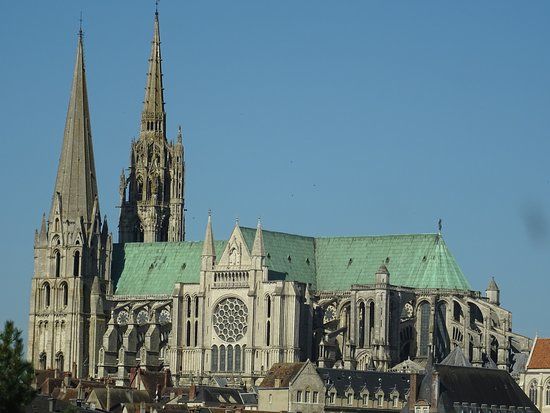
Favorite thing: Notre Dame of Chartres was a new Romanesque Cathedral built to house its sacred relic, the shirt (tunic) worn by Mary when she gave birth to Jesus. In 1194 with only 1 1/2 towers completed, it was consumed by fire leaving only the towers and West wall standing. Amazingly, the tunic was also unscathed. An hysterical wave of emotion enveloped all the people for miles around that this was a Sign and a new Gothic Cathedral was built in 25 years (except for minor aspects). Originally the doorways and wall were recessed 40 feet on a line with the backs of the towers, but they were now brought forward. The original wall only went to the tops of the lancet windows and this was altered slightly to continue upward with the latest architectural creation, a Rose Window. Vertical pilasters for rhythm were added and eventually the North Tower and a spire in Flamboyant Gothic were added and this is what we see now!
Written Apr 1, 2007
Favorite thing: When you visit Chartres, you'll inevitably be spending a considerable amount of time looking up. The architects actually intended the cathedral to feature its most beautiful adornments very high on the walls, guiding the eyes of worshippers to look up toward God and Heaven.
Fondest memory: There are literally thousands of sculptures and it's nearly impossible to photograph the best ones when you're standing below them.
The sculptures include depictions of workers and scenes of ordinary people's daily lives as well as a multitude of saints. Even French kings and queens have several statues beneath religous figures along a portal near the entrance that I like to call "Royal Row"
Updated Aug 6, 2005
Favorite thing: A fire actually destroyed the cathedral completly in 1194 except the south tower and the south steeple. The North Tower, if you could observe in the picture is slightly different in architecture.
The façade of the main entry called the Royal Portal and the beautiful window over this entry was rebuilt within only 39 years (1194-1233) in gothic style.
Written Jul 24, 2005
Favorite thing: Some of these windows actually dates back into the 12th century. There is the Blue Virgin, and also if you check in the side aisles and the ambulatory, some windows have been given during the 13th century by craftmen corporations, merchants etc..
When you go, please try to look under or at the bottom of the windows, and you will see the signatures of either the donors of these windows or that of the craftmen. These signature inform tourist about crafts, tools and costumes in the middle ages.
Written Jul 24, 2005
Favorite thing: The Cathedral of our Lady is a place of great wealth. As you drive into the town from Paris end, or Versailles as in my case, you could see the church in its majesty. I stop the car to take a shot of this first view.
It is a high place of chritianity, an important pilgrimage centre and also a cultural artistic and historical monument.
Fondest memory: The size of the church, and the stained glass.
Written Jul 16, 2005
Favorite thing: Before buttressing was invented walls were thick and bulky with no space for glass. Once builders began using buttresses, thinner walls could be supported with the buttresses and the stained-glass windows could be included in the construction. You can see these in Chartres and in the famous Notre Dame in Paris. I do think the buttresses in the cathedral in Paris has much more graceful buttresses than at Chartres.
Updated Jun 20, 2004
Favorite thing: The outdoor sculptures of Chartres are almost as renowned as the stained glass windows. They adorn the cathedral's exterior around the doorways. The sculptures in the photo are on the sides of the Royal Portal and are of the Apostles.
For more information on the sculptures, check out http://ww.blufflon.edu
Updated Jun 12, 2004
Favorite thing: Inside the cathedral there is a round section of carvings that depict times in the life of Christ. Each section is numbered as you can see in the picture. Each is a masterpiece itself. I haven't found any information on this series of carvings, so don't know when they were done or who made these carvings.
Fondest memory: This is such an amazing church, I would love to go back and take another look - just unforgetable.
Updated Jun 12, 2004
Sponsored Links
Mercure Chartres Centre Cathedrale
72 Opinions
77 Opinions
Ibis Chartres Centre Cathedrale
2 Reviews and 166 Opinions Very happy with this hotel for my situation. Took the train from Paris and was able to walk (perhaps...
Reviews and photos of Chartres attractions posted by real travelers and locals. The best tips for Chartres sightseeing.

Inside the cathedral there is a round section of carvings that depict times in the life of Christ. Each section is numbered as you can see in the picture. Each...
4 members live in Chartres
Q: Hi! I would like to travel from Chartres to Orléans, preferably by train. Are there any trains? Is there a bus to catch? How long...

A: Eva-li, there are no direct trains from looking at www.tgv-europe.com, so you must go via Paris or via Tours Centre. The trip is around 4 hours, 45mins (depending on the...
Read 11 Replies
1

In 3 decades we have visited Chartres at least 4 times. The first time we went as most tourists do, on a do-it-yourself day trip from Paris. We were totally overcome (as was our 10 year old grandson 8...
2

We were fortunate to visit this marvel of a cathedral on a sunny day. The nearly two hundred stained glass windows turned the interior into a prism of colors emanating from every side. It was an...
4

I was told severally about the importance of this pilgrimage centre by friends and colleagues. But, going there was not really a planned trip. I had set out to see Versaille for the second time with...
5

I've got some interesting experiences in Chartres. I'd love to share with you the 38 tips I've written, the 197 photos uploaded, and 7 travelogues I've created.
Build your own Chartres page
Sponsored Links