Oh dear, I really don't like this church. It is the second largest church in Paris - second only to Notre Dame - but the contrast between the architectural mongrel that is St Sulphice and the serene Gothic perfection of Notre Dame is, at least in my mind, both stark and unflattering.
I spent a long time staring at St Sulphice to try and work out what architectural style to ascribe to it ... and, in desperation, consulted Wikipedia (which charitably describes it as an 'unorthodox essay', which must be architectural code for 'a dog's breakfast'). It tells me that it was designed by Giovanni Niccolò Servandoni with a "double Ionic colonnade over Roman Doric with loggias behind them unify the bases of the corner towers with the façade; this fully classicising statement was made at the height of the Rococo". That explains it then - 'Rococo' is dangerously close to 'Baroque' in my book, and I am violently allergic to both!
I also dislike the church's interior (admittedly not quite as much as the exterior) but it does, however, boast one interesting feature: a gnomon. Much though this may sound like a resident goblin, it is in fact a device for calculating the dates of Easter. This is achieved through the alignment of a sunbeam shining through a lens set into one of the windows, a brass meridian line inlaid into the floor and an obelisk at noon on winter solstice (21 December) in a manner that I don't begin to understand. If this all sounds very much like mystic symbolism in the vein of Dan Brown novels, then it will come as no surprise to know that St Sulphice is the setting for one of the early scenes in the Da Vinci Code movie, although permission was refused for filming to take place here, so the setting was recreated using CG graphics. The mere thought of that hideous architecture in combination with Tom Hanks' unfortunate mullet haircut is just too much aesthetic overload for a soul to bear!
And, finally, the million dollar question: who was St Sulphice anyway? Well, St Sulphicius (also known as Pius) was Bishop of Bourges in the 7th century.
But I really like the square on which it stands ...
P.S. Just to further endorse its 'unorthodox' credentials, you may be interested to know that the Marquis de Sade was baptised in this church.
Update (October 2011): Our resident VT organist, dnwitte, informs me that St Sulphice is the place of pilgrimage for organists visiting Paris and also has the best resident organist in the city - maybe next time I should consider visiting blindfold???
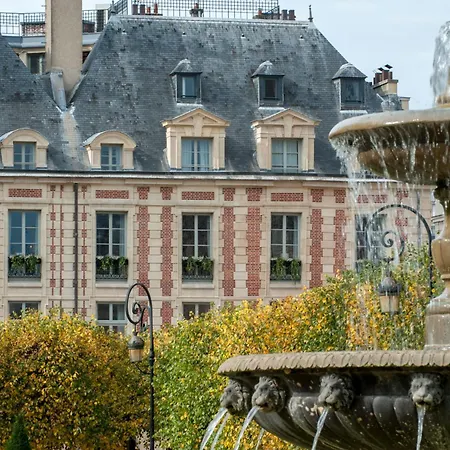
Although I actively dislike the architecture of St Sulphice church, I do find the large square on which it is located much more to my liking. It has pleasing proportions in keeping with the grandiose proportions of the church and an equally large fountain to match, making it one of Paris' more imposing squares.
The fountain is a nice piece of mid 19th century sculpture, and features a bishop at each corner (none of whom ever made it to cardinal). On a hot summer's day, the sight and sound of the water is particularly soothing, especially if you can bag a seat in the shade on one of the adjacent benches.
Living in a city that has relatively few public spaces, I really relish the way that Europeans utilise parks and squares as a place to congregate and while away their leisure time. I imagine that the square would be especially lovely in late spring, when the horse chestnut trees are in flower (apparently the 'candles' on the ones in this square are pink rather than white).
The monumental fountain of St Sulpice is of imposing size, 12 m high.
The three lower basins have an octagonal form. The second is decorated with four lions holding between their legs the arms of Paris. From the third water flows in the two lower basins through a nice system of waterfalls.
Above the basins stands a square construction with four niches for large statues of bishops which under King Louis XIV were famous as preachers. Two of them Bossuet and Fénélon are still in the memories of those who like me had to study their works at secondary school. Yes in those times we would read Bossuet and Fénélon at school and have fun at home reading Balzac!
These nostalgic souvenirs just to say that this fountain is really beautiful, actually better than what can be seen inside the St Sulpice church.
St Suplice was always a fine place to visit, but is now even more firmly back on the tourist agenda due to the popularity of Dan Brown's book "The Da Vinci code".
Whilst anyone with even a very basic theological knowledge would know that it is a load of complete twaddle, this has not stopped thousands being taken in by this elaborate con. Even more were no doubt taken in by the moronic film of the same name.
Many like to visit this church, which is the venue for one of the book's central scenes. If you look in one of the transcepts there is a typed notice (not sure if it is still there) which refutes the idea that the church was formally a pagan place of worship, that the brass line running across the church is an ancient 'rose line', and the inter-linked 'PS' on the stained glass windows are not a reference to a mysterious ' Priory of Sion'. The notice can't even bring itself to mention the book by name.
Whether you have read the book or not, the church is well worth a visit if you are in the Latin Quarter area.
I updated this tip just to say that I entirely agree with the opinion of Cathy Reichhardt. In French we use the word "art Sulpicien" as a definition of bad religious art.
Some like St Sulpice church, others not.
In France when one speaks about "art Sulpicien" it has often a pejorative meaning.
That's also what I felt after a second visit. The interior of the church is not really a highlight of religious art. I don't know what to say about the "Chapelle de la Vierge" from the 18th, maybe I better say nothing; it's so typically "Sulpicien".
But let's look in the other direction where one sees one of the world's finest and most famous organs, constructed by Aristide Cavaillé-Coll in 1862. He used many materials from the church's earlier French Classical organ built by Clicquot in 1781. The sound and musical effects with five manual keyboards of this instrument are almost unparalleled.
Presently the church is most known for references in popular culture. Dan Brown was mostly wrong with the Priory of Sion. After all the Da Vinci Code is a novel. Better as what concerns the literary value are the novels of the French writers like H. Balzac with " Splendeurs et misères des courtisanes" or J.K. Huysmans with "Là-bas".
Finally I prefer the outside with the original architecture of the two towers (one hidden by works) and the beautiful fountain from 1847 by Louis Visconti
In the square in front of Èglise Saint-Sulpice is a very large mid-1800's fountain that commemorates four bishops: Bossuet, Fénelon, Massillon and Fléchier. It was designed by architect Joachim Visconti, and each of the four figures was sculpted by a different artist. Place Saint-Sulpice is a lovely little square with cafes nearby and benches for resting tired feet or having a bag lunch. As you can see, these young people chose the fountain itself for a little tête-à-tête.
This 17th century baroque/neoclassical beauty was a church of note long before Mr. Brown figured it into his book. Only slightly smaller than Notre Dame, it was the place of the notorious Marquis de Sade's christening and Victor Hugo's wedding. The current structure, built on the site of a former church, dates from 1646-1745 with a facade that appears strangely out of balance due to a mismatched pair of towers: one was never completed. Interior restoration in the mid 1800's repaired damage occurring during the French Revolution when it was briefly a Temple of Victory, and additional interior and exterior cleaning and repair was performed and completed in the past decade.
Highlights include:
• One of the largest organs in the world with 6,500 pipes, 102 stops and five keyboards
• Frescos by Eugène Delacroix
• Beautiful Chapel of the Madonna designed by Florentine architect, Jean-Nicholas Servandoni, (who also designed the west facade) and sculpture of the Virgin by French artist, Jean-Baptiste Pigalle
• Gnomon: an astronomical device that operates much like a sundial, determined the exact date of Easter each year, and was employed in several other French and Italian churches. This one gained some notoriety due to its fictional role in the Da Vinci Code.
• Macabre tomb of curate Jean-Baptiste Languet de Gergy, commissioner of the gnomon, by René-Michel/Michel Ange Slodtz
The church is open daily from 7:30 AM - 7:30 PM and hosts regular organ and music recitals. This link has concert information in both French and English:
http://www.stsulpice.com
This link for background about the church itself is only in French but online translation sites can help you figure it out:
http://www.paroisse-saint-sulpice-paris.org/visite.aspx
Please be respectful in dress and conduct, and do your looking about when services are not in process.
St Surplice, is yet another well known church in Paris that has a musical history.
It is one of the biggest churches in Paris, with one of the biggest organs, frequent concerts are held here.
The church itself is old and imposing.
Great to visit and look around
After seeing the church feature in the film " The Da Vinci Code" starring Tom Hanks, I thought it was about time that i visited the church in reality. There was a service on going during our visit. It was fairly full.
The church is large and architecturally impressive.
What was not my surprise a couple of weeks ago when walking around by St. Sulpice and noticing that the scaffolding was finally down. The north tower is now showing nice and shiny. I'm afraid that the south tower need doing, still it does look much better. Begun in 1646, but only finished in 1745, it is the second largest church in Paris, slightly smaller than Notre Dame. Victor Hugo was married here and the Marquis de Sade and Charles Baudelaire were both christened in the church. Another claim to fame is of course the "gnomon and meridien line" that were featured prominently in the book and film "The Da Vinci Code". Whilst making a good book there is not an ounce of truth in saying "it was once a pagan church and the meridien line has never been known as the Rose Line". Neither is it in line with the meridien that goes through the Observatory. With the use of a small hole in the south window and using the sun, one could determine the time of the Spring and Autumn solstices and other scientific purposes such as determining the Earth's orbit by following the position of the pinhole point of the sun on the brass line.
The lovely fountain in the square is by Visconti and has four sculptures of Louis XIV's bishops.
Nearest metro is St. Sulpice.
Sponsored Links
Four Seasons George V Paris Paris
5 Reviews and 726 Opinions The Four Seasons George V is truly one of the world's great hotels. I really, really love to stay...
Saint James Paris Paris
1 Review and 160 Opinions Saint James is a beautifull place, oase of silence in the middle of Paris. Quietly good service,...
Hotel Relais Bosquet Paris
8 Reviews and 902 Opinions I know Hotel Relais Bosquet for a long time and it always been a very satisfying hotel. The care of...
Sponsored Links
Comments