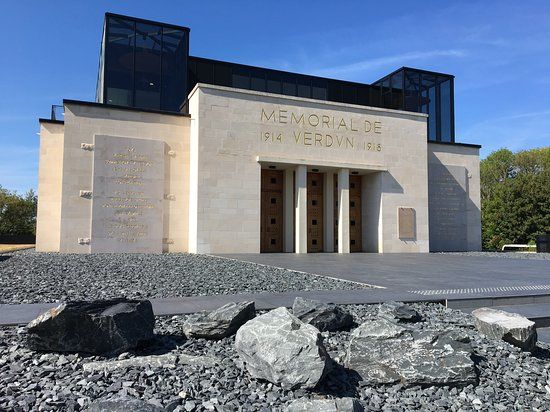
Having gone through Fort Vaux we chose not to see the insides of this also cave-like fortress. From the top were still visible craters from the battle nearly 90 years earlier. It is hard to capture the feeling you get as you wander these sites and think of the men who fought here, those who died, the scars on their families and villages. Every little village we drove through in this part of France had monuments to their sons who never came home.
Updated Apr 4, 2011
In a famous quote French General Henri-Philippe Petain said about the Germans...Ils ne passeront pas: They shall not pass. And now the statue on Mort Homme,,, Ils nont pas passe: THEY DID NOT PASS. But obviously at such great cost.
Quoted from the website listed:
"Mort Homme is a portion of the strategically vital ridge-line that formed the northwest bulwark of the Verdun Salient. It is on that portion of the battlefield west of the Meuse River -- an area not nearly as visited as is the better-known and more memorialized sector east of the river. During the year-long battle, the wooded crest was completely pulverized by artillery fire. And we are talking literally millions of shells. As photos so powerfully reveal, the entire perimeter of the Salient looked like the surface of the Moon. It was impossible to maintain trenches -- shell craters had to suffice for what cover there was. And Mort Homme was one of the most shell-torn and blood-soaked of an unimaginably bloody battle. To call it "Hell on Earth" would be an understatement"
Updated Apr 4, 2011
An important town of the 9th to 13th century, you can tour the 1000 year old Romanesque cathedral atop the old city. Other glimpses of medieval grandeur can be found in the old gates and vestiges of the old city walls.
Updated Apr 4, 2011
The Meuse River has always been an important part Verdun. Boats connect the City to seaports in both Holland and Belgium via a canal and lock system. There are two main quays - the London Quay is lined with cafes where you can sit out along the river.
Updated Apr 4, 2011
Atop the ruins of an old blockhouse is a Franco-American memorial remembering six companies of the 69th RI who vanished defending the villages of Haucourt and Malancourt during the initial German assaults on Cote 304 of early April 1916. The area was retaken by men of the US 79th Division in the first days of the Meuse-Argonne Offensive in September 1918.
Written Jun 27, 2009
Website: http://www.ww1battlefields.co.uk/verdun/leftbank.html
Cote 304 was attacked late in March and early in April after the initial assaults on le Mort Homme had been stopped. The Germans eventually would reach the summit on 29 June 1917, but the French would retake the hill on 24 August. The monument remembers the French units which took part in the actions here as well as the 10,000 who died here. There are a couple of poignant personal memorials here, too. One remembers 2LT Georges Fabre of the 3rd Mixte Regiment of Zouave Riflemen who died here 18 May 1916 at age 40. Another memorial nearby is to Joseph Girard who died in 1940 in another war. Trails take off into the scarred woods from here, as well, for a better picture of the still buckled landscape beneath the trees.
Written Jun 27, 2009
Website: http://www.wereldoorlog1418.nl/battleverdun/battleverdun33/index.htm
In March 1916, the Germans enlarged the field of battle from just the right bank of the Meuse to the left, attacking the French first here at Le Mort Homme and later at Cote 304. They were able to take the top of the hill after a month-long battle but were unable to push on from there. The French would eventually retake the hill in August after twelve meters of height was shaved off the crest of the hill. There is a monument to the 40th Infantry Division who left many men here and the very dramatic memorial to the dead of the 69th Infantry Division – a skeleton standing in its grave with the words of General Robert Nivelle changed slightly to “Ils n’ont pas passe” – “They did not pass”. Nivelle had issued an earlier order of the day which read “Ils ne passeron pas” – “They shall not pass”.
Written Jun 27, 2009
Website: http://www.wereldoorlog1418.nl/battleverdun/battleverdun33/index.htm
LTC Emile Driant was a conservative deputy from Nancy. He was a graduate of the French military academy of St Cyr, but since he was married to the daughter of the slightly infamous General Boulanger, he was barred from high command in the Army. As such, he became a writer as well as a politician. Rejoining the Army with the onset of WWI, he was given command of a demibrigade of Chasseurs a Pied and sent to the sector northeast of Verdun. His criticisms of the defenses there made life more difficult for General Joffre, especially when other politicians started asking questions. Some of the guns had been removed from the Verdun-Toul sector to other regions of the Western Front which made the areas around Verdun, at least, that much more perilous. On the day of the initial German attacks at Verdun, 21 February 1916, Driant and his two battalions of Chasseurs were still in the Bois de Caures (Hazelnuts). Stoutly resisting, the Chasseurs were eventually overrun and Driant was killed by a shell burst early that morning. His tomb – dating to 1922 – is erected here along a somewhat busy road deep in the woods. Thirteen unknown Chasseurs of the 56th and 59th BCP are arrayed in a semicircle behind his tomb. A path on the opposite side of the road leads to the site where Driant was mortally wounded and to where he was initially buried.
Written Jun 27, 2009
Website: http://www.cheminsdememoire.gouv.fr/page/affichelieu.php?idLang=en&idLieu=3011
Just to the west of Fort Douaumont and the Ossuary, the Tranchee des Baionettes is to be found. Here waited a group of French poilu - soldiers - in a tench during a particularly heavy German bombardment. When the shelling was over, there was nothing to be found of the soldiers but the bayonettes of their guns poking up through the ground, the soldiers entombed alive in the trench.
Updated Jun 27, 2009
Website: www.war1418.com/battleverdun
Built between 1875 and 1877 as a masonry fort similar in design to Douaumont, Souville was partially modernized in 1888. This fort was one of the forts making up the inner ring around Verdun – Douaumont and Vaux were on the outer ring. On 11 July 1916, the Germans launched an attack with some 40,000 which took them to the top of the fort, but they were unable to conquer those inside. If they had, then Verdun would have probably fallen. This was the high-water mark of the German advances at Verdun. The fort is very dangerous inside and all you can do is look at the entrance without going in.
During 1917, three casements - Pamart Casements - were added around Fort Souville to add to the defense of the fort. These casements did not feature turrets as they were too difficult to add during wartime conditions. Each casement offered up a pair of machine guns which made a repeat of 11 July 1916 much more difficult.
Written Jun 27, 2009
Website: http://www.cheminsdememoire.gouv.fr/page/affichelieu.php?idLang=en&idLieu=3031
Sponsored Links
1 Opinions
Sponsored Links
Comments