Favorite thing: Lautrec's cane was a support for him in two ways. Firstly it was a walking stick that helped him move about on his deformed legs. Secondly, it was specially made for him at his design to contain a central glass chamber in which he carried a goodly supply of cognac for times of need. This remarkable device is exhibited in the museum in his honor, among personal objects and photographs, all of which you are not allowed to photograph (as if they were works of art). We found this photo of him with his cane.
Fondest memory: The stigma of Lautrec's mis-shapen appearance weighed heavily upon him. Sadly when he lived (around 1900) the scientific cause of his deformity was totally unknown; nor did anyone realize that it affected his hands as well or that his bones were fragile and subject to micro-fractures.(Perhaps alcohol was an analgesic for him). His father and mother were first cousins and besides his being the last in the line of the Counts of Toulouse, he inherited an autosomal recessive gene from each parent that produced a form of dyschondroplastic dwarfism. This rare defect has been the source of one type of dwarf who are otherwise normal and long lived. They have been the favorites of monarchs. (Velazquez painted one in Las Meninas and other works; Cuvillies was an architect in Munich). The defect has been carefully inbred in dachshunds and bassethounds. The disease is a failure of proper bone growth from the cartilage of long bones (extremities , fingers, toes) Flat bones (skull and vertebrae) develop differently and are not affected. This produces an individual with a normal torso and head (think of a dachshund) with short legs (and arms). Such is human adaptability, that Lautrec could use his extremities, especially his hands, and in spite of his difficulty this may have driven him to be such a good sketcher.
Written Oct 11, 2009
Favorite thing: In the 15-16C , the vast majority of people were illiterate and so signs on shops were illustrative of the trade housed within. Making powders was a major part of medical compounding, hence the mortar and pestle repeatedly displayed on the ancient pharmacy sign. The pharma(cist)s also were adept at drying plants, extracting their essences and making solutions from powders. The expansion of scale was a challenge that was also rewarding. All of this was within the scope of "understanding" the 4 elements of matter: earth, air, water and fire. The procedures derived from them to release the essences from the matter. A "Materia medica" was the guide to the essences and their preparation so that a physician could treat illness.
Fondest memory: Thus a "pharma" was familiar with the processing of woad to produce indigo and could become rich. Ironically in the 19C, after the advent of the scientific-industrial revolution, the understanding of the chemistry of coal-tar, in Germany , led to the synthesis of aniline and a vigorous synthetic dye industry. This led to the discovery of the first synthetic therapeutic agent, Aspirin (by Fabriken Bayer). Most of the early pharmaceutical giants were in the dye business. Reality stumbles after history.
Written Oct 11, 2009
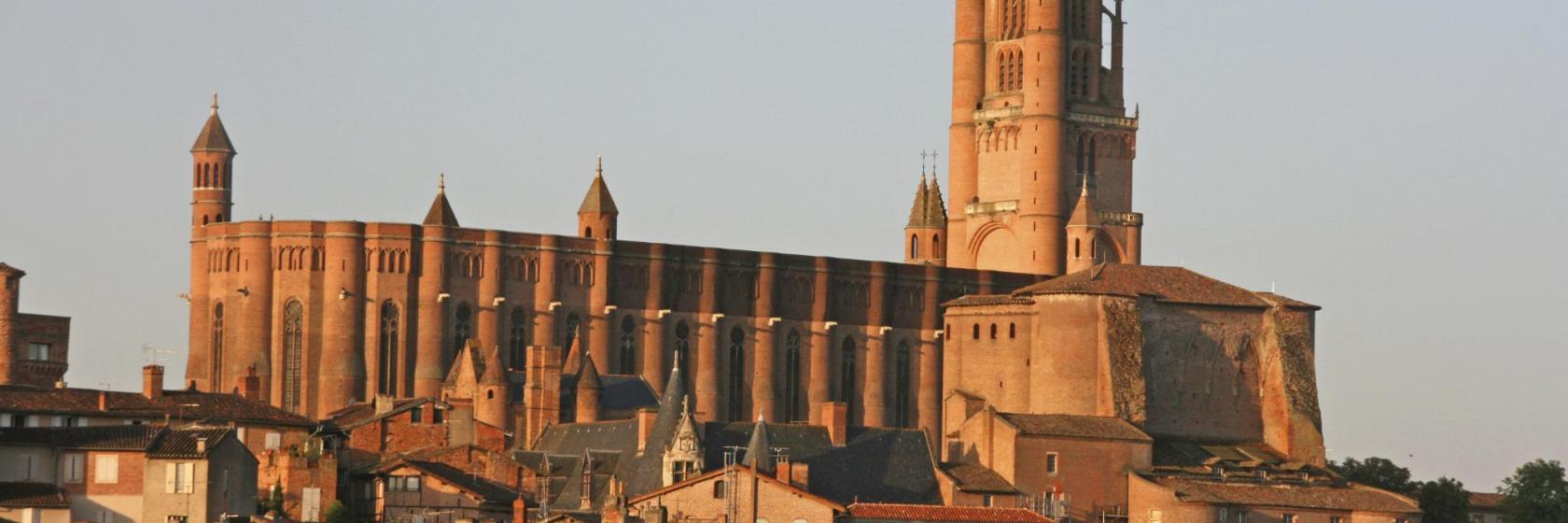
Favorite thing: Rocks in Albi area are not suitable for construction, or only of bad quality. . . . Since middle age, people of the area learnt to use the clay from the alluvia deposited by the Tarn River since a few thousands of years, to bake the bricks and to assemble them in various ways; it proved much cheaper than transportation of stones from far quarries, or much stronger (and less dangerous-fires-) than wooden constructions, and once the technique was mastered, big buildings began to raise in Albi.
There is the cathedral, the Palais de la Berbie, the high bridges, the market hall, and there are the more modest buildings and small houses. . . . . . In the old city, almost all is built with red bricks; the great monuments and buildings will have “their” tips, so here it is for the modest constructions, small staircases in the streets, little houses. . . . .
A few white stones in the window frames give a bit personality to the houses, like on the first picture, here under a tower of St Salvy Collegial; sometimes it is wood (picture 2) which personalises the brick walls.
Bricks are extensively used like here (picture 3), to make big retaining walls. I liked a lot this more modern house (picture 4), Boulevard du General Sybille, with rectangular and arched windows, on a big brick terrace, and where despite the weather, that day, the green of the shutters and the other greens from the trees fit so well with the red bricks.
If you had to renovate that house hosting a restaurant (picture 5), would you apply new rendering, or remove it and redo the junctures between the bricks?
Updated Jan 16, 2009
Favorite thing: Though Albi is a rather large city, it is for the most part extremely easy to find your way around. There is a large, free parking lot below the Cathedral and near the river. From here everything is a very easy walk. All the attractions are basically set in on centralized location. Once you find the Cathedral, everything is very nearby. The tourist office is set right next to the Toulouse-Lautrec museum in the Palais de le Berbie.
Most of the cafes and shops are also right near the Cathedral.
Fondest memory: The city is very beautiful. You can't go wrong.
Written Jul 15, 2004
Favorite thing: Ste Cecile is a huge cathedral (the same size of Notre Dame of Paris).
The stone lace of the entrance is marvellous.
The vault and the walls are painted and stainglasses are amazing.
Schedule : 8H30AM to 7PM in Summer (other months the schedule is reduced)
Entrance of the cathedral itself free.
Updated May 4, 2003
Favorite thing: On the right bank of Tarn.
The typical red bricks houses are raised to avoid the floods.
There is also here the La Perouse museum, the great sailor, born far from the sea and explorator dead during a quest in the Pacific.
Written May 4, 2003
Favorite thing: Presque chaque maison de la vieille ville à abrité un personnage, une histoire...
Nearly each house of the old city to sheltered a character, a history...
Fondest memory: Il faut flâner dans les rues pavées, un bon guide à la main, et remonter le temps.
It is necessary to stroll in the paved streets, a good guide to the hand, and to carry up the time.
Updated Apr 24, 2003
Favorite thing: The Jardin de l'Evéché (Garden of the Bishopric) overhangs the river The Tarn on a terrace surrounded with walls made of red brick. It is a "The French's Garden ", all made of boxwood forming a delicate lace of shapes.
Updated Mar 4, 2003
Favorite thing: Tourist Office
Palais de la Berbie
Place Sainte Cécile
F-81000 Albi
- Tel.: (+33) (0)5 63 49 48 80
- E. mail: accueil@albitourisme.com
- Internet: www.albi-tourisme.fr
Updated May 3, 2010
Favorite thing: Don't forget to check the Weather before the vsit.
Written May 3, 2010
Sponsored Links
1 Review and 99 Opinions We stayed two nights at this hotel and had breakfast and dinner there each evening. It has the...
1 Review and 3 Opinions The boss is the son but the retired father seems to do anything there. He is very kind and helpful....
61 Opinions
Reviews and photos of Albi attractions posted by real travelers and locals. The best tips for Albi sightseeing.

Don't forget to check the Weather before the vsit.
2 members live in Albi
Q: Hi, I'm just wondering if anyone knows what a bike ride from Albi to Cordes Sur Ciel might be like. Google maps puts it at...

A: It is 25 km but D600 is a rather busy road. I would suggest you to take smaller roads that are almost parrallel to D600. That should add a few km but it will be quieter...
Read 5 Replies
1

I travel by car through central France at least twice a year, between Pau and my hidden den in the Forez and I like to change itineraries, to look at the beautiful countryside of Midi Pyrenees and...
2

Albi is a nice city some 76 kms. north east of Toulouse, and just for the Cathedral, it deserves a visit. Pics: - Main: Cathédrale de Sainte-Cécile - Second: Cathédrale de Sainte-Cécile - Third: Albi...
4

Albi is called "red" because the ancient city was built with local red bricks : the churches, the palaces and the houses. It was set up more than 3 thousands years ago and has many things to show to...
5
Almost 8C After Its Inquisition

We arrived by car from Carcassonne, via Castres (we have Tips on both). Our hotel for the two night stay was on the far bank of the Tarn overlooking the river with the stern Cathedral of St.-Cecile......
Build your own Albi page
Sponsored Links