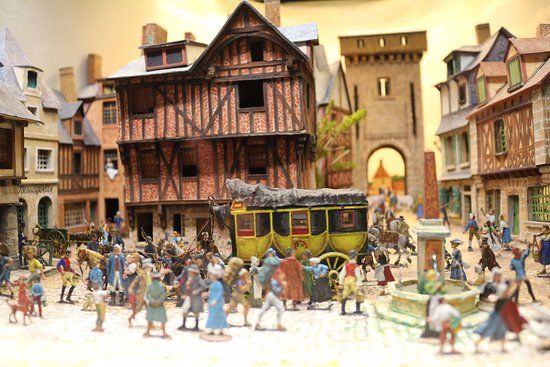
The end of World War I....Little bit difficult to find. Free car park. Couple of Euros to get in the musuem. Interesting for kids too.
This is where the German surrender was accepted by Marshal Foch, in a railway carriage, on the 11th November 1918. Thereafter the date was called Armistice Day. I presume the date wasn’t called that already, and the signing of the end of the First World War on that day was just coincidence.
There is a big slab of marble in the middle of two railway tracks where the respective carriages of the Germans and the Allies stood on that day. There’s also a big monument to the French that died in the Great War.
But the story doesn’t stop there. There aren’t many places that get greedy about having more than one shot at a place in history. For example you don’t hear much about the Great Fire of Waterloo or the Alamo Tea Party. However this particular forest clearing wanted much more than its allotted fifteen minutes of fame and it finally paid an infamous price for setting up monuments and boasting about surrendering Germans. This was when Hitler turned up in France in 1941. Never mind the elicit joys of the Rue St Denis in Paris or the fleshpots of murky Marseille, nope Hitler made straight for the same forest clearing in order to accept the surrender of the French where the Germans had been humiliated. He also covered up the French Dead monument with a swastika flag. Talk about a sore loser.
The French, in a supreme outpouring of ‘we won the war’ had even built a museum around Marshal Foch’s coach. You can still see it today in the same museum. Or rather you can’t… but they don’t tell you that until you’ve paid your couple of Euros to get in. This is because Hitler nicked the original coach and dragged it back to Berlin, where it got burned in the Tiergarten when the Russians invaded. The coach in the museum in the clearing is ‘a very similar one’. This is told to you after you’ve listened to about ten minutes of audio commentary telling you what a wonderful place in history the coach occupies.
Anyway don’t let it put you off, you can half close your eyes and pretend it’s the real thing. Far more impressive in this museum though, is about thirty stereoscope machines with the same number of original First World War stereo slides in each one. These are stunning and you do come out feeling as if you were there. I’ve never seen a display of stereo images like it and well worth the visit for those alone. Unfortunately the museum shop is fairly minging and, apart from a nice line in pistachio ice-creams, there’s no way of taking these amazing pictures home with you. It’s a shame the Germans didn’t end up running the shop, I’m sure it would have been a lot better
Written Sep 3, 2011
Website: http://www.webmatters.net/france/ww1_rethondes_2.htm
We were lucky that there was just the 4 of us and 2 others being guided around this beautiful chateau. The cost was very cheap and for kids under 18 free! Because we were a small group we were able to view the bathroom of Josephine, which you wouldn't normally see with a big group as it's a small room. There are some beautiful gardens that are free to look around
Updated Apr 4, 2011
Address: Compiegne town centre
Phone: 03 44 28 47 02
The impressive Chateau at Compiegne was built between 1755 and 1799. During the French Revolution the chateau was internally stripped but luckily the exteriour was left pretty much untouched.
This was one of the last of the royal palaces to be inhabited, built on the instructions of Louis XV by the architect Angel-Jacques Gabriel.
Updated Apr 4, 2011
Relics at the Church of St. Jacques, Compiegne. A really astounding collection of relics, there must be dozens of them! Apparently, much of these ended up here from several churches or abbeys in the neighbourhood in the wake of the French Revolution.
Updated Jun 9, 2006
There is a small war museum here, which is very interesting. 100s of photos taken in the trenches, it really brings it home what these men went though and the awful living conditions.
This is where both Armistice agreements were actually signed.
Admission was about 2 euros open 09:00 to noon, then 14:00 to 17:30.
Updated Nov 23, 2004
Phone: 0344851418
Joan of Arc was an incredible woman, at the age of 12 she began hearing voices to rid France of the English, by dressing as a man and wageing war. At the age of 17 in 1429 after various battles she and her troups had a great victory over the English. Joan had risen through the ranks so much, that she even sat next to Charles VII at his Coronation.
On May the 23rd, 1430 defending the royal city of Compiegne Joan was captured in the city by the Burgundians, they then sold her to the English, who then gave her to a court in the Normandy city of Rouen. She was tried for witchcraft, herasy, (and refusing to wear womens clothes!). On the 30th May 1431, at the age of 19 this very brave woman was burned at the stake in Rouen marketplace.
Hence the statue of Joan of Arc in Compeigne
Updated Nov 5, 2004
Clairiere de L'Armistace is where world war 1 officially ended, in a railway carriage, in ths clearing of the beautiful Forest of Compiegne. The armistace was signed at 11.00 on the 11th November, 1918.
In 1940, June the 22nd in the exact same railway car the French signed the armistice which acknowleged the German conquest of France.
The Railway car was then taken back to Germany to show to the German people in Berlin. In 1943 it was destroyed in Allied bombing of Berlin. What you see today is an exact replica.
Updated Oct 29, 2004
The Church of St Jacques built in two stages, firstly in the 13th century and then again in the 18th is famous for its beautiful stained glass windows.
On the morning she was captured Joan of Arc came here to paey in 1430.
This is a most attractive church both internally and exterally, the high vaulted ceiling is wonderful. An internal photo is in the Travelogue.
Updated Oct 29, 2004
Address: Rue de La Victor Hugo
This wonderful old timber frame building dates back to the 15th century. One of the oldest half timber frame buildings in the area.
Later in the 18th century it was home to the chief boatman (Maitres du Pont), who controlled the river traffic on the River Oise.
Written Oct 28, 2004
Address: Rue Des Lombards
The city centre of Compiegne is buzzing even on a week day. Plenty of cafes and shops here, even some you will have heard of. I guess this is for the Parisians who land in the city at the weekend. There is quite a mix of traditionally stone built, modern and even timber frame buildings.
Written Oct 28, 2004
Reviews and photos of Compiègne attractions posted by real travelers and locals. The best tips for Compiègne sightseeing.

The city centre of Compiegne is buzzing even on a week day. Plenty of cafes and shops here, even some you will have heard of. I guess this is for the Parisians...
1 member lives in Compiègne
Q: We are going to Compiegne for Armistice Day 11/11/2011 and trying to find information on the services or events to be held in...

A: Hi, I think the best thing is to call or mail the "office du tourisme" in compiègne. They might speak english if you call, if you mail you will have an answer. On the...
Read 2 Replies
1

Compiegne is a small city only 80km north of Paris. For centurys it was the country home for French Royalty, surrounded by the beautiful Forest of Compiegne. Apparently Compiegne is very popular...
2
Compiegne, a different holiday!

Fancied a differenty holiday to our friends and chose this area of France to visit. A beautiful town with an amazing chateau and so much to do nearby. Loved it so much we are going again this summer!
3
World War 1...Seconds out, Round 2

I can tell you very little of the town of Compiegne. We probably drove through it to get to where we were heading but I guess it must have been a bit of a ‘blink and you miss it’ sort of a place….and...
4

We stayed over at Compiegne on our way back to the Netherlands after our summer holiday 2005. We took a room at a hotel near the town centre, spent some time on the banks of the river Oise and had a...
5

This exciting village is great for history buffs. In one area you have the Chateau de Compiegne, once habited by Napoleon I, the Armistice wagon where the peace treaty to end WWI was signed, and...
Build your own Compiègne page