Favorite thing: The card is probably worth the 9 Euro for a three day pass to get into sites and get free bus rides. The museums to go into are not the major ones, but do include Diocesan Museum at the Dom, Historic museum at Alt Palace, Ludwig haus museum, for a total 6 in total. The card is purchased at information center on Geyersworth St on the island, or at some of museum entrances.
Updated Dec 17, 2011
Favorite thing: This is really to inform you that the information center is located on the island, near the tip and by Geyersworth building, off the street named after that. the center is large and has gooo literature, plans for tours and great guides behind the counters (5-6 of them) to help out, and/or sell Bamberg card or other tickets for sites.
Fondest memory: The lovely sites and preserved buildings.
Updated Dec 17, 2011
Favorite thing: Bamberg is located on the river Regnitz, close to its confluence with the river Main. The river makes Bamberg very picturesque.
The Regnitz is a left tributary of the Main and is 58 km in length.
The river is formed by the confluence of the rivers Rednitz and Pegnitz. Small portions of the Regnitz near Bamberg are incorporated into a canal connecting the Main with the Danube: the Rhine-Main-Danube Canal, which runs parallel most of the way from Bamberg to Fürth.
You can watch my high resolution photo of Bamberg on the Google Earth according to the following coordinates 49° 53' 36.80" N 10° 52' 57.75" E or on my Google Earth Panoramio Regnitz.
Written Apr 28, 2011
Favorite thing: Bamberg is one of the few cities in Germany that was not destroyed by World War II bombings.
More than 2400 listed buildings, winding lanes and an abundance of mediaeval churches make Bamberg a work of art of immense historical value.
Because of the impressively well preserved architectural ensemble in the Old Town, Bamberg was awarded the title of UNESCO World Heritage Site in 1993.
You can watch my 4 min 48 sec HD Video Bavaria Bamberg along by car HD out of my Youtube channel.
You can watch my high resolution photo of Bamberg on the Google Earth according to the following coordinates 49° 53' 31.78" N 10° 52' 55.47" E or on my Google Earth Panoramio Bamberg roof tops from the Rose Garden.
Written Apr 28, 2011
Favorite thing: Bamberg is a famous city in Bavaria which is located in Upper Franconia. I’ve never been in this area of Germany and was fond of it in 2009.
During the post-Roman centuries of Germanic migration and settlement, the region afterwards included in the Diocese of Bamberg was inhabited for the most part by Slavs (it was a very unexpected and interesting fact for me, haha!).
The town was first mentioned in 902 when it grew up by the castle of Babenberch.
You can watch my 5 min 07 sec HD Video Bavaria Oberfranken Heiligenstadt-Bamberg road HD part 2 out of my Youtube channel.
BAMBERG Tourismus & Kongress Service
Geyerswörthstraße 5
96047 Bamberg
Germany
Tel.: +49(0)951/2976-200
Fax +49(0)951/2976-222
You can watch my high resolution photo of Bamberg on the Google Earth according to the following coordinates 49° 53' 29.59" N 10° 53' 14.01" E or on my Google Earth Panoramio Little Venice 1.
Updated Apr 28, 2011
Favorite thing: One of the focal points of historical Bamberg is the Domplatz. It is an inspiring group fo buildings in a prominent location, one of the more impressive town squares you will visit. It has the unusual distinction of sloping at an awkward angle and is surrounded by a series of grandiose historical buildings.
From the main commercial part of Bamberg you have to ascend some stairs (pic 5).
Fondest memory: If you start at the 13th century Kaiserdom itself (pic 4), then going clockwise from there is the Alte Residenz, next to that is the Reiche Tor, and behind that is the Alte Hofhaltung, the old 15th century episcopal palace. Across the road from that is the Neue Residenz, the enormous 18th century L-shaped Baroque palace, and behind that are some picturesque views of the city center across the north east (pic 3). I just loved the curvature of some of the tiled roofs.
Updated Apr 17, 2009
Favorite thing: We were actually on a hill and looked across and saw the castle so we decided to wander over. The trail took us through some lovely woods (pic 4) before we reached Altenburg and then through farmers' fields after our visit (pic 3). Frankly, it was worth the effort just for the scenery alone.
Fondest memory: From 1952 to 1982, a brown bear named Poldi lived in a "Zwinger" (a small enclosure) in the Altenburg castle. The Zwinger is still there, but today only houses a stuffed bear and it's a sad sight when you realise what the poor bear had to put up with. Still, I suppose he was fed and cared for.
In pic 2 you will note that Rosemarie is pointing out an etching in the brick. This was made by the worker who made them. In pic 5 you will see various coats of arms that we came across over a portal.
It sorted of reminded us of home and a famous Aussie TV show for kids that starts off, "There's a bear in there...".
Updated Apr 12, 2009
Favorite thing: The Bamberg Rider has become one of the popular icons of German medieval art. The figure, horse, and plinth (base) are made of seven pieces of sandstone and represent a considerable technical achievement, although the rider's specific identity is uncertain. The original coloring was purposefully removed in the early 1800's on the orders of the Bavarian King, Ludwig I. Originally, the Bamberg Rider sat on a white-gray horse; the harness was gilded in gold. His robe was basically yellow, and over this his cloak had a alternating orange and dark red pattern enhanced by silver colored tin foil. The hem of the cloak and robe, the crown, belt and stirrup belts were gold leaf. The face was very light skinned, and in the eyes the pupils and borders of the iris were painted black.
Stylistically the figure resembles Philip Augustus at Reims and other proposed identifications include Henry II or another German ruler, Constantine, the first Christian emperor, and King Stephen of Hungary (997-1038), who was married to Henrich II's sister Gisela. In addition to the dynastic connections, the original coloring of the statue, which gave a dark brown or black color to the rider's hair, suggests it might be King Stephan as well.
Fondest memory: King Stephan is also represented standing larger than life next to the statues of Heinrich and Kunigunde (Kunegunde), at the left side of the entrance to the cathedral, the Adamspforte. King Stephan later became Saint Stephan in 1083, and most of the identifications of the Bamberg Rider suggest the concepts of saintly ruler, church foundation, an association of secular and religious power, so important in the imagery at Bamberg Cathedral. There are significant parallels between the Bamberg Rider and a slightly later Magdeburg Rider. But unlike the Magdeburg Rider, the Bamberg Rider is not freestanding and may have always had an interior placement.
The Bamberg Rider is presently positioned on the north pier in the entrance to the east choir. He sits firmly on his horse looking away from the wall with the reins in one hand and the strings of his mantle and the other and seems to embody the knightly virtues so important in the medieval domestication of those who fight.
Bamberg Cathedral continued to receive sculptural embellishments during the later Middle Ages. Wooden sculpted choir stalls dating from around 1380 were originally present in both the east and the west choirs of the cathedral. A frieze of Henry II and Kunigunde (Kunegunde) appear in the decorative program of the choir stalls along with saints, profits, and a collection of hybrid creatures. Tillman Riemannschneider sculpted the tomb of Henry II and Kunigunde (Kunegunde) between 1499 and 1513. Originally located in the east end of the nave, it consists of effigies of the emperor and sat on a tomb chest decorated with narrative panels of their lives, drawn mostly from the Golden Legend of Jacobus de Vorragine. A virgin altarpiece of 1523 by Veit Stoss, originally made for a Carmelite convent in Nuremberg, was subsequently transferred to Bamberg by Stoss' son during the reformation.
Most of the interior walls are bare today, because Ludwig I stripped off the medieval paintwork in the 19th century.
Written Apr 12, 2009
Favorite thing: The earliest known date that the Altenburg was known to have existed was 1109, although it is likely that it was built on the spot of an earlier palisade castle.
First it served as what is known is German as a "Fliehburg"; that is a castle not regularly inhabited, but serving mainly for city defence as a place where local residents could flee to in times of danger.
From 1305 to 1553 it was the residence of the Bamberger Fürstbischofs (the sovereign bishops of Bamberg).
During the Second Margraves' War (Zweiter Markgrafenkrieg) of 1553, the army of Margrave Albrecht Alcibiades von Brandenburg-Kulmbach burnt the castle down to its foundations.
Fondest memory: In 1801, Bamberger physician Adalbert Friedrich Marcus acquired the decaying castle and restored it from the ground up. E. T. A. Hoffmann, who was friends with Marcus, felt so drawn to the castle that he frequently stayed for a long time in one of the wall towers during the years 1808 to 1813.
In 1818, a society for the maintenance of the Altenburg, named the "Altenburgverein e.V. Bamberg," received the castle. Today one can find in the castle a restaurant, that also manages the so-called Knights Hall. This is mostly used for festive occasions such as weddings or founding celebrations.
Written Apr 10, 2009
Favorite thing: As indicated in the "to do" tips I find architecture interesting.
Fondest memory: The artistic patterns around windows, sometimes man made, other times with nature creating tracks around the window is something to be appreciated if you are of an artistic bent as, rather obviously, I am.
These examples are from the old part of the town on the western bank and include a half timbered (Tudor style) example in pic 4 and an example of dormer windows (from the latin "dorme" meaning "to sleep") in pic 5.
Updated Apr 9, 2009
Sponsored Links
1 Review and 79 Opinions This is a new hotel opened in July 2009. I had a single room for 3 nights but for a week or more...
Romantik Hotel Weinhaus Messerschmitt
1 Review and 32 Opinions I spent 3 weeks on business at this 4 star hotel. Its located in the centre of town. Rooms are...
1 Review and 113 Opinions Typical Ibis - you know what youre getting identikit furnishing no frills, though still...
Reviews and photos of Bamberg attractions posted by real travelers and locals. The best tips for Bamberg sightseeing.

As indicated in the "to do" tips I find architecture interesting. The artistic patterns around windows, sometimes man made, other times with nature creating...
36 members live in Bamberg
Q: Is the best way to get to Bamberg University from the U.S to fly to Munich and then take the train to Bamberg?

A: No big difference if you fly into Munich (MUC) or Frankfurt (FRA). DB timetable http://reiseauskunft.bahn.de/bin/query.exe/en From: MUC From: FRA To:...
Read 3 Replies
1

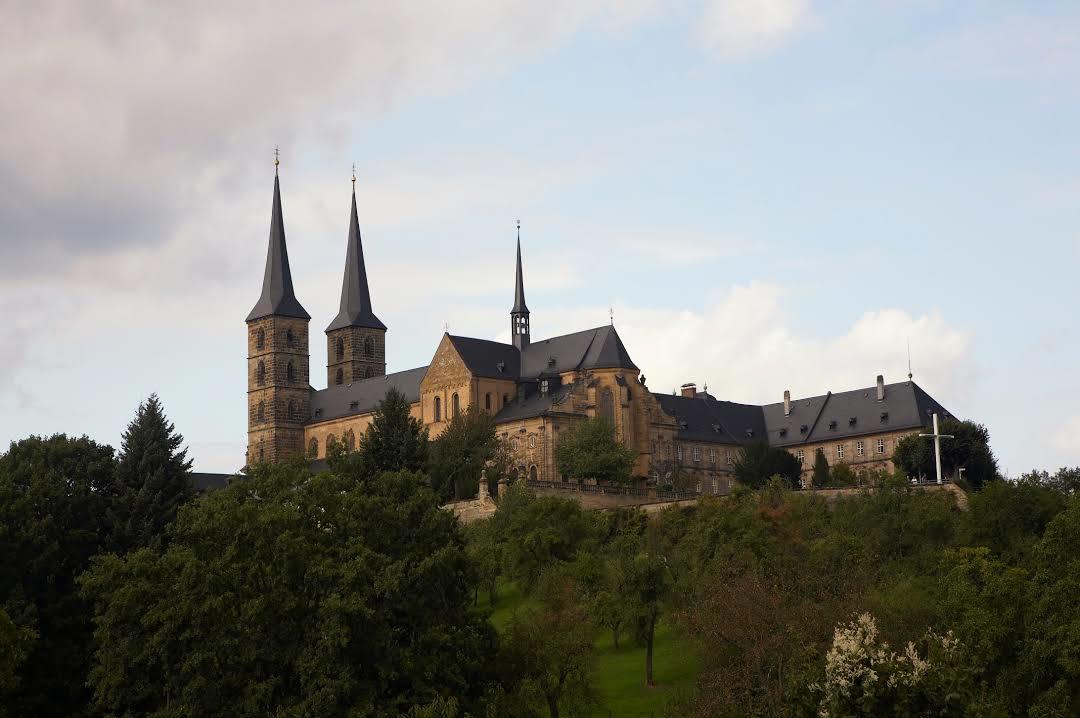
Michael's Abbey was founded in 1017 by Roman Emporer Henry II, who also claimed the city in earlier years to counterbalance the power rule of the Diocese of Wurzburg. The monastery also has/had a...
2

Welcome to the wonderful Bamberg!!! Bamberg is one of my best Bavarian towns. Walking along its streets, squares and fantastic architecture is a great experience. In the town you can see Medieval...
3

Bamberg is one of the few cities in Germany that was not destroyed by World War II bombings. More than 2400 listed buildings, winding lanes and an abundance of mediaeval churches make Bamberg a work...
4

I have a special place in my heart for this city as I lived and studied there for 2 1/2 years. Due to the fact that Bamberg miraculously escaped most of the World War 2 - bombings, it features a...
5
Bamberg - every cloud has a silver lining

This is a World Heritage Listed town that has escaped the ravages of modern wars and it retains an historic charm that cannot fail to win the visitor over. How prophetic that the reason it is as you...
Build your own Bamberg page
Sponsored Links