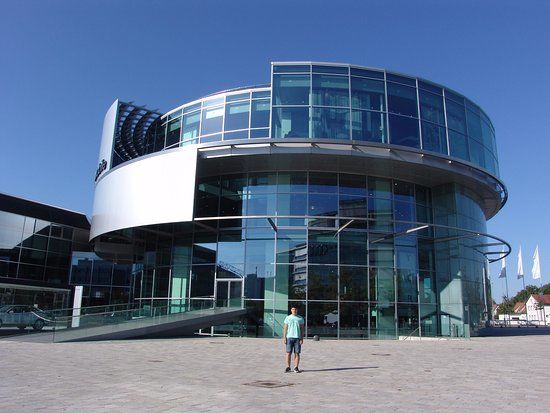
The museum is located at the AUDI Forum - the round building. It’s all very high tech and sophisticated.
It houses a wide range of vehicles going back to the early 20th century and some - especially the older ones - are beautiful. They also have quite a few motorcycles on display.
A centrepiece is a revolving display of modern models, but sadly it had broken down when we were there. The cars could still be seen, but not all from close up. Some of the rally cars and the Le Mans model were extra interesting.
Highly recommended if you're a petrolhead, and also if (like me) you're not.
Written Dec 4, 2011
Address: Audi Forum Ingolstadt, 85045 Ingolstadt
Phone: 0800 - 2 83 44 44
Website: http://www.audi.com/com/brand/en/experience/audi_forums0/audi_forum_ingolstadt/museum_mobile.html
I visited in August 2011.
History of Audi company is shown in the museum. You can see various cars and motorcycles with stylish bodies (especially, old typed ones) and why the Audi symbol of 4 circles were formed.
Besides the museum, there are an Audi goods shop and a cafe in the area. You can enjoy German beer and talking about Audi.
Admission fee w/o guided tour costs 2 euro.
Written Aug 22, 2011
Address: Audi Forum Ingolstadt, 85045 Ingolstadt
Website: http://www.audi.com/com/brand/en/experience/audi_forums0/audi_forum_ingolstadt/general_information.html
Audi Museum, 2-hrs plant tour is very interesting and informative. No photos allow inside the plant. It's fun to watch how sheets of steel to become a stylish sedan on-site. English guided tour 11:30am daily (may change). Since no one else booked the English tour, we had a "private tour" and were able to ask a lot of questions!
Updated Apr 4, 2011
My walking tour was all about (i) getting a quick impression of the old town and (ii) deciding which things I'd like to come back to visit properly.
This is on the "must see next time" list.
It is the German Museum of the History of Medicine. Built in a baroque "orangerie" style starting in 1723, it was the medical faculty of the state university, and sits in a delightful garden full of plants with medicinal qualities (opium poppies, for example).
We only took in the garden, and next time around I'll go inside!
UPDATE!
I did go around the inside in March 11. My guide was a local doctor, so I was very well informed! Well worth a few minutes.
Updated Apr 3, 2011
Address: Anatomie str
Website: www.ingolstadt-tour.de/wDeutsch/ausflugsziele/004_medizin.shtml
The historical museum is located in Kavalier Hepp, a gate building of the 19th century fortress. The permanent exhibition presents the history of the city and region from prehistoric times to the present. The 50 small rooms present the historical eras and topics like stone age, ancient Romans, the foundation of the city in the early middle ages, the medieval town walls, the Duchy of Bayern-Ingolstadt, the university, the counter-reformation and the Jesuits, the magistrate and ist representation, coins, baroque art and lifestyle, the age of enlightenment, crafts, trade and traffic, religious life, the development of the city in the 19th and 20th century, industrialization, Nazi time and World War II, post-war development. The toy museum has been integrated into Stadtmuseum and fills two rooms with its exhibition of historical toys. Another department is dedicated to the river Danube and its significance for Europe. Then there are temporary exhibitions about changing topics.
The museum is worth seeing to get a better idea of the city and its history, although the amount of details might be confusing. Probably the most spectacular exhibit is the stuffed white horse that the Swedish King Gustav Adolph rode during the 30 Year War. The poor horse was killed in battle in 1632 not far from here. A bit creepy... Article in German with some photos here
Photography is strictly forbidden, so no pictures of the interior here. I have to note that I found museum staff a bit grumpy.
Written Mar 3, 2011
Address: Auf der Schanz 45, 85049 Ingolstadt
Website: http://www.ingolstadt.de/stadtmuseum/
The mighty gothic church, impossible to overlook in the cityscape, is a relic of those times in the 15th century when Bayern-Ingolstadt was an independent Duchy and Ingolstadt its residential city. Like Neues Schloss, the church was built to express the status and the ambitions of the ruling Duke. The city had just been extended and surrounded with a new wall. A second parish was founded for the new quarters. The Münster was partly built as their parish church, but even more as the church of the ruling dynasty and their burial place. Duke Ludwig der Gebartete (Louis the Bearded) must have been incredibly worried about his worldly sins and his eternal welfare - he donated a foundation for 1000 poor but religious people who had to perform an everlasting prayer service according to a complicated schedule.
The church was begun in 1425. Construction works lasted for almost 100 years. Then the works were stopped, although the steeples remained unfinished. It was named "Kirche zur Schönen Unserer Lieben Frau", Church of the Beautiful Our Dear Lady - the grammar is a bit strange in here.
The position of the two western steeples is a particularity. They are not parallel to the nave but attached diagonally to the corners, just like the main tower of the New Palace. This seems to be an Ingolstadt particularity. The steeples are too small and too short for the huge nave.
The church is open in the daytime through the doors of the side naves. The enormous gothic hall looks even more impressive inside. Details that should not be missed: the fantastic vaults of the small side chapels along both naves.
Photos of the interior can be found here in this travelogue.
Photo tip: the best spot to catch the enormous building without 'falling lines' is from the courtyard of Canisiuskonvikt (photo 4).
Updated Feb 26, 2011
The church treasures of the Münster parish are on display in the treasure chamber, which is located inside the southern steeple.
Access is from inside the church. Entry is free. There is no one there standing guard, you just open the door and walk in.
This treasure is incomplete, though. The most precious possessions of the church have disappeared in the secularization 200 years ago, when state authorities took the most valuable pieces because of the monetary value of the materials, and silver, gold and jewels went into the treasury of the Electorate, later Kingdom of Bavaria. Paintings show what these pieces looked like.
Written Feb 26, 2011
This baroque jewel was built for the Jesuit college and for a Marian congregation of Ingolstadt citizens attached to the Jesuits in 1732 - 1736. The interior was created by the Brothers Asam. The fresco on the flat ceiling is known as the masterpiece of Cosmas Damian, the painter among the two.
The fresco reflects Jesuit theology and ideas. It represents the worldwide mission. In the four corners we see the four (then known) continents: Asia and Europe above the altar, Africa and America at the opposite end. The central scene shows the Assumption of Mary.
The painting is full of tricky perspectives that cause astonishing effects in the eye of the lookers-on. Like: In Africa (photo 3) there is a hunter aiming at a lion; when you walk the opposite nave the hunter's arrow keeps pointing at you. The temple above the choir grows larger when you approach the altar until it covers half the ceiling. When you walk/run towards the exit, watch Michael confronting Lucifer and his angels above the organ - looks as if the bad angels are indeed falling. And so on, there are several more. A guided tour that shows you these effects is worth joining. A small entrance fee applies and the person at the cash desk will happily guide you. Watching the tricks of the fresco requires quite a lot of walking and running around, as you have to see them from certain angles and then walk a certain way to see the changes - wind blowing into the fire, a tree falling and hitting a stag, and so on.
However... Well, I had a really funny experience in there, I think this was the funniest guided tour I ever had in a church. The really sweet elderly man from the cash desk struggled hard to point out the peculiarities of the fresco to a group of visitors. That group was from Thailand (all of them medical professionals on the way to a congress in Prague, they stopped in Ingolstadt for the Museum of Medical History and a bit of sightseeing). All the Thais spoke good English but our guide's English was, well, limited. He herded them around and showed them where to look in English but the explanations what to look at came in Bavarian. Some desperate people in the group asked me if I could translate, and soon I was translating for the whole group, much appreciated by the guide. It was a big laugh for everyone involved. We were running all over the church, to and fro. He started telling us something and after three words I said, wait, I have to explain what that is - the 30 Year War, or whatever. It was hilarious.
++++++++++++++++++++++++++++++++++++++++++++++++++++
A visit to the church also includes the treasure chamber. The church's most treasured object is the large monstrance (photo 4) , considered the most precious of its kind in the world. Created by a goldsmith in Augsburg in 1708, it depicts the Battle of Lepanto (a battle between the fleets of the Christian Holy League and the Ottoman Empire in 1571, which the Christians allegedly won thanks to the help of the Virgin Mary).
Updated Jan 15, 2011
Address: Neubaustraße
The rarest and most unusual plant that flourishes in the apothecary garden behind the Museum of Medical History deserves a special mentioning and a tip of its own. I have never seen this species anywhere else, it is really unique.
What does it cure? Hmmm, maybe the doctor's bank account...
Pecunia Europhaga translates to "the Euro-eating money plant". It is in fact a box to collect donations from visitors to the garden. A funny and clever one, though...
When you put a coin into the slot and press the lever to make it fall, the metal flower of the thing opens (see photo 2).
The plant is 'growing' at the entrance to the garden, impossible to overlook.
Updated Jan 15, 2011
"Herzogskasten" can be translated, tongue-in-cheek, as "Duke Box". This building is the residential house of the 13th century castle in Ingolstadt. Here the Dukes of Bavaria stayed during their occasional visits to Ingolstadt before the construction of the new castle.
Later on it served as grain storage and as the city's cash office (which explains the name: "Kasten" is the box the money was put into, and further on a word for the whole administration of said money box and its content). Nowadays it hosts the public library.
The building is a plain rectangular block. Its only ornaments are the stepped gables on both sides. The small oriel on the western side is the choir of the palace chapel.
Updated Jan 15, 2011
Address: Hallstraße
Sponsored Links
2 Reviews and 30 Opinions Hotel Ammerland: Breakfast room.
63 Opinions
NH Hotel Ambassador Ingolstadt
31 Opinions
Reviews and photos of Ingolstadt attractions posted by real travelers and locals. The best tips for Ingolstadt sightseeing.

"Herzogskasten" can be translated, tongue-in-cheek, as "Duke Box". This building is the residential house of the 13th century castle in Ingolstadt. Here the...
21 members live in Ingolstadt

Q: I will be in Ingolstadt for 5 weeks, in a hotel. Is there a place where I can do laundry? I would like to avoid using the hotel...

A: You can check this out: http://www.waschomat.de/betriebe/hindenburgstrasse.htm The German word for laundromat is "Waschsalon". When you google and the result is...
Read 2 Replies
1

I have been visiting this Bavarian City since 1982, and it never disappoints me. It is the home of Audi and I have been fortunate enough to have been shown round the plant three times. It is amazing...
2

The town where I live is twinned with Ingolstadt. My Rotary club is twinned with the Ingolstadt club. I hear about Ingolstadt all the time, for one reason or another. Then in summer/autumn '09 I...
3

Ingolstadt is a Bavarian city, close to Munich. When it's not cloudy or rainy it can be really nice here, especially in spring or summertime. Due to the fact that I am living in the Donau valley, it...
5

Despite having lived in Munich for some time, I had never the opportunity to visit this charming town. But on the year 2000 a business trip brought me to the Audi AG headquarters and I finally...
Build your own Ingolstadt page
Sponsored Links