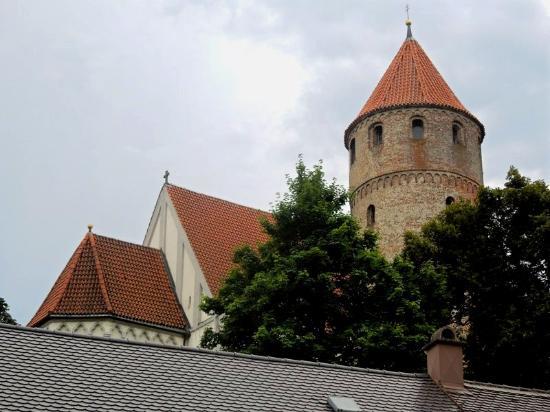
There are five main towers surrounding the town and connected by the wall. Some are shown below. The Sywollenturn dates back to around 1249 for the first one and the latter from1420 and lasted until 1964, now renovated. Gerberturn is also dating back to 1420. St. Blasius church is connected to the tower for defense use. It all was from 1420 when most of the wall and towers were built. The church is closed now so no entry. The Funfknopfturm is in English five buttons, and the ones shown here symbolize shields of countries that were allied in WWI. Still in good shape for the icons.
Written Jul 22, 2012
The walls surround the town and you can walk nearly all the way around the perimeter. They have a balcony and covered wood roof in most parts. it leads up to a walkpath and church at the top, above Crescentia Monastery before descending back to the town streets.
Written Jul 22, 2012
This is a hidden church and monastery on Am Brietn Bach. The church is small and only dedicated for daily people looking for a bit of salvation. The monastery is not open, but gardens above it are open on a terraced climb. There also is, of course, shops to purchase items. The complex was built between 1682 and 1744 in gradual parts. It was closed for some time and reopened in mid 1800's and it is a functioning monastery today
Updated Jul 22, 2012
This is a popular church for the townspeople. The confusion on the town brochures is this is said to be Evangelical church. But it is designated Protestant in internet references. I guess they use the facility for convenience.
It was constructed in 1604. The inside is rather ornate and used for church.
Updated Jul 22, 2012
A very large church and it is highly active for use by locals. It has an enormous tower outreaching the town at about 200 feet, and the inside is more typical for ornate, but an everyday life church for the people; not austentatious, but simple in design. It was started for construction in 1438, but a couple of years later the inside was modified to Baroque style, even though the outside now looks more modern day
Written Jul 22, 2012
This church is pretty large and has very beautiful wooden altars. It was built as a romanic church and reconstructed in gothic style from 1438 to 1443. In the 17th century then it was again changed to baroque and later to gothic revival style. The church tower is over 68 meters high. Notice that the square beside the church used to be the cemetary. I highly recommend to have a look at this church!
Item [24] on online map.
Written Jan 21, 2011
Website: http://www.kaufbeuren.de/desktopdefault.aspx/tabid-28/nr-24
The monastery started as a Beginen community around 1250. This was probably founded by Anna von Hof. From 1315 on the community followed the order of Saint Francis of Assisi, the Franciscan. In 1741 Maria Crescentia Höss became the head of the monastry for 3 years until her death in 1744. During the Secularization the monastry was disbanded, but in 1831 reestablished. In 2001 Pope John Paul II declared Maria Crescentia Höss holy. You can enter the church of the monastery, but people were praying here and I directly went out not to disturb them. The entrance is not on the same side as the entrance to the monastry, you will have to walk around the building complex to the right.
Item [21] on online map.
Written Jan 21, 2011
Website: http://www.kaufbeuren.de/desktopdefault.aspx/tabid-28/nr-21
Unfortunately at the hour of my visit the church was closed, repectively it was noon break for the time in which it is possible to get the keys for the church from the neighboring house. So I admired the interesting door beside the church leading through the city wall. Anyway, if you manage to get in: The building and interior is of late gothic style of the 15th / 16th century.
Item [14] of online map.
Written Jan 21, 2011
Website: http://www.kaufbeuren.de/desktopdefault.aspx/tabid-28/nr-14
The city wall up here looks exactly as a city wall should look like. It once was 1200 meters long and was built in 1420. Have a look at the nest houses for a lot of different nesting animals. It is mounted on the city wall.
Item [13] on online map.
Updated Jan 21, 2011
Website: http://www.kaufbeuren.de/desktopdefault.aspx/tabid-28/nr-13
After walking up to the citywall you will first see the impressive symbol of Kaufbeuren, the Fünfknopfturm (Five-Button-Tower). It was built in 1420 and up on the top there is still someone living in the guardsflat. The coat of arms mounted on the tower are representing the allied Empires of the Central Powers fighting in the First World War: the German Empire, the Austro-Hungarian Empire, the Ottoman Empire and the Kingdom of Bulgaria. From up here at the foot of the tower you have a nice view over the roofs of Kaufbeuren.
Item [12] on online map.
Written Jan 21, 2011
Website: http://www.kaufbeuren.de/desktopdefault.aspx/tabid-28/nr-12
Sponsored Links
Sponsored Links
Comments