WE decided it was not worth going inside after seeing how small it was outside. The house is unique in architecture, and who knows about the museum? It is located in a cluster of houses and buildings that also has the city museum and Spitalkirche. It has visual display of the 15 mile circular crater that created the region depression, and a theory of many things about craters.
It is open 9-5 daily and fee is 6 Euro
Written Jul 24, 2012
Website: http://rest-of-germany.eventseekr.com/rieskrater-museum-n6rdlingen/museums-galleries/venue/679281
This museum is inside the tower of Lopsinger. It goes up four floors and is narrow on each level. The displays are somewhat good, but some also are just "filler" for the museum. Either way, for 2-3 Euro, it is worth dropping by 10-5 daily to take a peek. Entry is from the wall that passes through the tower
Written Jul 24, 2012
The most adventuresome and interesting thing to do is take a walk along the wall that goes for over 1 1/2 miles+. Many unique views of the town and the houses can be seen from that perspective and the pictures from top good.
Written Jul 24, 2012
There are 5 main gates into/out of the town. All have a lot of charm and style all different a bit from the others. The main one in Lopsinger Tor that heads out to the highway east, and Deininger Tor going to another highway.
Written Jul 24, 2012
The church was built between 1427 and 1505 under the supervision of Nikolas Eseler, and then the tower was added in 1452. The tower is 90 meters (about 270 feet), has 350 steps, and the name of Daniel is for the Bible Daniel we all know. The lange is 93 meters-240 feet and 20 meters wide. There are three naves being held up be huge columns. The church became Catholic for a period after losing a battle to Imperial Army in 1634, and changed back to Evangelical in 1527.
Restoration took place in 1877, and after WWII, damages were repaired.
Written Jul 24, 2012
Website: http://de.wikipedia.org/wiki/St._Georgskirche_%28N6rdlingen%29
We found the Salvator Church while we were in search of a restaurant. We had already climbed the tower of the St. George’s Church in the center of town and really were not aware of this other church, which is closer to the wall. The exterior façade was very plain and it was only later in the day as we were walking the wall that we saw the back of the church, which looked more like a church we would have expected. The archway to the west door has an interesting relief of the Last Judgment.
The church began as a Carmelite monastery church in the 1400s, built on the site of a miracle that brought pilgrims to the area. It began a Protestant church during the Reformation only to return to a Catholic church in the 1800s.
The interior of the church was simple with white walls and colorful vaulted arches in the ceiling, but there was an old fresco on the wall of the nave and another one preserved in the choir. They are faded and time-weary, but still very interesting to look at.
Written May 1, 2012
Address: Salvatorgässchen 2, Nördlingen
Phone: +49 (0) 908 12 93 70
Website: http://www.pg-noerdlingen.de
The Rosarium is a pretty little rose garden next to the city wall in Nördlingen and not too far from the Berger Tor and the miniature golf course. I didn’t know about it until we started walking around trying to find the brewery restaurant that wasn’t open. I saw signs and followed them, leading me through a small gate in the wall that opened up to a pretty, well maintained garden with stone pathways and park benches. The roses were not in bloom yet, but I could just imagine the sights and scents of the Rosarium when the roses are at their most beautiful. It was a late Sunday morning and there was an elderly man reading the paper on one of the benches. So very peaceful!
The Rosarium is marked once you are in the general area of it, so to help you find it, I’ve marked it on this Google map.
Written May 1, 2012
Website: http://www.noerdlingen.de
Nördlingen is one of only three old medieval cities in Germany with an almost completely intact city wall (the other two being Dinkelsbühl and Rothenberg o.d. Tauber). It is pleasant to stroll around the wall and get a full view of the city. In most parts of the wall, it is a covered pathway – you are up high on the wall, but there is a roof that keeps the rain away (it was raining on our day in Nördlingen) but the city side is open so you can see the streets and houses and gardens below. The wall also had windows looking outside the city; in Nördlingen we saw homes and gardens, playgrounds for children, and a miniature golf course!
We started our hike around the wall by where we parked our car, which was at the Berger Tor (gate). That way when we finished our walk, we would already be conveniently at the car. As we walked along, we would go through or around the other gates of the city. Each one was different in appearance, shape and size. There is also a stream that flows through the city and two of the gates are water towers with small openings to allow the water to flow through, but not big enough for people to get into the city, unless they were underwater. Obviously this isn’t an issue nowadays when the gates are wide open, but in medieval times I am sure these gates were guarded.
Hubby and I enjoyed our walk; it was not crowded, although we did pass families with small children and several couples taking a stroll along the wall of Nördlingen.
Written May 1, 2012
Website: http://www.noerdlingen.de
St. George’s Church is the large Lutheran church in the center of town. This late-Gothic style church was built by the same architect that built the St. George Church in Dinkelsbühl. The interior is not as grand as other churches in Bavaria, but it is unique. I have never seen a church that had so many bronze shields on display, each with an animal of some sort that stuck out from the shield. I haven’t been able to find out any information on what they represent, but I am assuming they are similar to coat of arms for specific local families through the ages.
As someone who loves art, I was interested in the altarpiece that was on display on the left side of the nave. At first glance, it appears to be a classic altarpiece that was closed – we could see marks where hinges used to be. It was faded and appeared to be in dire need of love. I took a peek behind it and was shocked to see an empty shell! There was no interior to this altarpiece, which would explain why the hinges were gone – if they opened it up, viewers would be looking at the stone wall behind the altarpiece. As with the shields, I don’t know the story behind this altarpiece, who the artist was, or what happened to it. But I like how the church lovingly still displays it; maybe not in the most prominent spot in the church, but certainly in an area that it can still be admired for what it once was.
The choir has some interesting carved pieces in the stalls – and you could get up close to them unlike so many churches that have the choir roped off. The organ, located on the right side of the nave, was unique with its painted portraits on the lower portion of the organ.
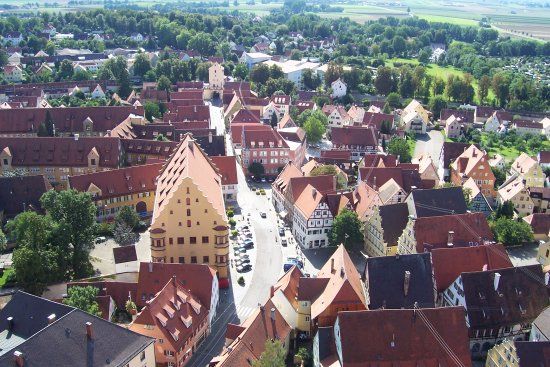
The west tower of St. George’s Church has a name – Daniel – and it is accessible from the outside of the church. For a fee, you can climb the tower for a spectacular view of the town and the surrounding area. Visit my Daniel tip for details on our climb up the tower.
Updated May 1, 2012
Website: http://www.noerdlingen.de
Daniel is the west tower of St. George’s Church in the center of Nördlingen. It can be accessed from outside the church to the right of the church entrance. The sign outside the tower entrance lists the fees associated with climbing the tower: €2,50 for adults, €1,70 for children. Unlike most places that have tower climbs, there was no one on the ground level to take our money. But, like most places that have tower climbs, Hubby and I had to go up to the top. We were once in a church in Plzen, Czech Republic, where we paid the admission fee part way up the tower. But we were part way up and no one to take our money.
But we kept climbing, round the spiral staircase and up some straighter stairs. The tower is 230 feet high and at each level there are signs telling you where you are in the climb and how high you are. About one third of the way up we came across the old winch that was used to pull things up to the top – it was a very large wooden wheel with various ropes. Later we would see the new electric winch currently used.
Almost to the top, we came to a level that had modern and clean bathrooms! Imagine that – at the top of the tower! That was definitely a first. But still no one to take our money…
We climbed a short staircase to another room and guess who we found! The man to take our admission fee! My first thought was amazement that he climbs those steps everyday to get to his job! Then my next thought was, well, he doesn’t have to go all the way down for the bathroom! We paid our admission and looked around this room, which had some small displays and posters. He had maps for sale and a couple books and answered a couple of our questions. Then we headed up the final small set of steps to the top and we were out on the top of Daniel.
The day was rainy, cold, and dreary, but we got that spectacular view of the city that we had been promised. Unfortunately, the surrounding area view was not a wondrous since it was overcast. But we still got a wonderful view.
If you want to see this same view, check out the YouTube video of the final scene from “Willy Wonka and the Chocolate Factory” (the Gene Wilder version, not the recent Johnny Depp film). Nördlingen is town that Willy Wonka’s glass elevator flies over in the final scene of the movie and you can see Daniel in the video. To see this scene and Nördlingen from the sky, check out this YouTube video.
After admiring the view, we were on our way back down the steps, which always seem to go faster on the way down than on the way up! We enjoyed our tour of Daniel and Nördlingen from above.
Written May 1, 2012
Comments