Carl Benz was born on November 25, 1844 in Mühlburg, now a Western suburb of Karlsruhe. The exact location of his birth had long been unknown but recent research shed light on the secret. Benz was born in the in named "Stadt Karlsruhe" in Rheinstraße 22 where his mother, Josephine Vaillant, was working as a servant. Later she married the locomotive driver Johann Georg Benz. The inhabitants of Mühlburg are quite proud of "their son" and that he was born in Mühlburg not Karlsruhe.
The house is gone, it was demolished when the street was extended in the 1950s. Nowadays Rheinstraße is a modern shopping street and a busy main road. However, now that the location is known, a memorial has been installed over the summer of 2011 to commemorate Benz's origins. A quite funny one, in fact...
Carl Benz has received his own parking in front of the modern shop building which is now Rheinstraße 22. A reconstruction of his first automobile of 1886 - simplified in order not to encourage vandalism and without engine, i.e. not functional - has been built. It is parked on the pavement in the street, and it even received its own parking sign. On a board the story is explained, there is also a photo of the original inn house (photo 3). And a bench to sit and rest and admire!
The rebuilt automobile is a recent addition but it is already popular with the children of the quarter, and not only the children.
Updated Oct 20, 2011
Not many people know about it, only the people who live alongside the Rhine or in the Karlsruhe area know the lakes.
The lakes were built because the cities needed small stones to build up houses, so they took out the stone of the former river bed. The way and the route of the Rhine changed a lot in the last 1000 years, so there are many small water washed stones in the ground whcih are used for building houses.
The lakes most times lay in quite areas, sometimes in the forrest. There are so many that it would be too difficult to describe where they all are. In Linkenheim we have three, Leopoldshafen has 2, Neureut 2, Liedolsheim 2...
On the website below you will find all lakes in Baden-Württemberg, check it out!!!
Updated Apr 4, 2011
Durlach is a suburb of Karlsruhe with the old time village charm. It was probably founded in the 12th century and was annexed to Karlsruhe in 1938.
I enjoyed a lot walking through its narrow lanes and admiring old houses.
In Durlach you can go to the top of a mountain named Turmberg. There you can go up to an ancient tower. From this you can enjoy a landscape over Karlsruhe and other places.
Durlach is located east of Karlsruhe. It 's around 5-6 km far from the city center. I went there by tram n. 1 and got out at Schlossplatz.
Updated Nov 16, 2010
Baden-Baden, the famous and fashionable spa, rests in a wooded valley and is atop the extensive underground hot springs that gave the city its name (Baden=Bathe). Roman legions of the emperor Caracalla discovered the springs. The leisure classes of the 19th century rediscovered the bubbling waters, establishing Baden-Baden as the unofficial summer residence of many European royal families. Their palatial homes and stately villas still grace its tree-lined avenues.
Updated Feb 24, 2010
Website: http://members.virtualtourist.com/m/2a8b3/12d15/
The little palace, hardly more than a manor, is located on the southern boundary of the city. It once belonged to the Margraves of Baden-Baden. Margravine Sibylla Augusta - see my rastatt page for more about her - had it built as a hunting lodge and summer resort for occasional visits by her Italian court architect Domenico Egidio Rossi from 1698 to 1702. The palace grounds are surrounded by a circular moat.
Nowadays, you will notice striking contrasts between the main building and the surroundings. The palace is occupied by ateliers of the High School of Art. So it is semi-public, you can enter from the bridge in the south and see it, no one cares. The lawns are probably maintained twice a year and the premises have that lovable air of neglect one associates with artists.
The surroundings, however, have been turned into a golf course. The golf club, which has a rather upscale air, uses the side buildings in the north. Both spheres are strictly separated and seem to ignore each other...
Scheibenhardt is far away from any public transport. It can either be reached by car from the freeway towards Autobahn entry Karlsruhe-Süd, or by bicycle. This is no place one would cross oceans for but it makes a nice stop on a bike tour in the floodland forests south of Bulach and Weiherfeld.
Written Nov 7, 2009
If you're a fan of independent movies and strive for watching new films every week or two, then Schauburg is the place for you. With 5 to 8 movies running at the same time, you'll have a wide range to choose from. Movies from all over the world, festival winners, unknown masterpieces and classics. Featuring a nice bar and comfortable halls, you're garanteed to have a good time there. Films run mostly in the original language with subtitles. Another plus.
Written Jun 13, 2009
Website: http://www.schauburg.de
This is a dead end short street with some beautiful Art Deco (Jugendstil) houses. These were built between 1901 and 1903.
You can find this street entering a big arch you find into a big building. The nearest tram stop to this street is Muehlburger Tor. It isn't far from Europa Platz.
Updated Dec 5, 2008
In 1802/03 a little palace was built in town, the Amalienschlösschen. It was meant for the Prince Karl Ludwig, the son of the reigning Margrave, who died quite young. The palace was then used by his widow, princess Amalie, as a summer retreat.
World War II bombs destroyed the palace in 1944. After the war the area was turned into a park, the Nymphengarten. All that is left of the palace are the basement and a few stairs.
Location: : Ritterstraße, behind the Museum of Natural Science.
Updated Aug 6, 2008
Squeezed between river, port, railway and highway, the protected landscape reserve of the Burgau, South of the suburb of Knielingen, contains all the landscape types of the Rhine plain. The dike along the Rhine bank protects the area from floodings, in summer this dike puts on a beautiful coat of wild flowers.
Behind the dike you'll come across some wheat and corn fields and a farm, the Hofgut Maxau.
A narrow belt of wetland forest separates the fields from the Knielinger lake, which is home to water birds and amphibians.
Furhter inland, reed areas mix with orchard meadows.
Written Jul 21, 2008
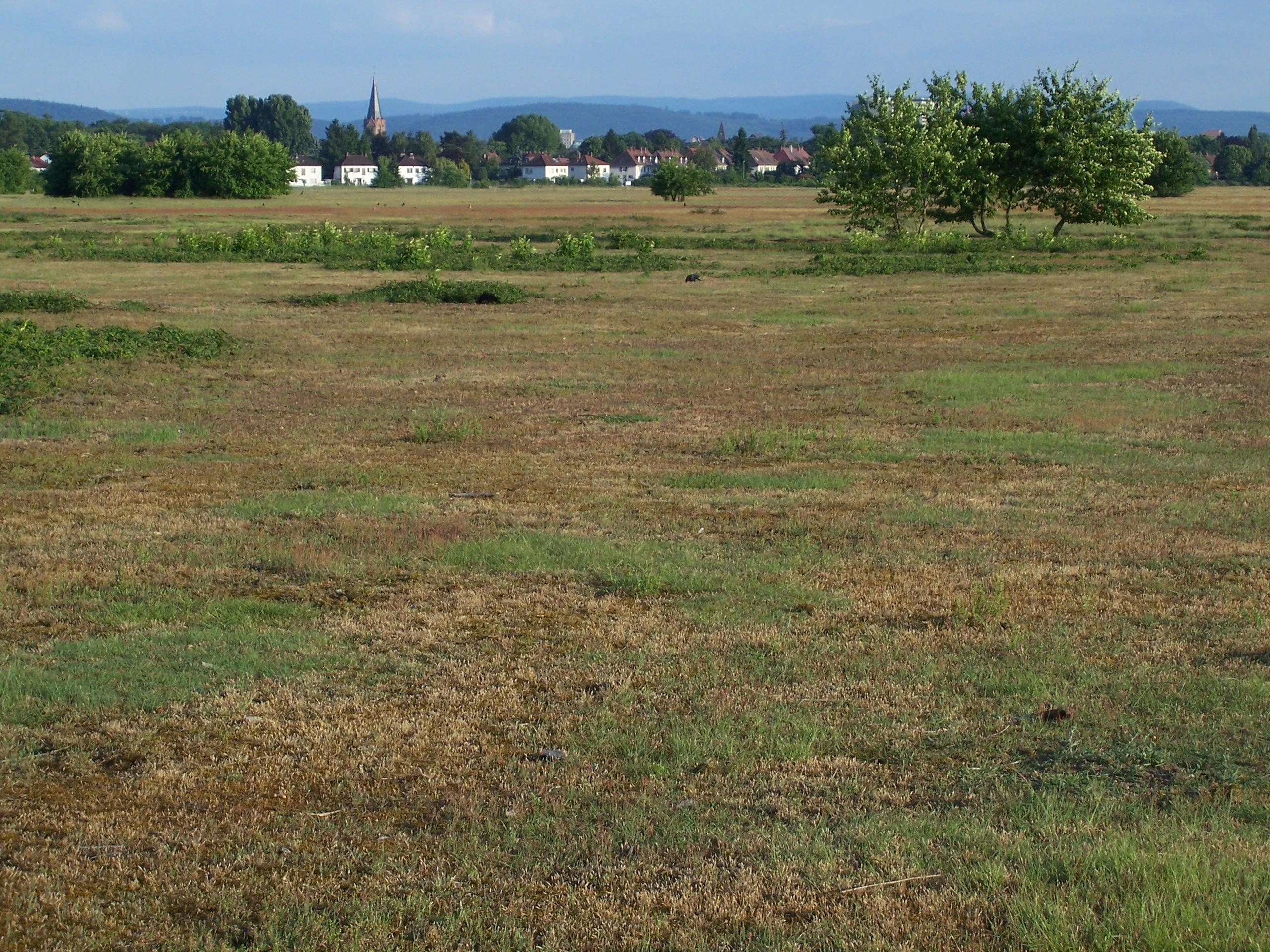
The Rhine was originally a river with many branches and dead arms, winding through extended floodlands. In the early 19th century the river was regulated and straightened in order to make it navigable and reduce floodings. The engineer Johann Gottfried Tulla planned and organized this huge project which began in 1817. Further canalization took place in the 20th century.
Noweadays we realize the ecological problems of such projects. The floodlands serve as water reserve and storage, destroying them will not reduce but increase floodings. In addition to that, these wetland forests, river branches and lakes are homes to many endangered species, both animals and plants. The still existing remnants of the Rhine floodlands are now protected landscapes or even nature reserves.
In spite of the industrial areas in between, like the Karlsruhe port, the oil refinery and other factories - you'll see the chimneys from about everywhere -, these floodland areas are valuable habitats where birds, amphibians, dragonflies etc. can be observed.
The floodlands can be explored on foot or better, because of the distances to be covered, by bicycle. There are enough marked trails to take you around.
For hikers: Tram 6 to "Rappenwört", or tram S5 to "Karlsruhe Rheinbrücke".
Written Jul 21, 2008
Sponsored Links
4 Reviews and 106 Opinions This report refers to me staying at the Renaissance Hotel Karlsruhe in Februar 2009 during a...
6 Reviews and 60 Opinions I picked the Acora hotel, because I needed a safe parking place for our car and also I wanted to be...
3 Reviews and 241 Opinions My husband attended a conference in Karlsruhe, and this was the conference hotel. As you can tell...
Reviews and photos of Karlsruhe attractions posted by real travelers and locals. The best tips for Karlsruhe sightseeing.

The Rhine was originally a river with many branches and dead arms, winding through extended floodlands. In the early 19th century the river was regulated and...
165 members live in Karlsruhe
Q: Concerns. Our tickets show us catching the 3:37am train from Karlsruhe-Durlach to Bruchsal for a ICE at 4:07am to Frankfurt...

A: Have a look at the German railway site in English: http://reiseauskunft.bahn.de/bin/query.exe/en If you put in your journey and click 'show details' you will see...
Read 17 Replies
1

The approaching Euromeet 2008 convinced me to build my own page about Karlsruhe although there are already many others online - I seem to be the 147th VT member who lives here. Anyway, an art...
2
Karlsruhe - the cradle of VirtualTourist

Karlsruhe, the city where I work and live nearby has an important significance for all VT-members, because it is the place where all began. Although the name VirtualTourist.com was bought from an...
3
EASY TO GET HERE, EASY TO SEE & A VT EUROMEET !!!

Kalrsruhe means ‘Karl’s Rest’ in German. Karl was a minor royal and wanted to set up a capital in the area. The first town told him no. So he took all his wealth and built a bigger and better city.......
4

I moved to Karlsruhe in 1996 and I have really learnt to love this city: Karlsruhe is a friendly place, which certainly has a wonderfully mild climate and a fantastic location: it lies on the Rhine...
5
Opera and cycling in Karlsruhe

If you look at a map of Karlsruhe you will see that there are streets radiating out from the Palace in all directions. Actually the back ones radiate out through the woods and the front ones through...
Build your own Karlsruhe page
Sponsored Links