Helmstedt Things to Do

  Double chapel and convent buildings
by Kathrin_E
 
  • Double chapel and convent buildings
      Double chapel and convent buildings
    by Kathrin_E
  • Former Chapel of St Georg
      Former Chapel of St Georg
    by Kathrin_E
  • Türkentor
      Türkentor
    by Kathrin_E
  • Two renaissance portals of Juleum Novum
      Two renaissance portals of Juleum Novum
    by Kathrin_E
  • The aula
      The aula
    by Kathrin_E
 

Most Recent Things to Do in Helmstedt

Türkentor – Gate of the Turks
Kathrin_E profile photo

2.5 out of 5 starsHelpfulness

Kathrin_E 2846 reviews
T��rkentor

The gate belonged to the abbey complex of St Ludgeri. The original was destroyed in 1944. A reconstruction has been put up in the 1980s.

The gate is a triumphal arch. It praises Austria’s victory against the Turks in 1716.

Written Mar 25, 2010

Related to:
 Architecture
 Historical Travel

Was this review helpful?

Hausmannsturm Gate and Chapel of St Georg
Kathrin_E profile photo

2.5 out of 5 starsHelpfulness

Kathrin_E 2846 reviews
Hausmannsturm and chapel
2 more images

Only one of the once four town gates is preserved, the Neumärker Tor in the west. The gate tower is also known as Hausmannsturm. Neumärker Straße, the street that leads through it, is Helmstedt’s main shopping street (but don’t expect too much, this is a small town).

The chapel next to the gate tower belonged to the hospital of St Georg , a medieval foundation outside the town wall. It was built after 1322. The hospital is gone. The chapel has long been applied to worldly use and nowadays hosts a jewellery shop.

Written Mar 25, 2010

Related to:
 Historical Travel
 Architecture

Was this review helpful?

Monastery of St Ludgeri: The Double Chapel
Kathrin_E profile photo

2.5 out of 5 starsHelpfulness

Kathrin_E 2846 reviews
Double chapel and convent buildings
4 more images

The small separate building in the courtyard contains two chapels. The lower chapel is dedicated to St Peter and Paul, the upper chapel to St John Baptist. Legends tell that the lower chapel is of Carolingian origin and served as missionary chapel in the 9th century Christianizatiof the region. However, the present building was only begun in the 11th century. When the three convent wings were rebuilt, the chapel also underwent some alterations to connect it to the convent buildings and give it a baroque outer appearance. The bell-shaped spire was added in those times.

The upper chapel of St John Baptist was redesigned and received a new stucco decoration which is dated 1710. An inscription under the picture of the chapel refers to this renovation (photo 3). The painted antependium depicts Bishop St Liudger, the patron saint of the abbey church.

The lower chapel of St Peter and Paul is still (or again) plain and Romanesque. The altar has a 17th century stone retable with crucifix and apostles. It is damaged, the crucified Jesus has lost his arms. The sign on the prayer bench in front of the altar says, “Lord you have no arms any more – use mine.”

The chapels are open in the daytime.

Written Mar 25, 2010

Related to:
 Religious Travel
 Historical Travel
 Architecture

Was this review helpful?

Monastery of St Ludgeri: Crypt of St Felicitas
Kathrin_E profile photo

2.5 out of 5 starsHelpfulness

Kathrin_E 2846 reviews
Crypt of St Felicitas
4 more images

The 11th century crypt underneath the church is accessible from the courtyard of the convent underneath the northern transept. St Felicitas was the original patron saint of the abbey. The main church was later dedicated to St Ludgeri but the chapel in the crypt remained with St Felicitas.

If the door is locked, ring the bell at the parsonage office and ask them to let you in. (I was lucky, the secretary saw me and came out to open the door for me).

In the corridor two pieces of the medieval church floor are on display. These were found during excavations. The floor is made of plaster and shows engraved figures, inscriptions and ornaments with black and red outlines.

Written Mar 25, 2010

Related to:
 Architecture
 Historical Travel
 Religious Travel

Was this review helpful?

Monastery of St Ludgeri
Kathrin_E profile photo

2.5 out of 5 starsHelpfulness

Kathrin_E 2846 reviews
Monastery of St Ludgeri
4 more images

The monastery complex is one of Helmstedt’s greatest architectural treasures after the Juleum. It was founded in the 9th century and always connected with the abbey of Werden in Essen, both were ruled by the same abbot. The abbey of St Ludgeri was an imperial abbey, thus not subject to the Duke of Braunschweig and not affected by the introduction of the reformation. In the 18th century the convent and economy buildings were rebuilt in baroque splendour while the Romanesque church remained. The monastery stayed in operation until 1802/03 when it was closed down in the secularization. The abbey church became the catholic parish church of Helmstedt.

The economy buildings are only partly preserved. In the 1980 a main street was built right through the premises and some buildings demolished. The small pigeon tower is now standing in the middle of the road.

The interior of the church still shows a Romanesque structure but has been modernized in post-war 20th century. The church and the courtyard of the convent are open in the daytime. Don’t miss walking round the church through a small passage into the courtyard to see the crypt and the double chapel (see separate tips).

Written Mar 25, 2010

Related to:
 Religious Travel
 Historical Travel
 Architecture

Was this review helpful?

Former Beguine House
Kathrin_E profile photo

2.5 out of 5 starsHelpfulness

Kathrin_E 2846 reviews
Parsonage, former house of the Beguine community
1 more image

The most beautiful half-timbered house in the surroundings of St Stephani Church now serves as parsonage. It was built in 1580 for the Beguines, a Christian community of women which existed in Helmstedt already in the 14th century.

Written Mar 22, 2010

Related to:
 Historical Travel
 Religious Travel
 Architecture

Was this review helpful?

Church of St Stephani
Kathrin_E profile photo

2.5 out of 5 starsHelpfulness

Kathrin_E 2846 reviews
Church of St Stephani
4 more images

St Stephani is the main parish church of old Helmstedt. It is located on the highest hilltop within the old town. The hill was turned into a platform and stabilized by a wall on the steep eastern side. The surrounding churchyard used to be the cemetery. One baroque burial chapel, dated 1683, is still standing on the edge.

The origins of the church date back to the 12th century. The low but imposing massive westwork is the oldest part. It has never been higher than it is now and can hardly be called a steeple.

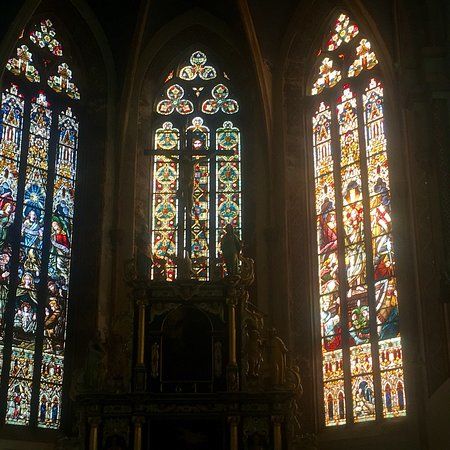
Nave and choir were rebuilt and enlarged in the 13th/14th century in gothic style. Altar, pulpit, galleries and all other pieces of ‘furniture’ are post-reformation and tell of protestant theology. For the experts, there are some interesting paintings with decided Lutheran iconography. 19th century historism added the side galleries and the stained glass windows.
The brass baptismal font in the western part of the nave, founded in 1590, is one of the most precious works of art in this church.

The church is open in the daytime. Access from the southern side where the parking lot is.

Written Mar 22, 2010

Related to:
 Historical Travel
 Religious Travel
 Architecture

Was this review helpful?

Holzberg Square
Kathrin_E profile photo

2.5 out of 5 starsHelpfulness

Kathrin_E 2846 reviews
Holzberg
3 more images

When walking into the old town from the train station, the large trinagular square (huh?) named Holzberg is probably the first you reach. It is used as a parking lot and full of cars. Watch your steps, as it is paved with cobblestone, only the sidewalks are a bit smoother. Anyway, don't miss looking at the houses around the square. There are some pretty half-timbered houses with elaborate woodcarved decorations, built in the 16th/17th century.

The square is located on a gently descending slope. If you want to visit the Juleum/university, the tower shows among the houses at the lower end, just walk in that direction.

Written Mar 22, 2010

Related to:
 Historical Travel
 Architecture

Was this review helpful?

Professors’ Houses
Kathrin_E profile photo

2.5 out of 5 starsHelpfulness

Kathrin_E 2846 reviews
House of professors Conring and von der Hardt
1 more image

After the opening of the university Helmstedt experienced a boom. Professors and students and other staff involved with the university moved into town. They needed housing. A lot of pretty houses, some half-timbered and some in stone, were built in the streets around the university. You will find signs on many facades that tell who used to live when in that particular house. The university is gone and the famous professors are gone but their impressive houses remained.

Written Mar 20, 2010

Related to:
 Historical Travel
 Architecture
 Study Abroad

Was this review helpful?

Market Square and Town Hall
Kathrin_E profile photo

2.5 out of 5 starsHelpfulness

Kathrin_E 2846 reviews
Town hall in market square

The town’s market square is rather unspectacular. Like Holzberg it is triangular, not square. The most interesting institution for visitors here is probably the tourist information.

The southwestern corner is occupied by the town hall. A much older, probably medieval building was substituted by a new one in 1904-1906. The imposing historistic façade shows a mix of renaissance and late gothic style.

Written Mar 20, 2010

Related to:
 Architecture

Was this review helpful?

Comments

Top 3 Hotels in Helmstedt

Der Quellenhof

 1 Opinions

 Hotels in Helmstedt

Show Prices

Parkhotel Helmstedt

 4 Opinions

 Hotels in Helmstedt

Show Prices
Map of Helmstedt