This statue of the Great Man stands outside the Rathaus, and directly across from the offices of the Route Charlemagne.
It's actually a trifle underwhelming, as it appears to be about life size (Charlemagne wasn't called 'Charles the Great' just for his achievements, since his skeleton proves that he was a big bloke even by our standards, and a veritable giant for his time), but is elevated so high off the ground that you can't really get a good look at it. Also it was hard to photograph as the sky was overcast and the contrast between the colour of the Rathaus and the statue wasn't good.
Given that Charlemagne is the main show in town, this statue is a frankly a bit disappointing, and nowhere near as impressive as the stunning golden reliquary head of Charlemagne that is on display in the Treasury (the classic image that is plastered over all the tourist literature, but of which, bizarrely, there wasn't a single postcard available when I visited!).
Maybe someone's going to give this statue a clean and/or a regild before the complete Route Charlemagne is launched in 2012, which would go a good way towards enhancing its appeal?
Updated Dec 14, 2011
I like cities, but I don't much enjoy prolonged exposure to hoards of people, so after a couple of hours in Aachen's old town during Karnival (a coincidence rather than something I'd planned), I felt the need to escape the madding crowds of pleasantly half-enebriated people in bizarre garb.
Fortunately Aachen's old town is small and surrounded by a 'belt' of parks and gardens. I followed my nose to the Salvatorburg, just north of the spa complex, which is a steep walk through a park which gives way to some lovely woodland. Even though the town is only a few hundred metres away, it feels as though you have escaped the city and the walk up the hill is exhilarating.
At the top of the hill is the exquisite Salvatorkirche, a gorgeous little church all but hidden from the town below by the surrounding trees. Coincidentally it was the second Salvatorkirche that I had stumbled across in as many days, and it seemed as if the atmospheric intimacy of Aachen and the imposing bulk of Duisburg's towering namesake were at opposite ends of the spectrum.
As befits the setting, the interior of the church is simple but very beautiful, and very much in keeping with the architecture. One of the rather whimsical yardsticks that I use to 'rate' churches is whether I'd like to be have been married there, and I had no problem whatsoever imagining the pews filled with family and friends.
A lovely spot to catch up on yourself and just 'be', and perhaps a good spot to offer a prayer for your loved ones.
Updated Dec 14, 2011
Warm water is one of life’s great pleasures, and when feeling sick, sad or generally out of sorts, I can be counted on to retreat to a hot bath. So I am greatly endebted to BillNJ for his excellent Aachen page which first brought the Carolus Therme spa to my attention.
Travelling to Aachen in chilly early March whilst recuperating from bronchitis, (and despite multiple layers of clothing superimposed on skiing thermal underwear) I felt permanently cold, and was disappointed that my (budget) hotel did not offer a bath into which I could retire for a therapeutic wallow. This temporarily privation made me realize how the rank and file of Europeans over the centuries must have felt, as easy access to hot water would not have been a fixture of life in the Dark or Middle Ages even for the nobility, so it is not hard to appreciate the allure of Aachen's thermal springs.
The Carolus Therme is a spa complex established around the thermal springs first developed by the Bronze Age Celts (and possibly even before) and which provided the focus for the Roman settlement of Aquae Granni. Today the springs have been developed into a luxurious –yet affordable – spa complex which presents locals and visitors with the ideal opportunity to pamper yourself and sooth aching muscles in all weathers.
The complex is separated into two: a series of indoor and outdoor pools, and an upstairs complex of saunas and treatment rooms. The pools are of varying temperatures and serve different functions: my personal favourite was a ‘blue grotto’ with very warm water and two water cascades under which you can stand to massage your neck and back (as well as cunning little water jets on the base of the pool to massage your feet).
Elsewhere there are pools and jacuzzis of differing temperature and intensity, and participation in a number of activities are included in the price: when I visited, there was an aqua aerobics class (attended by a motley selection of people, ranging from teenagers to pensioners) and a meditation class. And, in contemplating the holistic definition of 'wellness', of course you should never underestimate the opportunity that such spas offer for an unexpected ego boost, as there are always people older and fatter than yourself in these complexes!
For my money, the best fun is one of the outdoor pools – warm enough to be pleasant even when the outside temperature was 3˚C – which is equipped with a 'current' (water, not electrical!) that is activated on every few minutes. This current allows you to part swim, part body surf around the perimeter of the pool and is enormous fun.
The sauna complex (in which nudity is 'compulsory' - I just love that Teutonic directness when it comes to rules!) has a number of themes, which seem to range from Baltic log cabins to scented desert experiences: I had meant to try these out, but as it turned out, couldn’t summon up the energy and enthusiasm to tear myself away from the pool complex!
There are also no fewer than three restaurants, some of which you can access in your bathers/dressing gown.
Being of an inquisitive (alright, nosey) disposition, I enjoy the wonderful opportunities that spas present for 'people watching'. Over the course of the afternoon, I monitored the progress of a lovestruck German youth who was on what appeared to be his first date with a charmingly cosmopolitan Russian polylinguist - he was clearly besotted, and I was silently cheering him on for the entire afternoon. How do I know this? Well, I shamelessly eavesdropped every time we found ourselves sitting in the same jacuzzi!
The fee is payable on exit, depending on what services you have used (which means you don’t have to make up your mind in advance): in my case, 3.5 hours in the pool complex cost €12.50, and use of the saunas would have cost an additional €10. Swimming costumes are required for the pool complex, whilst towels and dressing gowns can be hired (or purchased), although it’s obviously cheaper to bring your own. I also found a USA Today travel article that mentioned that, "Carolus Thermal Baths offers a gift certificate for all those who donate blood at the clinical center at University Hospital Aachen. For the sake of safety, do not take your thermal bath on the same day you donate blood." I am not sure that this is still the case - and, if it is, I'm peeved that I didn't know beforehand, as I am a dedicated blood donor - but as I was recupering anyway, they probably would (and should) have turned me away!
Note that no children under 6 are allowed.
Highly recommended!
Updated Dec 14, 2011
Address: Paßstraße 79
Website: http://www.carolus-thermen.de/go/thermalwelt-innen/english.html
I was surprised to find that there is a strong link between Aachen and Hungary - apparently there was major medieval pilgrimage traffic between the two, and the Queen of Hungary visited on pilgrimage in 1337 with a staggering encourage of over 700!
Charlemagne built up a formidable collection of relics (including crowd pleasers such as fragments of Mary's robe, the swaddling clothes and loincloth of Jesus, and the cloth used to wrap the severed head of John the Baptist). This made it one of the premier pilgrimage sites north of the Alps in its own right, as well as a popular staging point for pilgrims heading west to the better known Santiago di Compostela.
One of the chapels in the Dom is known as the Hungarian chapel, and outside the Dom, a contemporary statue of a rather mournful looking St Stephen has been erected.
Saint Stephen I was the first King of Hungary who is credited with bringing Christianity to the Carpathian Basin: morever, unlike the more famous Charlemagne, he at least seems to have managed to hold onto his sainthood (see my Aachen introduction for more on Charlemagne's 'de-sainting'!)
I think that this is a very attractive statue, and I particularly like the jewelled detail on his cloak. For maximum photogenic opportunity, visit when the adjacent magnolia tree is in bloom (sadly I'm not that organised, but other people's online photos look stunning)!
Updated Nov 15, 2011
The shrine of Charlemagne is located in the choir of the Dom and this confection of gilded splendour is impossible to miss!
When Charlemagne was canonised in 1165, the Emperor of the time, Frederick Barbarossa, ordered that his mortal remains be exhumed and placed in a magnificent shrine worthy of his saintly status. The shrine, as was customary at the time, was an oak chest, with external panels extravagantly decorated with silver and gilt relief. Usually such Romanesque shrines depict the Twelve Apostles along their sides, but in this case, they have been usurped by sixteen local kings known for their particular generosity towards the Aachen Dom (the precursor of sponsorship rights?)
I have a sneaking regard for insolence (so long as I'm not on the receiving end of it), and what I most enjoyed about this shrine was the figure of Charlemagne - flanked by the Pope on one side and the Bishop of Aachen on the other - which depicts him towering over both! We know for a fact that Charlemagne was a big man (estimates of his height based on his skeleton range between 1.84m and 1.90m, which would have made him a veritable giant in his day, despite his father being known rather dismissively as Pepin the Short), but one suspects that the message being conveyed here has little to do with physical stature and everything to do with a pointed comment on the authority of the Emperor in relation to the authority of the Church! Even more cheekily, the face of Charlemagne on the shrine is actually that of Frederick Barbarossa, thus underlying the link between the emperor of the time and his illustrious forebear!
I can't remember how many of Charlemagne's bones are still housed in this shrine - we were told by our guide, and it was a good many less than the requisite 206. Presumably some of the smaller ones may have been lost during exhumation and transfer into the shrine, but more likely a goodly number of them - certainly his skull and a few other bits and bobs now on show in the Treasury - have been 'harvested' as relics. So much for resting in peace (more like pieces)!
Updated Nov 15, 2011
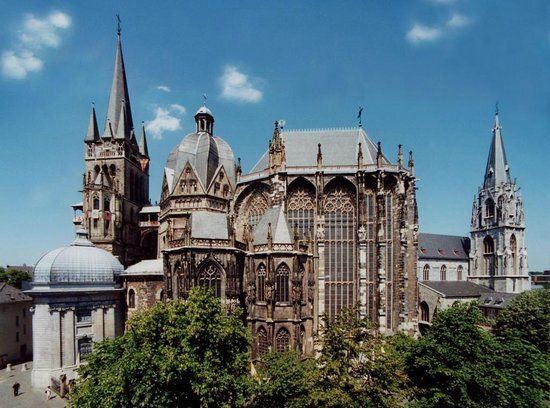
Aachen’s Dom is a surprisingly small but exquisite gem of Gothic architectural perfection and was one of the twelve original sites worldwide - and Germany's first - to be granted UNESCO World Heritage status back in 1978.
The oldest part of the Dom is the Palatine Chapel (under renovation when I visited in March 2011, so although entry was possible, the roof wasn't visible), which was commissioned by Charlemagne and began construction in 792 - a staggering early date when you think about it. The octagonal design was inspired by Byzantine churches - particularly San Vitale in Ravenna - and the cathedral was dedicated to the Virgin Mary in 805 by Pope Leo III.
In common with the vast majority of European cathedrals, the Dom is a venerable mongrel which it has been subsequently added on to in several phases. the most notable of these additions is the soaring Gothic choir built to accommodate the tourist hoards of the day - pilgrims flocking to what was the most significant pilgrimage location north of the Alps at the time (and a major staging post en route for Santiago di Compostela). The choir was consecrated on the 600th anniversary of Charlemagne's death in 1414 and several smaller chapels have been added since then.
Unlike other Gothic cathedrals (such as the Dom in Koeln and Notre Dame de Paris) Aachen’s Dom lacks flying buttresses, and is instead supported by several metal ‘girdles’ which support the structure. The lack of external buttresses means that there is no visual interruption to the vertical external walls of the choir and make it seem deceptively tall. The windows it houses are the tallest north of the Alps and are on their third set (having succumbed to a fire in the Middle Ages and a thorough battering by artilliary fire during the battle of Aachen in WWII).
Because of renovations, I couldn't view the mosaics of the Twelve Apostles on the dome of the Palatine Chapel, but the nature-themed mosaics that adorn the interior of the Palatine Chapel are lovely - and appear very much in keeping with the Byzantine theme, they are actually a much later addition and only completed in 1902. Ironically, this lavish adornment of a Catholic church was paid for by Protestant Kaiser Wilhelm II - one would like to think that this was evidence of ecumenical cooperation at its best, but more likely reflect nationalistic pride in the church Charlemagne built! Look for the mouse close to Charlemagne's throne.
The Dom has seen the crowning of 30 kings and a dozen queens, but relatively few of these were subsequently buried there. It seems that monarchs of the age were keen to be crowned on the throne of Charlemagne, but preferred their bodies to be interred in St Denis in Paris: an unfamiliar concept today, but reasonable enough at a time when both lay within the same Empire. (For more detail in this, have a look at my St Denis tips on my Paris travel page).
Photography is allowed - you will pay 1 Euro for the privilege, but this is free for people on guided tours (which I would highly recommend). An English language tour takes place at 14:00 each afternooon.
I suggest that you have a look at this bronze model of the Dom before you tour around, as this allows you to appreciate the structure in its entirety and understand how the different sections fit together (like most medieval towns, later buildings have since clustered around the church, and it's not possible to get an uninterrupted view). This is also an innovative way to allow people with partial/no sight to appreciate this architectural masterpiece.
Updated Nov 15, 2011
The entry to the Dom is a lovely spot, provided it's not crowded with tourists.
You enter from the west and pass through gates into what would be called a 'church close' in England, lined by houses that presumably once housed clergy and other associated with the Dom and would now constitute extremely desirable real estate. I didn't see it myself, but I would imagine that it's particularly picturesque just before dusk as the sun sets over the gate and bathes the Dom in gentle light.
The massive bronze 'Wolf Doors' are the main entrance to the Dom and date back to the 800s when the Palatine Chapel (the original part of the Dom structure) was built. There is a legend that a deal was done with the Devil when funding ran short to complete the Dom, and in return, he was promised the first soul that entered the church. The canny townsfolk reneaged on the deal by herding in a wolf rather than a person, which so enraged the Devil that he slammed the huge bronze door in fury, and caught his thumb, which was left behind in the door. Lesser mortals now use a rather less impressive person-sized side entrance adjacent to the Wolf Doors.
This event is commemorated by a bronze statue of a wolf with a hole in its chest which sits in the cathedral antechamber, presumably through which the Devil ripped out its soul.
As they say, the Devil's in the detail ... or in this case, "The Devil's the hell in with the detail"!
Updated Apr 11, 2011
I love city walls - they give me a sense of security which is probably totally misleading given how often many of these have been breached throughout history!
Aachen has a couple of reassuringly solid city gates, and fragments of the medieval city walls still remain: if you look at a map of the city centre, you can see that what was most probably the location of the old city wall is now a ring of parkland around the Old Town.
I particularly like this gate - the Pottnor Gate, just north west of the town centre - because you can still see the remains of the moat. In my subsequent research, I was charmed to discover that this wonderful building is still in use - as the scout hall of the Holy Cross Scout Troop!
Updated Apr 8, 2011
Aachen is blessed with many beautiful fountains - apparently over 60 in all - most of which were unfortunately cordoned off when I visited, less drunken Karnivallers should fall into them, doing damage to both themselves and the fountain!
The 'Circle of Money' fountain is the one that I liked most, and symbolises the circulation of money. It was sculpted by Karl-Henning Seemann and sponsored by Sparkasse Aachen, a local bank.
The figures arranged around the outside of the fountain are affectionate caricatures of people in all walks of life, and I particularly enjoyed the way that the water circulated in the fountain itself. Very symbolic in an unpretentious and accessible way (just my kind of art)!
There is a small park adjacent to the fountain which was just starting to show the first evidence of spring bulbs when I was there, and seems to be much favoured by families. The park also has a small area of 'amphitheatre style' seating which seems to be regularly used by school groups.
Updated Apr 8, 2011
(work in progress)
I thought that the municipal sculpture was one of the highlights of my time in lovely Aachen: I love the accessibility of this artform, and the fact that it is part of people's day-to-day lives.
Of all the sculptures, this was perhaps the one that I liked most: a sleeping lion located by the statue of ******** on *******. There was no notice to explain its significance, but I loved its peacefulness and lifelike proportions - a far cry from the usual mane-bristling, rampaging lions of heraldry. In fact, it put me in mind of C.S. Lewis' 'The Lion, the Witch and the Wardrobe' (my all time favourite children's book, which inspired the Narnia movies), where the White Witch turned animals opposing her rule to stone. I, for one, wouldn't be at all surprised if you could bring this lion back to life with the flick of a wand!
Updated Apr 8, 2011
Sponsored Links
3 Reviews and 290 Opinions My budget sadly didn't run to staying at the Hotel Quellenhof, but that didn't stop me appreciating...
1 Review and 234 Opinions I had two adjoining rooms here on my recent trip to Aachen with my parents and friend. We loved the...
1 Review and 177 Opinions Very nice room in a good hotel, next to the citycentre but quiet for a good night's rest. I booked...
Reviews and photos of Aachen attractions posted by real travelers and locals. The best tips for Aachen sightseeing.

(work in progress)I thought that the municipal sculpture was one of the highlights of my time in lovely Aachen: I love the accessibility of this artform, and...
84 members live in Aachen
Q: I have a trip in Aachen for 1 week and I buy many things and would like to find some cheap or second hand luggage to carry it...

A: Do you mean something in which to carry your purchases back home i.e. suitcase? Or do you mean lots of suitcases that you can then sell back home? Sorry, your post is...
Read 3 Replies
1
City of Kings and Thermal Baths

Charlemagne (aka Karl der Grosse in German, Karel de Grote in Dutch, Carolus Magnus in Latin, and Charles the Great in English) became the sole King of the Franks in 760 A.D. upon the death of his...
2

Aachen is a border city just six kilometers away from the Three Countries' Corner, which is a place up in the woods where the borders of Germany, the Netherlands and Belgium all come together. As in...
4
Aachen - City of Coronations and Cakes!

Aachen was the setting for a VT meeting in September 2004. Many thanks to Sabsi for an open invitation to join her here and for meeting us at the airport and accomodating us in her Dusseldorf...
5

History of Aachen Wieder kommt die Weihnachtszeit, die schoenste Zeit im Jahr, bringt den Menschen weit und breit Frieden und Freude dar. ~~~~~~~~~~~~ Ein Frohes Weihnachtsfest und zum...
Build your own Aachen page
see all Aachen member meetings
Sponsored Links