
Become a Virtual Tourist Member Today!  Sign Up for Free | Sign In
Things to Do in Trier
Search:

Home » Travel Guides » Europe » Germany » Land Rheinland-Pfalz » Trier » Things To Do

Trier Hotels

Real reviews from real travelers.

Trier Things To Do

Plaque at the entrance - Trier
Plaque at the entrance
by kokoryko
Reviews and photos of Trier attractions posted by real travelers and locals. The best tips for Trier sightseeing.
Trier Map
Sort By:  Most Recent | Best Rated
Elector's Palace,
  • Tip Rating:
  • smschley
  • Updated By smschley on March 20, 2005
  • Trier Page by smschley
  • Trier Things To Do
    by smschley
    The Elector's Palace is a 17th century palace that adjoins the Basilica, and originally was built in a rectangular shape with two courtyards inside. They remained unchanged until Johannes Seitz, to make it the archbishop Elector’s official residence, rebuilt the south-wing 1757-61 in the style German Renaissance style. But this project was never completed and the balance of its proportions was seriously impaired by the Basilica's subsequent restoration during the middle of the last century.

    Its inner staircase is the work of the sculptor Ferdinand Tietz The figures on the balcony and on the pediment (Ceres, the Goddess of Agriculture and Fertility, the Putti and Graces) are all his or his school's work. The Palace is now the seat of the District Government and Administration.

    The buildings in the second palace courtyard were damaged or destroyed in 1944 during WWII and later partly replaced by new buildings. The Red Tower (Der Rote Turm) dating from the middle of the 17th century was restored here in 1966.

    The Elector's Palace is situated at one end of the Palace Garden opposite the Kaiserthermen (Imperial Thermae). At the edge of the Palace Garden lies the Landesmuseum.

    The palace cannot be entered because its interior is used for city offices, but the adjoining Palace Gardens (Palastgarten) are always open and free.

    Leave a Comment

    Not Helpful 1 2 3 4 5 Very Helpful

    Visiting Trier?

    Read reviews about Trier Hotels

    Real Reviews from Real VirtualTourist Members.

    Imperial Bath House - Kaiserthermen
  • Tip Rating:
  • smschley
  • Updated By smschley on March 20, 2005
  • Trier Page by smschley
  • Trier Things To Do
    by smschley
    Today’s ruins of the Trier’s Imperial Baths (Kaiserthermen) are the remnants of construction which was probably started around 300 AD under Emperor Constantine. Its construction was probably never finished, and are modest compared with the original, vast complex that once stood here.

    Construction had been interrupted around 312 due to the lack of funds as Constantine focused his political interests on the Mediterranean. When construction resumed, the baths were converted to barracks for the mounted imperial bodyguards, with 800-1000 soldiers plus their horses. The caldarium (warm bath) building became the drill hall/flag sanctuary. In the Middle Ages, it was converted into a castle, "Alderburg." Finally, around 1120, it was incorporated as a corner bastion of the new medieval city wall.

    Today from materials excavated, the South Apses wall has been reconstructed to some extent, and nowadays serves as background for an outdoor theatre festival. It extends 855 feet east to west, and 477 feet from north to south, and is one of the largest monumental ruins from the world of antiquity. What you can see is three stories above ground, but there are another two stories below. In almost no other complex is it possible to visit such a complicated subterranean passage system.

    At these baths, prominent Romans would have relaxed and entertained. The partly preserved, partly rebuilt brick work of the large apse in the picture was once part of the hot-water bathing room. In less repair are other bathing rooms, as well as a cold-water baths, a sauna and a massage room. This structure is the second largest bath in Trier, next to the Barbarathermen, and the fifth largest in the Roman Empire.

    Leave a Comment

    Not Helpful 1 2 3 4 5 Very Helpful
    Trier Cathedral
  • Tip Rating:
  • mustertal
  • Updated By mustertal on October 28, 2005
  • Trier Page by mustertal
  • The Dom - Trier
    The Dom
    by mustertal, 1 more photos
    How we missed the Cathedral on our last visit 15 years ago, I will never know. I would advise you to visit the Dom information office which is directly across from the cathedral, before you go into the Dom. The Cathedral is a magnificent building and the inside was pretty amazing, very hard to describe the magnificence of this Dom.
    The founder of the Dom is thought to be Emperor Constantine ( 306 - 337 ), on his 20th administration anniversary, he began construction around 326.
    During restoration of the Cathedral in 1960 - 1975, a gold crucifix was created to replace the missing silver shrine.
    Services in the Cathedral are held week days : 7.00h Holy Mass : 9.00h High Mass.

    To arrange a tour tel : 06 51/97 90 79-0

    Leave a Comment

  • Directions: North of the Market square
  • Not Helpful 1 2 3 4 5 Very Helpful
    Karl Marx House
  • Tip Rating:
  • smschley
  • Updated By smschley on March 20, 2005
  • Trier Page by smschley
  • Trier Things To Do
    by smschley
    Karl Marx was born in 1818 in the upstairs room of this old burgher's house at 664 Bruckergasse, a busy thoroughfare at the time that winds down to the bridge over the Moselle river. It’s amazing that for someone as famous as Marx there is still things about his life that is unclear. His father Heinrich was descended from a long line of Rabbis and was well respected amongst the Jewish community for his skill in the courtroom. As Heinrich's clients began to leave the city in search of employment, his work had suffered so badly that he took an unprecedented step and converted to Christianity. It’s not sure if this was done right before Karl was born or when he was about 6 years old.

    Another unclear issue is how long he actually lived in this house. Some say that his father had taken a lease on the building only one month earlier and moved out when Karl was fifteen months old. Others say that he lived in this house until 1835 when he moved to attend school in Bonn. Regardless, seems like at least everyone agrees that he was born there.

    The house was bought by the German Social Democratic Party in April 1928. It currently is a museum devoted to his life and times run by the Friedrich Ebert Foundation in Bonn. The Karl Marx House in Trier, comprises two buildings each with its own functions and purposes; the birthplace museum and the study center. The birthplace museum has exhibits on Marx's personal history, volumes of poetry, original letters, and photographs with personal dedications. There's also a collection of rare first editions and international editions of his works, as well as exhibits on the development of socialism in the 19th century

    Leave a Comment

  • Address: Bruckenstrasse 10
  • Directions: open: Apr-Oct Mon 2-6pm, Tues-Sun 10am-6pm; Nov-Mar Mon 2-5pm, Tues-Sun 10am-1pm and 2-5pm
  • Not Helpful 1 2 3 4 5 Very Helpful
    Porta Negra
  • Tip Rating:
  • smschley
  • Updated By smschley on March 20, 2005
  • Trier Page by smschley
  • Trier Things To Do
    by smschley
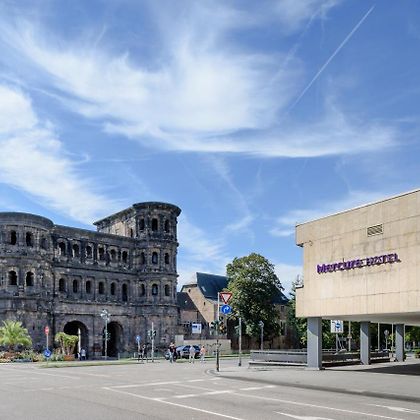
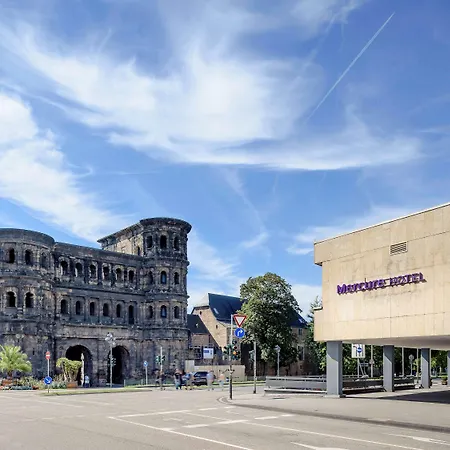
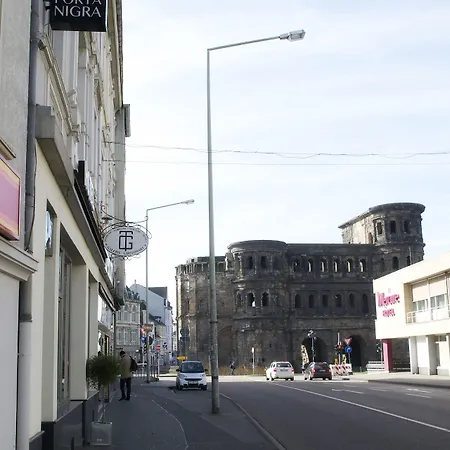
    Porta Negra or the Black Gate as some people call it is found right in the center of town and stands as the entrance to the old town. It is huge!!!! Its enormous dimensions make it a unique monument for its kind and time. Back in the 2nd century, when it was built, it presented a strong and effective defense to protect the Roman Empire against the Germanic tribe, and an impressive symbol of Rome’s might and power.

    The Roman Empire was huge; it spread over the Middle East and from Africa to Britain and Germany. Towards the end of the Roman Empire, Trier, on the Moselle, was one of its capitals. There the Romans built a huge entrance gate around 180 AD, the Porta Negra, to keep the Celts out of the city. Master Roman builders piled up the stone blocks without using mortar. Iron clamps and the weight of adjacent blocks still keep the structure in place. The Porta Negra was preserved thanks to a Greek monk by the name of Simeon, who came to Trier in 1028 to seek a devout life of solitude. After his death, it was converted into a church, allowing it to be preserved. It was not until the arrival of Napoleon I that the Roman building had most traces of its past removed. The "Porta Negra" in Trier is perhaps the largest Roman portal still standing. The Gate has been called Porta Negra, or "Black Gate, as far back as the 11th century as this old Roman gate has been blackened by air pollution over the centuries

    Leave a Comment

  • Directions: Downtown Trier
  • Not Helpful 1 2 3 4 5 Very Helpful

    Visiting Trier?

    Read reviews about Trier Hotels

    Real Reviews from Real VirtualTourist Members.

    Amphitheatre
  • Tip Rating:
  • smschley
  • Updated By smschley on March 20, 2005
  • Trier Page by smschley
  • Trier Things To Do
    by smschley
    The Amphitheatre, on the outskirts of the modern, as well as the Roman town, was built into the very slope of the Petrisberg, not far away from the Weinlehrpfad. This prestigious building was built around 100 AD and richly decorated during the following centuries. You can go underneath part of the Amphitheatre to where some of the gladiators waited and see where many waited for their death. Once on the Amphitheatre floor you could look around and see the tunnels and rooms where animals and other gladiators entered from. It was somewhat unnerving knowing that people fought and died where you were standing for amusement of others.

    Its western half held the imperial box and seats reserved for high-ranking civil servants. Its main entrances, to the north and south, had originally been provided with magnificent facades with ample space for three passages and vaulted entrances. On its western side, two smaller doors led upwards and to the tiers.

    The arena had room for roughly 20,000 people .In the 4th and 5th centuries spectators could watch the often bloody spectacles unfold from the sloped spectator stands. . Its size means it is the tenth largest among the 70 preserved ancient amphitheatres. In the walls, there are openings into stone chambers that served to accommodate people and animals. Beneath the arena are the cellar rooms where the necessary equipment and backdrops for the performances were kept

    The Amphitheatre was at the same time a town gateway, so that the north entrance laid inside and the south entrance outside the town walls. The gate structures and the remaining walls were used for quarrying in the Middle Ages and also later on.

    Leave a Comment

    Not Helpful 1 2 3 4 5 Very Helpful
    Hauptmarkt Market
  • Tip Rating:
  • smschley
  • Updated By smschley on March 20, 2005
  • Trier Page by smschley
  • Trier Things To Do
    by smschley
    The Hauptmarkt (Main Market), one of the most magnificent squares in the whole of Germany, is located a few blocks from the Porta Negra on Simeonstrasse, the pedestrian shopping street. The market is surrounded by a wonderful mix of beautiful Renaissance and Baroque architecture with historic Roman-era buildings and ruins.
    In commemoration of a charter to hold markets in Trier, Archbishop Henry (958) erected a market cross in its centre which made this market the focal point of the town's further development during the Middle Ages. Trier’s Market Cross was erected on a granite pedestal dating from Roman times.

    The market's south front holds the Church of St. Gangolph. St. Peter's Cathedral and the Church of Our Lady are very close to the market The most significant civic group of buildings is formed by the 'Steipe' and 'Rotes Haus' (Red House). One early booster, Johann Polch, the cathedral clerk and head of the bakers' guild, built the 17th-century Rotes Haus. It has a Latin inscription, itself three centuries old, which reads: "Trier existed 1300 years before Rome. May it enjoy eternal peace."

    Germany’s oldest pharmacy, Löwenapotheke (Lion’s Pharmacy) was founded here in the 1600s, and a town-house nearby, built in the 1700s, is the birthplace of Karl Marx. Among the several sidewalk cafes in the Hauptmarkt, one can be recognized by the ever-popular Golden Arches — familiar food and drink, and there are clean restrooms on the second floor.

    Leave a Comment

  • Directions: downtown
  • Not Helpful 1 2 3 4 5 Very Helpful
    Barbara Therme baths
  • Tip Rating:
  • smschley
  • Updated By smschley on March 20, 2005
  • Trier Page by smschley
  • Trier Things To Do
    by smschley
    The city contains the ruins of two large Roman bathhouses, the Kaiserthermen that sits adjacent to a major traffic circle, and the Barbara therme closer to the river. These ruins are extensive, giving the visitor a good picture of the complexity of the structures.

    In Roman times, the spacious and richly ornamented building of the 'Barbara' Bath stood close to the bridge over the Moselle which is a short walk from the Basilica of St. Matthias. These public baths, built in 150 AD are considerably older than the Imperial Baths, and were the second largest public bath in the Roman Empire ,second only to Trajan's baths in Rome. The walls of the bath were not built as high as the others. Mainly because the old walls, as those of the Amphitheatre, served as a conveniently situated quarry until the 17th century, making was remained not so impressive as those of the Imperial Baths.

    Their name of 'Barbara Thermae' actually derives from the suburb of St. Barbara, later on built on part of the old site. The term thermae was the word the Ancient Romans used for the buildings housing their public baths.

    An impressive and convincing proof of the skill of urban architecture of that period, these baths were built near the bridge across the Moselle at the western end of the town's Roman Main Street, leading eastwards - from the Moselle bridge to the Imperial Baths and then to the Amphitheatre. Later on, during the Middle Ages, this same street with its walls, towers (Red Tower) and gates ('Neutor') became the town's southern boundary. This is today the Südallee and Kaiserstrase.

    Leave a Comment

    Not Helpful 1 2 3 4 5 Very Helpful
    St. Peters fountain.
  • Tip Rating:
  • smschley
  • Updated By smschley on March 20, 2005
  • Trier Page by smschley
  • Trier Things To Do
    by smschley
    Trier seems to have a fountain on every block. I have a list of thirteen but there may be more. Saint Peter, whose statue tops the ornate fountain on Trier's market (Hauptmark) square, has stood there for 400 years since 1595. Still he's really a newcomer in town, for Trier is at least five times older. In fact, it was already a city when Peter was still out fishing on the Sea of Galilee. Today the fountain is another popular spot to meet friends in the market. Though there is a small sign warning the thirsty that this water is not for drinking there is a small spigot available from which one can draw water. The fountain was the work of the sculptor Hans Rupprecht Hoffmann who had his large studios in Trier. The statue symbolizes justice, fortitude, temperance, and prudence.

    Leave a Comment

  • Directions: Downtown Marketplace
  • Not Helpful 1 2 3 4 5 Very Helpful
    Let the Train take the Strain
  • Tip Rating:
  • mustertal
  • Updated By mustertal on February 7, 2009
  • Trier Page by mustertal
  • Romer Express - Trier
    Romer Express
    by mustertal
    If your time is limited, then why not take the Romer Express, this little train runs around the city, taking you past most of the ancient remains, and, most of the sites the City has on offer.
    The trip takes 35 minutes, you'll see, Karl Marks birth place, the Roman baths and the Amphitheatre.
    The train runs every 25 minutes April - October
    and every hour March - November.
    Adults €6 (2007 prices).
    Child €3
    Family €15 ( 2 adults + 3 children). (2007 prices)

    Leave a Comment

  • Address: Olewiger Strasse 151
  • Phone: 06 51/99 35 95 25
  • Directions: Next to the Porta Nigra.
  • Website: www.roemer-express.de
  • Other Contact: info@roemer-express.de
  • Not Helpful 1 2 3 4 5 Very Helpful
    More Trier Tips
    Overview
     
    Hotels and Accommodations
    Tips: 34 - Photos: 27
    Things To Do
    Tips: 374 - Photos: 584
    Nightlife
    Tips: 25 - Photos: 16
    Transportation
    Tips: 24 - Photos: 17
    Restaurants
    Tips: 38 - Photos: 42
    Shopping
    Tips: 9 - Photos: 9
    Off the Beaten Path
    Tips: 29 - Photos: 30
    Tourist Traps
    Tips: 5 - Photos: 4
    Warnings or Dangers
    Tips: 3 - Photos: 2
    Local Customs
    Tips: 16 - Photos: 21
    Packing Lists
    Tips: 2 - Photos: 1
    Sports Travel
    Tips: 9 - Photos: 10
    General Tips
    Tips: 60 - Photos: 57

    Best Trier Travel Deals

    Fly Lufthansa to Germany
    Travel to Munich and beyond. Book, save & fly!

    Cheap Germany Flights
    Enjoy Berlin this Fall. Book Your Ticket to Berlin Now!

    Berlin Hotel Deals
    Find the Perfect Hotel! Book Online for the Lowest Prices Guaranteed.

    Neuschwanstein in bavaria
    Castle by Hohenschwangau hotel between the two royal castles

    Fly to Europe
    Our lowest fare - guaranteed. No online booking fees.

    Sponsored Links

    More Trier Travel Deals

    Cheap Flights To Europe
    We Sell Discounted Fares to Europe Search, Compare and Save Big!

    Germany Hotels
    Get our best price guarantee on all travel to Berlin at Expedia

    Germany Vacations
    Choose From 22 Exciting Vacations to Various Destinations Worldwide.

    Sponsored Links

    Trier Hotels


    About VirtualTourist |  10 Great Things to Do On VirtualTourist |  Contact Us |  Press Center |  Help |  User Agreement |  Privacy Statement
    Virtual Tourist® ©1994-2009 VirtualTourist.com, Inc. All Rights Reserved.