The catholic St. Joseph church is, so sto speak, the correspondent to the Ev.-Luth. Markuskirche. It is also located in the Sonnenberg district, only a few blocks away.
It was built in the style of a (Neo-)Romanesque basilica 1907 - 09 according to plans of Isidor Wingen. The tall church tower is a landmark of the district. The whole ensemble of church, school building (which is now an Ev.-Luth. school), sports hall and parsonage, built in the years after 1900, is originally preserved and pretty unique (not only) in Chemnitz.
Several renovations brought changes to the interior. The original frescos were painted over, the pulpit was removed and an ambo was added. The altars are still originally preserved, the main altar is an excellent work by a workshop from Munich.
Like Markuskirche this church is also open on Wednesdays 10-12/14-16 h.
Written Sep 28, 2012
Website: http://www.buergerverein-vom-sonnenberg.de/HP_St.Joseph/index.htm
This church, located at a nice square (Körnerplatz) in the district Sonnenberg south of the main railway station, was built in Neo-Gothic style by Berlin-based architects Abesser&Kröger 1893 - 95. The design follows the traditions of North-German brickstone architecture, quite unusal for Saxony. The church suffered only minor damage in WWII (stained-glass windows destroyed) and was renovated in the 1990s - it's very beautiful. The interior appears much brighter than originally; the walls, which were decorated with dark frescos, were painted brightly in 1934/35.
The interior is originally preserved. Very beautiful are the ornate lamps/chandeliers, the pulpit, the altar and the baptismal font - all of them originally preserved.
The church is open on Wednesdays, 10-12/14-16 h. The oversight guy is quite chatty, and if you speak German he will tell you *anything* about the church :-)
Written Sep 28, 2012
Website: http://www.markus.kirche-c.de/
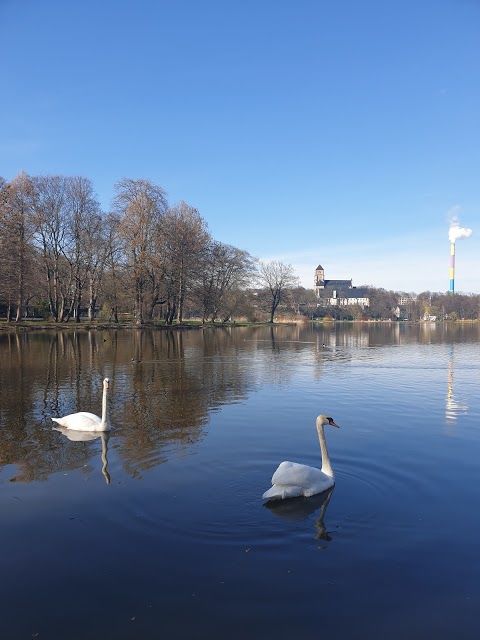
One of the beautiful gardens/parks in the city is the Stadtpark that basically stretches over 6 km from the city centre along the small Chemnitz river. It goes back to a private park created in 1798 which was bought by the city in 1884, neighbouring areas were bought step by step in the following decades, so the park became larger.
Mostly the park reminds of an English park, in the southern parts it's even more like a forest, the designed areas are closer to the city centre. Very nice are the rosarium (pics 1, 2), the small lake (pics 3, 4) and the shrubs garden (pic 5).
You can easily reach the park by following the paths along the Chemnitz river from the city centre (e.g. from Falkeplatz/Museum Gunzenhauser), walk for about an hour until you reach a crossing street where you find bus stops to get back to the city centre (bus #43 in either direction, change to any tram line after a couple of stops).
Written Sep 28, 2012
When the technology of brewing beer changed (pureness law "Reihnheitsgebot" in Bavaria in 1516) it was necessary to have cool cellars for storing the beer for a longer time. Chemnitz had no such rooms, thus they started digging cellars in the underground of the Kaßberg hill. These cellars were first mentioned in 1531, more and more were added over the years. From the late 19th century on local restaurants and merchants from the neighbouring market hall used the cellars for storing beer, wine, veggies etc.
From 1938 on the cellars were reconstructed for air raid shelters. During the bombings in WWII thousands of Chemnitzers' survived there. During the communist era the cellars were not used but in the late 1990s they were rediscovered and some of them were made accessible.
Guided tours aside they also have events there: concerts, cabaret, shows, readings etc. I did not have much time but the guide was happy to give me a quick and free intro tour of only 5 minutes (usually tours are 45 minutes). The history, especially of the cellars during WWII is pretty interesting. You can also see quite some pieces in an exhibit.
Open in the 2 - 5 pm, in winter on weekends only, in summer Thu - Sun. Fee 2 or 3 Euro, cannot remember exactly since I didn't pay.
Written Mar 2, 2012
Phone: (0371) 33 46 056
Website: www.chemnitzer-gewoelbegaenge.de
Right on the Chemnitz river, north of the old town, is the market hall located. It was built after plans of Eduard Hechler in 1891, restored 1994/95 but I saw construction works going on when I visited in 2011 again - parts of the hall were closed.
The walls are of brickstone with sandstone and yellow brickstone decoration/reliefs. The roof is an iron construction, supported by 33 delicate iron pillars inside. The design of the central dome was obviously inspired by Baroque architecture.
Once the construction works are finished this will again be a fine place for shopping, I am sure.
Address: An der Markthalle 1
Written Mar 2, 2012
Another excellent example for the architecture of New Objectivity (Neue Sachlichkeit) is the municipal indoor swimming pool. It was built according to plans of Fred Otto 1928 - 35 and recently renovated. The large complex consists of several larger and smaller cubes. The main entrance is accentuated with a flight of steps and pergolas.
Really funny are the figures at the bottom of each of the several flagpoles in front of the main entrance. They depict water animals like ducks and otters e.g.
Of course the Stadtbad is not only there for watching: Bring your swimsuit and go swimming! They have a 50 m pool and a 25 m pool. Open daily, admission 3.50 Euro. A nice sauna/steambath area is also available, cost is 8 Euro for 2:30 hrs.
Bus # 22, direction Glösa, stop "Am Stadtbad" or
Bus # 76, direction Küchwald, stop "Georgbrücke"
Updated Mar 2, 2012
I hope you don't think this is advertising for this bank corporation ... nope. This is about the building where they have one of their residences in Chemnitz. It was constructed 1925/26 in the style of New Objectivity (Neue Sachlichkeit) which is typical for the 1920s/30s in Germany. The big block's facade is curved, and it is decorated with some figures. Don't hesitate to go in, it is a public building. The vestibules are beautiful, richly decorated.
Falkeplatz 2, next to Museum Gunzenhauser (same architectural style).
Written Mar 2, 2012
The interior of the castle can be visited, but don't expect too much. Historical interior is limited to the construction and the rests of some frescoes. The timberwork of the roof is quite impressive. Apart from that, these rooms are used for temporary exhibitions and events.
Exhibition focus on contemporary arts and crafts and design - if you are interested in these topics a visit can be worthwhile.
When I visited they had an exhibition about pottery and textile art, and another about design from Saxony in DDR times. I admit that I had expected at least some kind of exhibition about the history of the castle but... nope.
Opening hours:
April - September: Tuesday - Friday 11.00-17.00, Saturday, Sunday, public holidays 11.00-18.00
October - March: Tuesday - Saturday, public holidays 11.00-17.00
Entrance fee: adults 3 €, kids and concessions 1.50 €
Written Oct 7, 2011
The little water castle on the outskirts of Chemnitz is a popular destination among locals but hardly known beyond. The building qualifies as a Renaissance castle but it is the weirdest one I have ever seen. The building is a cube with big gables in the shape of ogival arches on all four sides and smaller gables over the corners. The spiral staircase is crowned with a small tower. The castle is surrounded by a moat and accessible over a stone bridge. The adjacent triangular courtyard is surrounded by rows of lower economy buildings.
The castle was built in the 16th century for Wolf Hünerkopf, a man who had become rich with the silver mining in the Ore Mountains as master of the mint in Annaberg. The Saxon Elector even ennobled him. To express his wealth and status he had himself built a castle in the countryside. Later on it was sold to a noble family from the Baltics who lived here for about 200 years.
The ensemble's history in the 20th century is less pleasant. In Nazi times it served as camp of the Reich Labour Service. After the war it became the seat of the Soviet commander. In DDR times it was used as Jugendwerkhof, i. e. an 'educational' work camp for girls who got themselves in trouble with the law.
After 1989 the castle and its surroundings have been well restored. Together with the moat and the surrounding park this is indeed a romantic location. Don't forget your camera. and because you asked, yes, it is possible to get married there.
The former economy buildings around the courtyard have become a centre of arts and crafts. Several artisans have their workshops and shops in there - worth a look if you like these kinds of things. There is also a hotel, a pub/cafe and a restaurant. (Ladies, if your male companions don't like the idea of browsing the shops, park them there with a beer, the local Braustolz will be more to their liking...)
The castle itself is used for exhibitions of design and crafts.
More photos here in my travelogue
Website in English
How to get there: From the centre of Chemnitz, take the tram 552. Get off at "Bahnhof Neukirchen-Klaffenbach" (NOT at "Haltepunkt Klaffenbach", that's one stop too early), from there it is a five minutes walk to the castle. You'll see the castle's little tower from there.
Updated Oct 6, 2011
Villa Esche is well known as Henry van de Velde's arhictectural masterpiece. However, few know that he has designed a second villa for Chemnitz. The owners, the Körner family, were related to the Esches and employed the architect after they saw their new villa.
Villa Körner had long been neglected until two architects discovered it and decided to renovate it in its original shape. The villa is no museum - it hosts a dentist's studio and the offices of a lawyer. Upon friendly request and appointment visitors can enter the main hall, which has also been restored according to van de Velde's design. I did not try, though (it was Monday morning, I did not want to disturb the lawyer and I hate dentists).
Location: Beyerstraße 25. Beyerstraße is the extension of Barbarossastraße just North of Kassberg quarter.
Written Oct 6, 2011
Sponsored Links
1 Review and 1 Opinions I picked the hotel mostly because of its location, conveniently close to the station and the city...
1 Review and 0 Opinions nice stay , confortable rooms nothing particular. MANY BETTER PALCES AT LOWER PRICE IN THE AREA...
Sponsored Links
Comments