I am a post-graduate student and I live in Patras. When I firstly came at Patras I knew only about the well known places to go. But I didn't have a clue where to go to eat delicious plates or to go shopping. After a year I discovered two very usefull sites that in a superb way are tourist guides of where to go and where to be every hour of the day. Events, sales, offers, good restaurants, bars and clubs of Patras writen by the people who live and are interested for this Town of Greece. You can easily find from virtual tourist where to go out for a walk but you miss the living of the place. I find virtual tourist a very usefull tool but i think that it can expand.
Finally I ll share the two sites I mentioned before:
1st: http://www.secretpatras.gr
2nd: http://www.soffer.gr
Written Feb 1, 2012
Address: Maizwnos 27, Patras, Hellas
Website: http://www.webplay.gr
The Rion-Antirion Bridge goes across the Bay of Corinth and connects the Peloponnese with mainland Greece. It is almost 9,500 ft long, and is the longest cable-stayed bridge in the world. It is in an area with a lot of seismic activity, and it was built to accommodate that movement.
It opened in 2004, just before the 2004 Olympic Games, and the first person to cross it was the runner with the Olympic torch. The bridge was also blessed by the Patriarch of the Orthodox Church. Before it opened, the only way across was an expensive ferry.
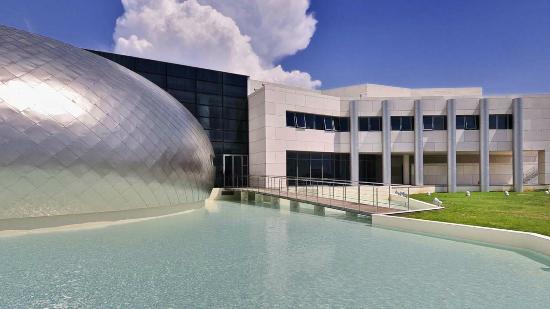
The bridge’s visitor center/museum is worth a visit--it has a number of displays about the bridge, including the Olympic torch.
This was a beautiful drive along the coast—the beautiful bridge, turquoise sea, cream and yellow houses with orange tile roofs, and lots of flowers in bloom.
Updated May 26, 2011
Address: Patras
It is really a pity that few people know this "jewel": the Municipal Galery of Patras.It was founded in 1988 and is housed on the ground floor of the Municipal Library, besides the Old Town Hall, a location with many historical memories.
The Municipal Galery of Patras boasts of one of the richest painting collections dedicated to Greek painters, outside Athens.Of special interest and precious value, are the works of the 19th ventury, by Greek painters like: Nikos Kounelakis, Andreas Kriezis, Ioannis Doukas and Georgios Samartzis, as well as the portraits of Greek prime ministers, originated from Patras, as: Demetrios Maximos, Demetrios Gounaris and Andreas Michalakopoulos.
Updated Jul 23, 2010
Address: Maizonos 110, GR-262 21 PATRAS
Phone: 0030-2610-276 540
Website: www.depap.gr
Some other interesting churches in the city center are:
Pantanassa church (pic 1). A big impressive but ugly church considering the fact it isn’t the usual orthodox style. But the architecture is a matter of personal taste, I’ve read many articles that consider this church as an architectural jewel. It was under renovation during my visit and the people were having the Sunday morning ceremony next to it at a small chapel next to the church (pic 2). The Pantanassa church was built at the same spot where a small church (dedicated to Virgin Mary) was during the ottoman occupation. The church we see today was built in 1859 (but started in 1847). The clock was put in 1884 and it is still in use. Some of the paintings inside are made by Xatzigiannopulos and Prinopulos, local famous painters of that era. In front of the church you can read a sign that says “come to my house and in fear, cause this place is sacred”, just in case you didn’t know this is a church :)
I visited Eisodia church (pic 3) on my way back from the Old Town. It’s located at the top of several stairs but looks nice from the street level. It’s 50m away from the Odeum at Eisodia street. It is a side church from Agios Nikolaos parish. The legend says that it was built by a woman and she dedicated it to Virgin Mary. We don’t really know when it was built but the oldest written document is from 1848. Actually, there was a small church there and the one we see today was built in 1982 in the usual byzantine style by the architecture Ioannis Vais.
Agios Dionysios church (pic 4) is located near the port at the Agios Dionysios district. The church was built in 1829 by Greeks that came to Patra from Zakinthos island. In 1909 the old church was teared down and a new one was built in 1928. For some strange reason the man (guard?) was kind of upset while I was taking pictures there.
And the last church is the one that made me laugh, it is another church (under construction actually, pic 5) dedicated to… …guess who! Yes, to Saint Andrew of course :) The church is called Agios Andreas Ierapostolos (Apostle Saint Andrew)
Written Mar 10, 2010
In walking distance from the center is the Vor.Ipiru (North Epirus) square (pic 1). I just wanted to visit Agia Sofia church (pic 2) that has some nice murals inside (pic 3) but during the ceremony (a baptism) it was difficult to take many pictures there without disturbing the locals although they were all focused on the baby :).
So, I went out and noticed the fountain opposite the square (pic 4) showing a woman staring at the water while the streets started to get busy (they are day and nights by the way). This square is gonna be the first as you coming from Athens towards the center of Patras.
The streets around there aren’t cute at all and even a small chapel dedicated to Agios Alexios (two blocks away from the square) was ugly too (pic 5).
Written Mar 9, 2010
After the second day I had lost the number of the churches dedicated to Saint Andrew! After many orthodox ones all over the city and the catholic one at Vas.Olgas square I noticed another one, the Anglican Church of Saint Andrew!! It’s between huge green plants and I liked the neogothic style of it. It was built in 1872 with the financial help of the local Anglican protestant community. It has a gabled roof and nice long windows, the church was fully built by granite stones that came by boat from Scotland!
The church is also used for several events like art exhibitions etc
Written Mar 9, 2010
Address: Agiou Andrea & Karolou streets
It seems the city wants to honour the famous greek poet Kostis Palamas (1859-1943) so I noticed several spots in the city about him.
His house is the most interesting one, a building that is located at 241 Korinthou street, in city center. It is the house (pic 1) that Palamas was born and when he moved to Athens it was the place where Serao family (from Italy) lived and where the Italian writer Matilde Serao (1856-1927) was born. In our days it houses the Kostis Palamas Institution.
Kostis Palamas is one of the most famous greek poets with more than 40 poetry collections, many theatrical plays and other books. He lived in Patras only for 6 years. It was that age when he lost both his parents and moved to live in Mesologgi with an ankle of him.
I saw some statues of him in the city with the most famous at Normal square (or Kostis Palamas square in some maps). It is a small square with a bronze statue of Kostis Palamas, showing him skeptical (pic 2).
Written Mar 9, 2010
Before my visit to Pantokratoras church in the Old Town I checked some other churches around.
Agios Dimitrios church (pic 1) was the only one I could go inside though as all the others were closed. I checked the interior (pic 2) which was very typical for an orthodox church but nothing to get excited with.
At the back yard were a lot of children playing football and screaming like crazy, I skip them and reached Agios Fotios church. It’s a tiny chapel actually (pic 3), the sign outside informs us that it belongs to the orthodox army (whatever it is) and that there is a ceremony every Sunday at 17.30. I took my pic and returmed back toward the castle area.
Written Mar 9, 2010
Old town or upper city (Ano Poli) is called the area under the castle of Patras. I loved walking around here and check the old houses, some nice neoclassical buildings and interesting sites like the Roman Odeum, Pantokratoras church, the old municipal hospital etc
There is even an old Hamam there (pic 1). It was built in 1400 (during the Venetian era) and kept in good shape by the ottomans who liked and were using hamam anyway. It is still in use (after the renovation in 1987) and from what they say one of the last ones in Europe. It is located at 29 Mpoukaouri street.
It is open for women 9.00-21.00 on monday, Wednesday, Friday and for men 14.30-17.00 on Tuesday, Thursday, Saturday. The entrance fee is 5 euro Tel:2610274267
Of course, the most impressive building in the Old Town is the Pantokratoras church (pic 2) with the impressive bronze cupolas. The legend says that the Greeks during the revolution against the Ottomans used the bronze to make bullets. The interior has some interesting paintings too(pics 3-4). There was an ancient temple on the spot where the church is dedicated to Zeus. The first christen church was built here at 900AD but it turned into a mosque during the ottoman empire. The one we see today was built after the revolution and based on Agia Sofia (in Istanbul).
Behind Pantokratoras church you can see the Old Municipal Hospital(pic 5). It’s a neoclassical building that was built at the end of 19th century by the Danish architecture Ch. E. Hansen. It was a hospital from 1872 till 1973 but in our days houses cultural events and exhibitions. The entrance is from Papadiamontopoulou 17A, there’s no entrance fee and it is open 8.00-15.00
Directions:just walk up Agiou Nikolaou street
Written Mar 9, 2010
I walked up the Gerokostopulu stairs to reach the Roman Odeum which is the oldest in Greece. Although its not impressive and beautiful as the one in Athens I liked it a lot on a sunny morning with the guard of the place telling me “sorry” many times because of some garbage in some areas of the theatre! I asked why and he told me that the previous night there was a dance performance and he didn’t have time to clean yet! First I checked the surrounded area where I saw some mosaics(pic 2) etc Then, I walked up the stairs of the Odeum (pic 3) but of course I wish I could see a performance here. If you visit Patras during the summer period check for posters all over the city for performances and concerts here. It has a capacity of 2800 people. You can visit the Odeum for free daily (except Monday) 08.00-15.00.
The Odeum is still in good shape with nice decoration (Pausanias talked about it after his visit in 170BC, he also mentions an Apollo statue but you cant see it today). The people of Patra supported Etolians against Galatians (279BC) and they created the Odeum with the spoils that war. The Odeum was partly destroyed because of wars and earthquakes and covered by ground but came back to light in 1889 by accident! The authorities needed ground for the port and when they dig the hill they found the Odeum! It was only in 1956 when the whole area was turned into an entire archeological site.
The square Agiou Georgiou (officially now as 25 of March) is opposite the Roman Odeum (pic 4). There are some tables where you can relax for a while. It’s a historical square because this was the square where the greek revolutioners gathered (along with people from Patra) on 22nd of March 1821 to hear the where Germanos (the bishop of Patra) canted for those who would fall in battle and prayed for the victory (the revolutioners screamed “freedom or death” as you can see in many monuments (pic 5) dedicated to the greek revolution all over Greece). By the way, Patra had been burned by the turks in 1779 some years after the unsuccessful revolution of 1770.
Written Mar 9, 2010
Address: Germanou & Sotiriadou
Phone: 2610220829
Sponsored Links
Sponsored Links
Comments